
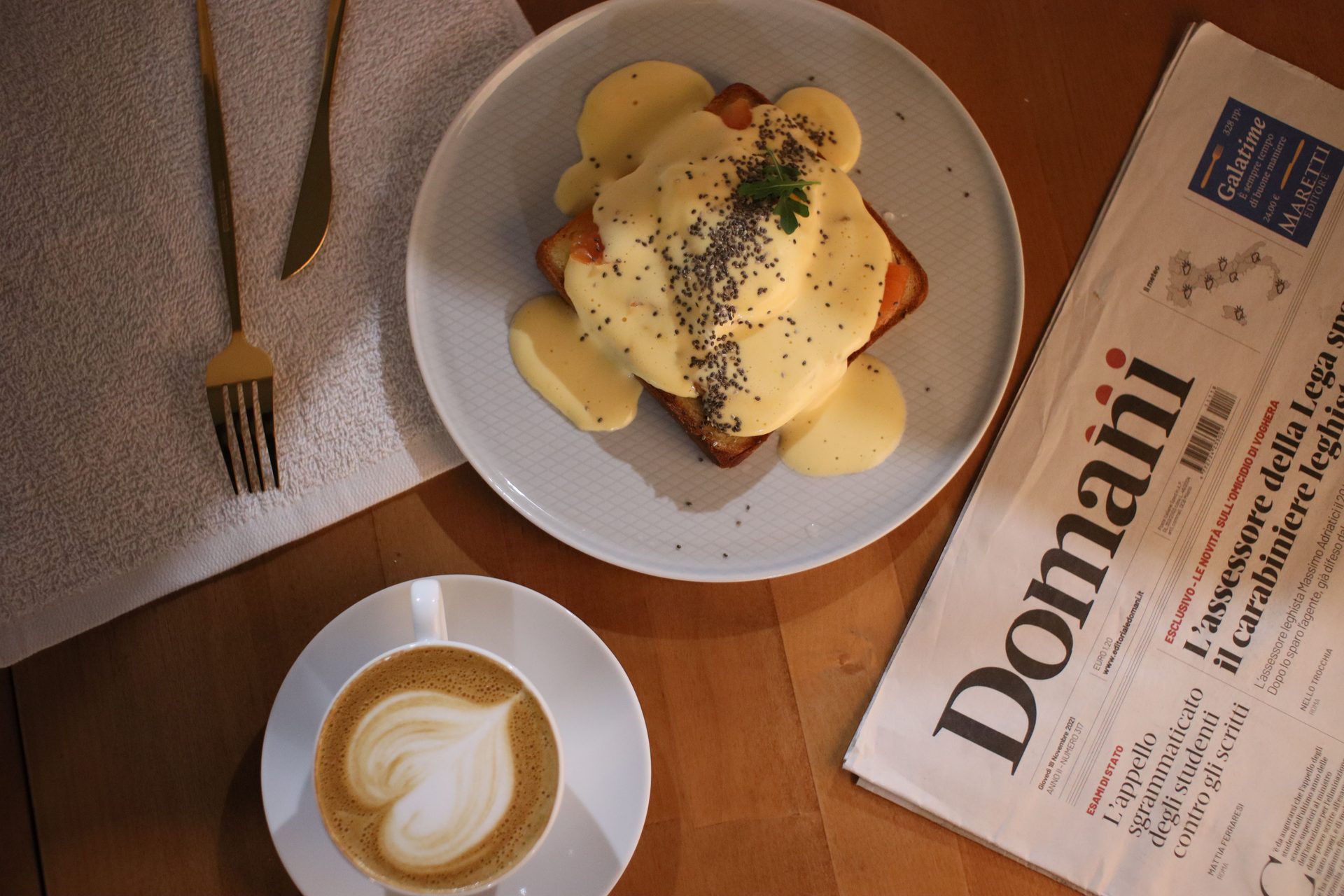
A traditional Italian breakfast rarely lasts longer than ten minutes, yet it follows an order almost every regular at the bar knows by heart. Walk into any café between seven and nine in the morning and you will see the same choreography repeat itself: a quick greeting, a coffee ordered by name, a pastry eaten standing up, and the whole ritual finished before the cup has fully cooled.
Unlike the hearty, savory spreads found in many other countries, breakfast in Italy leans sweet, small, and fast. This guide walks through the 14 drinks and pastries that make up that routine, from the five coffee styles that anchor the morning to the regional pastries and the one savory exception that proves every rule has its outlier. For readers curious how this compares to other morning meal traditions around the world, the contrast is part of what makes it distinctive.
1. Cappuccino
Cappuccino is built from a single shot of espresso topped with steamed milk and a dense cap of foam, usually in a ceramic cup just large enough to hold both in balance. It is a morning-only order in most of Italy; asking for one after a midday meal tends to draw a raised eyebrow from the barista rather than a straight refusal. Paired with a pastry, it is the single most recognizable element of a traditional Italian breakfast.
Ordering one at the counter follows a pattern that catches many visitors off guard the first time:
- Go to the cash register first, not the counter, and state what you want.
- Pay and take the printed receipt (lo scontrino).
- Walk to the bar counter, hand over the receipt, and repeat the order out loud.
- Drink standing at the counter rather than carrying it to a table, unless table service costs extra.
Pro Tip: If you want to drink like a local, order the cappuccino before 11 a.m. and expect to finish it in just a few minutes at the counter rather than lingering over it.
2. Caffelatte
Caffelatte is the softer, milkier cousin of cappuccino, made with more steamed milk and less foam, often served in a wide bowl-like cup at home rather than at the bar. Italian households frequently make this version for children or for a slower weekend morning, since the higher milk ratio mellows the espresso’s intensity. It is less common to order caffelatte at a café counter, where cappuccino and plain espresso dominate the menu.
The at-home version is typically paired with bread, biscuits, or a slice of cake rather than a bar-bought pastry. Other cultures have their own version of a warm, milk-forward morning drink; readers interested in that comparison can look at traditional Egyptian drinks for a different regional take on the morning cup.
3. Espresso
Espresso, simply called un caffè at the bar, is the fastest and most common order of the day: a single concentrated shot pulled in under 30 seconds and drunk in two or three sips while standing. It has no milk, little room for customization beyond sugar, and almost no ritual beyond the order itself. For many Italians it is not paired with food at all in the morning, serving instead as a quick jolt before or after a light pastry.
The speed and simplicity of espresso sit in sharp contrast to slower, more elaborate tea ceremonies found elsewhere. Readers who want to see how differently another culture treats its morning beverage can compare this with traditional Chinese drinks, where preparation itself becomes part of the ritual rather than something to rush through.
4. Latte Macchiato
Latte macchiato flips the usual coffee-to-milk ratio: a tall glass of warm, lightly foamed milk gets “stained” with a small shot of espresso poured in last, creating distinct layers before stirring. It is visually the most striking of the milk coffees, often served in a tall clear glass specifically to show off the gradient between milk and coffee. Because the coffee content is lower than in a cappuccino, it is sometimes considered a gentler entry point for younger drinkers or anyone easing into espresso-based drinks.
Like cappuccino, it stays a morning order almost exclusively, and it is rarely seen on afternoon or evening menus at a traditional bar.
5. Espresso Macchiato
Espresso macchiato reverses the previous drink: a standard shot of espresso gets “stained” with just a small dollop of foamed milk, rather than the other way around. The result is a drink that looks almost like plain espresso but carries a slightly softer edge, making it a popular choice for people who want the quick hit of espresso without quite as sharp a bite.
Taken together, these five drinks form the backbone of coffee culture at breakfast, and the differences between them come down mostly to the milk-to-espresso ratio and how that milk is prepared.
| Drink | Base | Milk Style | Typical Serving Time |
|---|---|---|---|
| Cappuccino | 1 shot espresso | Steamed milk with thick foam | Morning only |
| Caffelatte | 1 shot espresso | Large pour of warm milk, light foam | Morning, often at home |
| Espresso | 1 shot espresso | None | Any time of day |
| Latte macchiato | Small shot espresso | Tall glass of milk, coffee added last | Morning only |
| Espresso macchiato | 1 shot espresso | Small dollop of foam added last | Morning, quick order |
6. Cornetto
Cornetto is the pastry half of the classic bar order, a croissant-shaped roll that is slightly sweeter and denser than its French relative, often glazed on top rather than left plain. Bakeries typically offer three or four standard fillings side by side in the display case, and regulars learn to recognize each by shape or a small marking on the crust rather than reading a label.
- Vuoto (empty, plain)
- Alla crema (pastry cream)
- Al cioccolato (chocolate cream or chips)
- Alla marmellata (fruit jam, often apricot)
The pairing of a cornetto with a cappuccino is so standard that ordering just one of the two can prompt the barista to ask if the other is coming. For a sense of how this compares to a related pastry-and-coffee pairing elsewhere in Europe, see traditional French food, where the croissant plays a similar morning role.
7. Pasticciotto
Pasticciotto is a small oval pastry with a shortcrust shell and a warm custard filling, closely associated with the Salento area of Puglia in Italy’s deep south. According to a regional recipe archive, the pasticciotto is “the quintessential breakfast pastry in Salento,” and local tradition traces its invention to 1745 at the Ascalone pastry shop in Galatina, near Lecce.
The pastry is almost always served warm rather than cold, since the shortcrust shell loses some of its character once it sits. A travel guide to the region notes that it typically costs between €1.50 and €2.50 per pastry at local bakeries, making it an affordable daily habit for residents rather than an occasional treat. One food writer describes it as the perfect companion to a caffè latte in the morning, noting that “in Salento it is eaten hot at the bar beside an espresso.”
Important Note: Pasticciotto is a regional specialty tied closely to Puglia and Salento rather than a pastry found on every bar counter nationwide, so travelers outside the south may need to seek out a bakery that specializes in southern Italian pastries.
8. Sfoglitella
Known correctly as sfogliatella, this shell-shaped pastry comes from the Campania region and is built from dozens of thin, crisp layers wrapped around a filling of sweetened ricotta or semolina custard, often scented with citrus. According to Wikipedia, the pastry’s name derives from the Italian diminutive of “thin leaves” or “layers,” a fitting description of its flaky, almost architectural shell.
Two main versions circulate through Neapolitan bakeries. Sfogliatella riccia, the curled and labor-intensive classic, uses repeated rolling and folding to create its signature ridges, while sfogliatella frolla swaps in a shortcrust dough for a softer, quicker bite. A regional food publication adds that a third variation, sfogliatella aragosta, “resembles the curled tail of a crustacean” and is typically filled with a sweeter whipped cream. All three are generally bought from a pasticceria rather than made at home, since the folding technique takes real practice.
9. Caffè D’orzo
Caffè d’orzo is roasted barley brewed and served in the same small cup as espresso, offering the same dark color and bitter edge without any actual caffeine. It became a common fixture on Italian breakfast tables largely as an alternative for children, pregnant women, or anyone avoiding caffeine, and many bars keep a barley pot running alongside the espresso machine specifically to meet that demand.
Key Insight: Caffè d’orzo shows that “coffee” at an Italian breakfast table is as much about ritual and cup shape as it is about caffeine itself, a pattern echoed in other regional breakfast traditions where a warm roasted drink stands in for coffee, such as some tables that favor herbal infusions over espresso.
Despite the lack of caffeine, caffè d’orzo is treated with the same seriousness as any other coffee order, right down to the small cup and quick drinking pace at the counter.
10. Fette Biscottate
Fette biscottate are dry, twice-baked rectangular toasts, closer in texture to a rusk than to standard sliced bread, designed specifically to hold up under a spread of jam or butter without going soggy. They are a pantry staple rather than a bakery purchase, bought in long packaged stacks and eaten at the kitchen table rather than standing at a bar.
The ritual of dunking a slice into caffelatte or simply spreading it with apricot jam is one of the most common home-breakfast habits in the country, especially for children heading to school. This style of simple, dry toasted bread as a breakfast base has parallels elsewhere in the Mediterranean; see traditional Greek foods for a related approach built around dried rusks and olive oil.
11. Spremuta
Spremuta is freshly squeezed juice, most often orange, pressed to order at the bar counter rather than poured from a carton. Italian oranges tend to run on the sweeter and less acidic side, especially varieties grown in Sicily, which makes the juice a popular addition to breakfast without needing added sugar.
It usually appears alongside a coffee and pastry order rather than replacing either, filling the role of a small refreshing extra rather than the meal’s centerpiece. Fresh-pressed juice culture varies widely by region and climate; for a tropical counterpart built around different fruit, traditional Venezuelan food offers a useful point of comparison.
12. Ciambellone
Ciambellone is a simple ring-shaped cake, light and only mildly sweet, baked at home in large batches meant to last several days on the counter under a glass dome. It leans on basic pantry ingredients such as eggs, sugar, flour, and oil, with lemon zest or a splash of liqueur as the most common flavoring.
Because it keeps well and slices easily, ciambellone is often the cake that appears on a family breakfast table during a weekend or holiday rather than a weekday rush. For readers planning a celebratory spread, breakfast ideas built around cake and special occasions follow a similar logic of baking something simple that can be sliced for a crowd.
13. Plumcake
Plumcake in Italy refers to a dense, loaf-shaped sponge cake, usually studded with chocolate chips, raisins, or candied fruit, that bears only a loose resemblance to its English namesake despite the borrowed name. It is almost always store-bought rather than homemade, sold in individually wrapped slices by major Italian bakery brands and stocked in the breakfast aisle of nearly every supermarket.
Its appeal lies in convenience: a slice of plumcake with a coffee covers breakfast for someone rushing out the door on a weekday morning, filling much the same role that packaged breakfast bars or muffins play in other countries.
14. Panino Valdostano
Panino valdostano is the clear outlier on this list, a savory sandwich from the Valle d’Aosta region built on a small round roll filled with fontina cheese and cooked ham, then typically warmed until the cheese softens. It represents the mountain, alpine side of Italian food culture, where heartier, cheese-and-cured-meat breakfasts have more in common with neighboring Switzerland and France than with the espresso-and-pastry routine found further south.
Common Mistake: Assuming all of Italian breakfast is sweet. The panino valdostano is proof that the alpine north keeps its own savory traditions alive, closer in spirit to the dairy-and-bread breakfasts found in other savory breakfast cultures than to a cornetto and cappuccino.
It appears far less often than the sweet staples on this list, usually reserved for a heartier morning before physical work or a mountain hike rather than a routine weekday start.
What This Reveals About Breakfast Around the World
Lined up together, these 14 items show that a traditional Italian breakfast is less about quantity and more about rhythm: a short, sweet, mostly liquid ritual repeated the same way almost every morning. That pattern sits at one end of a spectrum; at the other end sit heartier, savory spreads built around bread, cheese, and cured meats, the kind found in many Balkan breakfast tables, where Albanian breakfast dishes often include fried dough, olives, and yogurt-based drinks served alongside strong coffee.
That contrast is part of what makes comparing regional breakfast traditions worthwhile. Readers curious how a fast, bar-counter breakfast stacks up against a completely different morning pace can look at traditional Japanese breakfast or traditional South African food for two more distinct approaches to how the day’s first meal gets built. Italy’s version, built on espresso and a handful of pastries, remains one of the simplest to recognize anywhere in the world.