
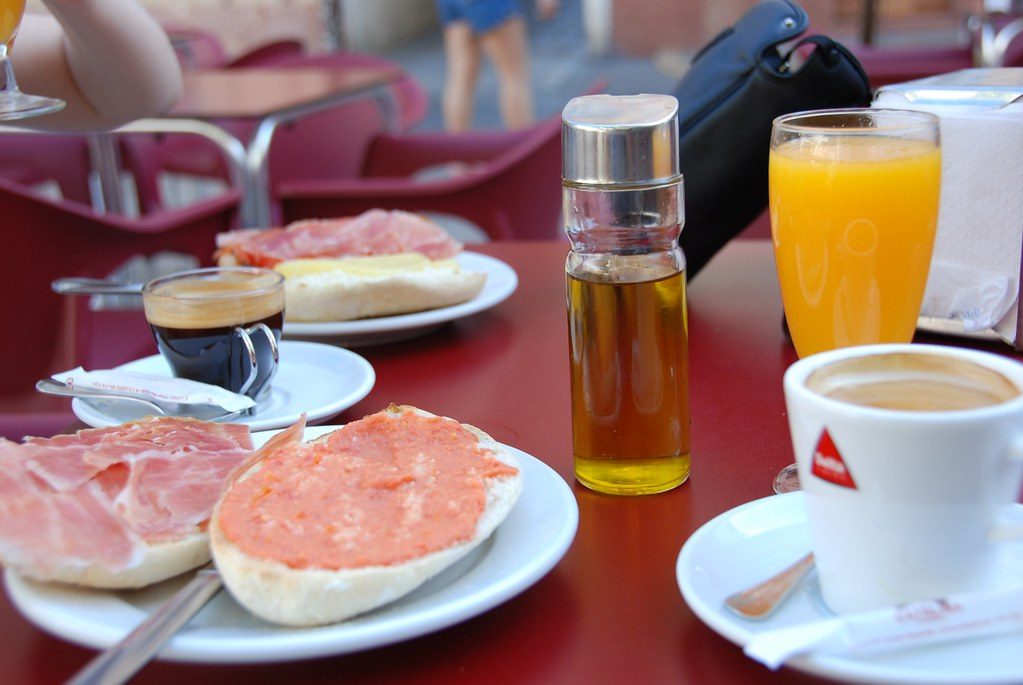
A traditional Spanish breakfast rarely looks like the heavy spread found elsewhere in Europe. Many Spaniards eat two smaller meals instead: a light desayuno at home, followed by a more filling second breakfast at a bar or café mid-morning. That habit alone sets Spain apart from countries where breakfast is the day’s biggest meal before a long stretch to lunch, and it shapes nearly every dish on this list, as the breakfast traditions covered across different cultures often show.
From the tomato-rubbed toast of Catalonia to the fried tiger-nut drink of Valencia, what Spaniards eat each morning changes sharply by region, yet most dishes share the same backbone of good bread, strong coffee, and olive oil. The following 20 dishes, pan con tomate through jamón serrano, show what actually lands on the table across Spain, and how these regional breakfast traditions compare with the slower, savory-leaning morning meals found elsewhere in the world.
1. Pan Con Tomate
Pan con tomate is the dish most Spaniards reach for first: toasted bread rubbed or spread with ripe tomato, drizzled with olive oil, and finished with a pinch of salt. Catalonia claims it as a local staple, though versions of it appear on breakfast tables from Barcelona to Valencia. Garlic is optional depending on the household, and some cooks grate the tomato into a pulp rather than slicing it.
The dish works because it needs almost nothing to taste good, which is part of why it shows up next to similarly simple, olive-oil-forward dishes among Mediterranean breakfast staples further east. Making it well comes down to three steps:
- Toast firm, rustic bread until the edges crisp but the center stays soft.
- Rub a cut garlic clove across the surface, then follow with a halved ripe tomato, pressing until the pulp soaks into the bread.
- Finish with a generous drizzle of extra virgin olive oil and a pinch of salt.
2. Tostada Con Tomate
Tostada con tomate is pan con tomate’s close cousin, but it leans more toward a crushed or blended tomato topping rather than a rubbed one, and it often appears with a slice of jamón or manchego cheese on the side. It is the standard order at bars in Madrid and across much of central Spain, usually paired with a café con leche.
The dish sits in the same family as toast-based breakfasts found across other European breakfast tables, though the olive oil and tomato keep it distinctly Spanish. Bread choice matters here: a firm baguette or barra holds the tomato without turning soggy, which is why many bars toast it twice before serving.
3. Tortilla Española
Tortilla española, also called tortilla de patatas, is a thick omelet of eggs, sliced potatoes (Solanum tuberosum), and usually onion, slow-cooked in olive oil until set. It is served at room temperature far more often than hot, which makes it practical for breakfast counters that prep it hours in advance and cut wedges to order.
Its origin story is genuinely disputed. One popular account ties it to a poor housewife in Navarre feeding a general during the First Carlist War, but the oft-told story that a Carlist general in Navarre “invented” it during the First Carlist War is now widely viewed as a legend. Written evidence only muddies things further.
Important Note: Sources disagree on when the dish actually began. Extremadura, especially Villanueva de la Serena, claims the earliest documented version in 1798, while Navarre provides one of the first clear written references in 1817, yet some food historians trace mentions of a similar egg dish back even further, with historians finding mentions of the dish dating all the way back to 1604 and by the late 1700s, the recipe already widespread across the country. Treat the Carlist War legend as folklore rather than documented fact.
4. Churros Con Chocolate
Churros con chocolate pairs ridged, deep-fried dough with a cup of chocolate thick enough to coat a spoon. The star-shaped ridges on a churro are not decorative; they increase surface area so the dough fries evenly without burning. One theory behind the name ties it to Spain’s own sheep breeds, since the name is thought to be derived from the Churra sheep, whose curled horns resemble the shape of churros.
Madrid’s most famous churrería has been serving the pairing for well over a century. The Chocolatería San Ginés has served chocolate con churros since 1894, after the building first opened as a restaurant and inn in 1890. It still runs around the clock near Puerta del Sol.
Common Mistake: Ordering a single churro to dip rather than a full ración is a common visitor misstep. Churros are typically sold by the half-dozen or dozen specifically for sharing and dunking, not as a one-off snack.
5. Chocolate Caliente
Chocolate caliente on its own, without churros, is still a breakfast staple in colder months, especially in northern Spain. It differs from drinking chocolate found elsewhere because Spanish versions are deliberately thickened, almost to a pudding consistency, rather than thinned with extra milk.
That texture has roots in how Spain first adapted cacao after it arrived from the Americas. Spanish chocolatiers transformed the bitter, ceremonial drink with sugar, cinnamon, and milk, creating a thick, silky beverage known as chocolate caliente. The result sits closer to a dessert than the thinner hot tea traditions brewed across Asia, where the point is a light, clarifying start to the day rather than an indulgence.
6. Huevos Rotos
Huevos rotos, literally “broken eggs,” layers fried eggs over a bed of fried potatoes, often with jamón or chorizo mixed in. The dish gets its name from the moment a server or diner breaks the yolks at the table, letting them run over the potatoes underneath.
It reads as more of a brunch plate than a quick coffee-counter breakfast, and it is common at bars that serve a fuller morning menu. The combination of eggs and starchy vegetables links it loosely to egg-forward breakfast habits found in other regional morning menus, though the potato base keeps it rooted firmly in Spanish cooking.
7. Huevos Revueltos
Huevos revueltos are Spain’s version of scrambled eggs, usually cooked slowly over low heat and folded with ingredients like wild mushrooms, chorizo, or shrimp rather than served plain. Texture matters more than speed here; the eggs stay soft and slightly loose rather than fully set.
Bars in northern Spain frequently add seasonal mushrooms, while coastal versions lean toward shellfish. The approach of building flavor directly into the eggs rather than serving sauces on the side echoes spiced scrambled-egg dishes found among other regional egg preparations worldwide.
8. Ensaimada
Ensaimada is a coiled, spiral-shaped pastry from Mallorca, traditionally made with a dough enriched by saïm, or pork lard, which gives the bread its name and its soft, slightly greasy texture. Plain versions dust the top with powdered sugar, while filled ones hold pumpkin jam, custard, or sobrasada sausage inside the coil.
It is sold fresh from bakeries across the Balearic Islands every morning and travels well, which is why visitors often carry boxes of it home. The pastry remains tied closely to regional Balearic traditions that extend beyond food into local festivals and folk customs.
9. Magdalenas
Magdalenas are small, lemon-scented sponge cakes baked in a shell-shaped or cupcake mold, made from eggs, sugar, flour, and oil or butter. They are the default pairing for coffee in many Spanish households, sold in plastic-wrapped multipacks at nearly every grocery store.
Their simplicity makes them closer to a daily staple than a special-occasion treat, similar in role to the plain, rice-based dishes that anchor breakfast routines in Japan, even though the ingredients could not be more different. A good magdalena has a domed top with a visible crack, a sign the batter rose properly in the oven.
10. Café Con Leche
Café con leche is strong espresso mixed with roughly equal parts hot or steamed milk, typically served in a glass rather than a cup. It is the anchor drink of a Spanish breakfast and the default order alongside tostada, magdalenas, or churros.
Spain’s coffee menu has specific terms worth knowing before ordering, since the ratios change the drink entirely:
| Coffee Style | Coffee-to-Milk Ratio | Typical Serving |
|---|---|---|
| Café con leche | Roughly 1:1 | Glass or large cup |
| Cortado | Roughly 1:1, smaller volume | Small glass |
| Café solo | No milk | Small cup |
| Carajillo | Espresso with a splash of liquor | Small cup |
It pairs especially well with sweeter items, and many bars put together a set morning combo built around it, the same way certain sweet breakfast pairings get built around a single drink elsewhere.
11. Cortado
A cortado is a smaller, stronger relative of café con leche: an espresso “cut” with just enough warm milk to soften the bitterness without diluting it. It is the preferred order for anyone who wants coffee flavor to lead rather than milk.
Pro Tip: A cortado is not the same drink as a flat white or a macchiato, even though menus abroad sometimes use the terms interchangeably. Asking for it by name in Spain reliably gets the right proportions of milk to espresso.
12. Bocadillos
Bocadillos are Spanish sandwiches built on a baguette-style roll rather than sliced sandwich bread, and breakfast versions tend to be simple compared to lunch ones. Common breakfast fillings include:
- Jamón serrano or jamón ibérico, plain or with a little olive oil
- Tortilla española, served as a thick wedge between bread
- Chorizo, either fresh and grilled or cured and sliced
- Calamares, especially in Madrid, often with just a squeeze of lemon
The format is close enough to other handheld, bread-based breakfasts that it draws natural comparisons to sandwich-style morning meals from Latin America, where similarly portable bread rolls carry savory fillings.
13. Pan Con Mantequilla
Pan con mantequilla keeps things plain: toasted bread with butter, sometimes topped with sugar, jam, or a drizzle of honey. It is the breakfast of choice for children and for anyone who wants something lighter than tostada con tomate or a full bocadillo.
It appears most often at home rather than in bars, since it requires no preparation beyond a toaster and a butter knife. Despite its simplicity, it remains one of the most common breakfast orders across Spanish households precisely because it asks nothing of the cook.
14. Pan Mollete
Pan mollete is a soft, slightly flattened bread roll associated with Antequera in Andalusia, with a pale crust and a dense, pillowy interior. It is typically split, lightly toasted, and topped with olive oil and tomato, or with zurrapa, a spreadable pork preserve.
Because the bread itself is softer than the firm barras used for pan con tomate elsewhere, mollete holds toppings differently, soaking up olive oil rather than staying crisp. Andalusian bakeries sell it specifically for breakfast, and it rarely appears on lunch or dinner menus.
15. Fartons
Fartons are long, soft, glazed pastries from Valencia, dusted with a thin layer of sugar and meant to be dunked rather than eaten dry. Their spongy texture is built specifically to soak up liquid without falling apart, which matters because they are almost never served alone.
Valencian bakeries pair them with a cold drink rather than coffee, a tradition that connects directly to the next entry on this list. The bread’s airy crumb and light glaze make it closer to a dessert than a savory breakfast item, even though it is eaten first thing in the morning.
16. Gofio
Gofio is a toasted grain flour from the Canary Islands, traditionally made from maize or a mix of grains, then stirred into milk, coffee, or broth to thicken it into a warm porridge. It is a holdover from a rural, resourceful style of cooking that made use of whatever grain was on hand.
The texture lands somewhere between porridge and a thick drink, and it serves the same comfort-food role that heavier, grain-based dishes play in other rustic European cooking traditions, where simple staples stretch to fill a whole meal. Gofio shows up less often on the mainland, making it one of the more regionally specific entries on this list.
17. Horchata De Chufa
Horchata de chufa is a cold, milky-looking drink made by soaking and grinding chufa, or tiger nuts (Cyperus esculentus), with water and sugar, then straining out the solids. Despite the name’s overlap with Latin American horchatas made from rice, the Valencian original uses no rice at all.
It pairs almost exclusively with fartons, dunked the same way churros meet chocolate caliente elsewhere in Spain. The drink’s plant-based base puts it in the same category as other traditional plant-derived beverages that rely on a single humble ingredient for their flavor.
Pro Tip: Horchata de chufa is best served very cold and consumed the same day it is made, since fresh versions without preservatives separate and lose flavor quickly.
18. Sobao Pasiego
Sobao pasiego is a dense, buttery sponge cake from the Pasiega valley in Cantabria, made with a high proportion of butter relative to flour, which gives it a moist, almost caramelized crumb. It is baked in small paper molds and sold individually wrapped in most northern Spanish bakeries.
Unlike magdalenas, which are light and citrus-forward, sobao leans richer and slightly savory from the butter content. It pairs naturally with café con leche, and Cantabrian families often serve it alongside quesada, another regional cake, during weekend breakfasts.
19. Manteca Colorá
Manteca colorá is a spreadable pork lard colored and flavored with paprika, garlic, and sometimes oregano, traditionally made from leftover fat after a household’s annual pig slaughter. It gets spread thickly on bread, the same way butter or olive oil might be used elsewhere.
The dish belongs to a broader category of preserved pork fats used to stretch meat further and avoid waste, a practice that shows up in preserved and cured food traditions from other regions that similarly evolved around limited refrigeration. It remains most common in rural Andalusia and Extremadura, where the pig-slaughter tradition it comes from is still practiced.
20. Jamón Serrano
Jamón serrano is dry-cured ham made from white pig breeds, salted and air-dried in mountain conditions for months at a time. Thin slices of it appear everywhere at breakfast, folded into bocadillos, laid over tostada, or eaten plain alongside bread and olive oil.
Quality grades matter more here than with most breakfast foods, and the differences show up quickly once prices are compared.
| Ham Type | Pig Breed | Typical Curing Time |
|---|---|---|
| Jamón serrano | White pig breeds | 9–12 months |
| Jamón ibérico | Iberian pig breeds | 18–36 months |
Key Insight: Jamón ibérico, especially the acorn-fed bellota grade, costs considerably more than jamón serrano and is usually reserved for special occasions rather than everyday breakfast, where serrano remains the standard.
Ham also carries a strong seasonal association in Spain, showing up heavily during the same holiday spreads covered in Spain’s traditional Christmas dishes, where whole legs are often carved tableside.
Taken together, these 20 dishes show that a traditional Spanish breakfast is less about one fixed menu and more about a shared set of habits: strong coffee, good bread, and a willingness to eat something small now and something more substantial later. The regional spread, from Canarian gofio to Valencian horchata, makes Spain’s morning table far more varied than the single-dish stereotype of tortilla and coffee suggests, and it stands apart from heavier, pastry-driven regional breakfast traditions found elsewhere in Europe and the Balkans. Trying even a handful of these dishes on location, rather than relying on one city’s version, gives a far better sense of how differently Spain eats each morning depending on where the sun comes up.