Traditional Peruvian Clothing: 16 Iconic Andean Garments Explained

November 20, 2026
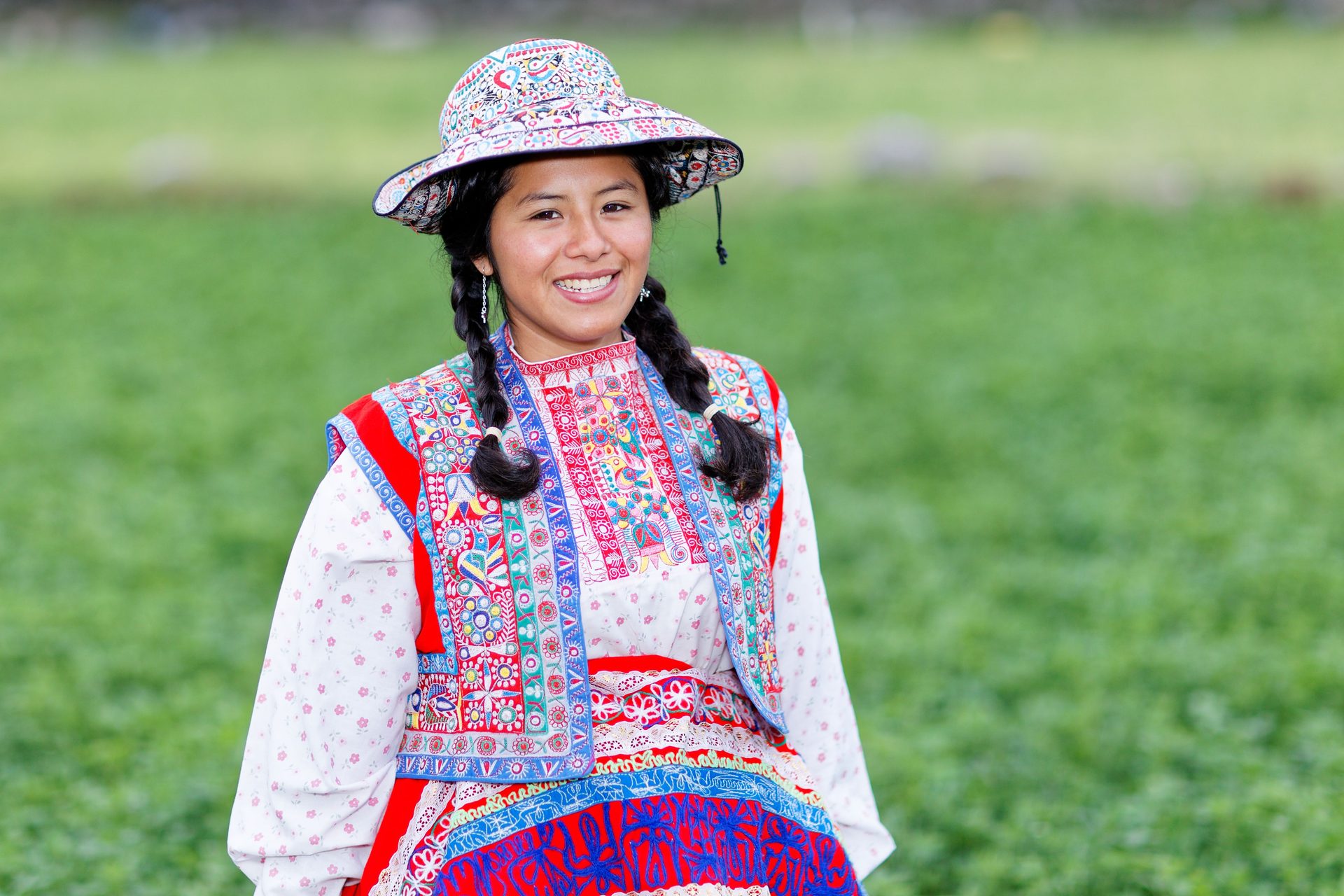
Traditional Peruvian clothing does something most fashion systems gave up on generations ago: it still tells a stranger exactly where a person comes from. Hats are a vital component of traditional Peruvian clothing, especially in the highland regions, where they play an important role in expressing both cultural identity and social status. Among the women, hats such as the montera are particularly prominent. These hats come in various shapes, sizes, and designs, each specific to different regions and communities, often serving as an instant indicator of one’s origin. A pleat pattern, a belt color, or the shape of a hat brim can place someone within a few valleys of their home village.
This guide walks through sixteen garments and accessories that make up traditional Peruvian clothing, from the layered pollera skirt to the rubber-soled ojotas sandals worn across the Andes. Examples of traditional Peruvian clothing include ponchos, multicolored skirts, wide-brimmed hats, and shawls decorated with symbolic motifs representing the connection with nature and the Andean worldview. Readers curious about how other cultures encode identity into fabric may also enjoy comparing these pieces with traditional Japanese clothing or traditional Indian clothing, both of which share this same instinct for turning cloth into a kind of language.
| Garment | Typically Worn By | Material or Function |
|---|---|---|
| Pollera | Women | Layered wool skirt, outer band trimmed in puyto |
| Lliclla | Women | Woven shoulder cape, fastened with a tupu |
| Jobona | Women | Short embroidered wool jacket worn under the lliclla |
| Montera | Women | Stiff, region-specific hat |
| Sanq’apa | Women | Woven hair wrap or headpiece, varies by community |
| Chumpi | Men and women | Woven waist belt, sometimes a calendar record |
| Tupu | Women | Decorative pin used to secure the lliclla |
| Puyto | Women | Patterned band trimming the pollera’s outer skirt |
| Awayu | Women | Large carrying cloth for children or goods |
| Chuku | Men | Quechua term for a regional hat style |
| Chullo | Men (and children) | Knitted wool hat with earflaps |
| Poncho | Men | Woven outer wrap for warmth |
| Cushma | Men and women | Ankle-length cotton tunic from the Amazon |
| Chompa | Men and women | Knitted alpaca sweater or pullover |
| Chuspa | Men and women | Small woven bag for coca leaves and small items |
| Ojotas | Men and women | Sandals, often soled with recycled tire rubber |
1. Pollera
The pollera began life as an imposed garment rather than an indigenous one. Indigenous women were instructed to wear Spanish‑style skirts called polleras. Over the following centuries, Andean women reworked the design into something distinctly their own. Over time, Andean women adapted these garments using alpaca or sheep’s wool, vibrant natural dyes, and ruffled layers, transforming the pollera into a symbol of indigenous identity.
A finished pollera is rarely a single layer of fabric. One cannot speak of Peruvian women’s attire without mentioning the pollera, a voluminous skirt comprised of multiple-layered underskirts and an outer skirt trimmed with puyto bands. Those trim bands do more than decorate the hem; they carry meaning that is explained further in the Puyto section below.
The skirt’s details function almost like a résumé of the wearer’s background. The pollera is the wide, multi-layered pleated skirt worn by Andean women. The number of layers and the embroidery often signal a woman’s community and status. Readers interested in how other regions use layered garments to signal rank might find a parallel in traditional Pakistani clothing, where embroidery and fabric choice carry similar social weight.
2. Lliclla
The lliclla is one of the most visible pieces of traditional Peruvian clothing for women. Lliclla is a Quechua word that translated means “cloak,” although it is also often called Manta. This traditional clothing is often worn by Andean women. Lliclla is usually a textile that covers the back and shoulders of Peruvian women.
It stays in place through a simple but elegant fastening method. They are usually fixed to the front with pins or Tupu, or simply by wearing it tied. This traditional Peruvian cloak is also used to carry children on women’s backs. You can read more about that pin in the Cusco clothing overview from a local travel resource.
No two llicllas look quite alike. Designs vary by community; some llicllas feature bright stripes, while others showcase pallay motifs. It is smaller than the awayu (also called k’eperina), a larger cloth used primarily as a carrying sling for children or goods.
3. Jobona
Underneath the lliclla sits a garment that rarely gets the spotlight but does a lot of the work. These are the little jackets that women wear under the Lliclla. They are usually very brightly colored and have other bright patterns that are woven into the jacket.
The jobona is essentially the Andean answer to a fitted wool blazer. The jobona is a traditional Peruvian garment for women in the Andean region. It is a wool jacket, decorated with colorful buttons and worn under the lliclla. Finishing touches like metal buttons and contrast trim turn a practical layer into a decorative one, a detail covered in more depth by Tierras Vivas .
4. Montera
If one accessory reveals a woman’s hometown faster than any other, it is the montera. Montera is a typical Peruvian Andean somewhat hard cloth hat, lined with fabric. It can be round or rectangular. It is easily identified the village or the region where the person comes from by looking at the colors or designed of the hat.
Key Insight: A montera’s shape and color once worked like a postal code. Villagers could place a stranger’s home community almost on sight, long before road networks connected the highlands.
That tradition is shifting in practical, if slightly less personal, ways. Monteras are particularly interesting because they come in so many different shapes and styles. In past decades, you could tell where a woman was from by what type of montera she had. Now, however, it is increasingly common for women to buy monteras at the market from residents of other regions. More regional detail is available through Ecela Spanish ‘s cultural notes.
5. Sanq’apa
The sanq’apa belongs to the quieter, less-documented side of traditional Peruvian clothing. In several Quechua-speaking communities, it refers to a woven wrap or ornament used to bind and decorate a woman’s braided hair, typically made from the same multicolored handspun yarn used in llicllas and chumpis.
Important Note: Terminology for hair wraps and smaller accessories varies considerably between Quechua dialects and communities, and English-language documentation on items like the sanq’apa remains limited. Readers researching a specific region should consult local textile cooperatives or community sources for precise names and meanings.
Despite the scarcity of written records, the underlying logic matches everything else on this list: handwoven accessories exist to be noticed, and even a hair wrap can carry a community’s color palette and weaving style.
6. Chumpi
The chumpi is a belt, but calling it “just a belt” undersells its role. Chumpi is a garment used to fasten clothing around the waist. This word comes from the Quechua language meaning belt.
Both men and women rely on it, though for slightly different jobs. Women wear chumps to fasten their skirts or to secure swaddled babies and men to fasten their trousers or as a means of supporting themselves with heavy loads. In some communities the belt carries even more weight, literally recording time. Chumpi is a woven belt; in Taquile, a wide “calendar belt” varies by community, documented by UNESCO and Peru’s Ministry of Culture. More on that specific tradition appears on Machu Picchu Peru Tours ‘ garment guide.
7. Tupu
The tupu is small, but without it the lliclla would simply fall off. Lliclla – a small rectangular hand-woven shoulder cloth fastened at the front using a tupu, a decorated pin.
Pro Tip: When shopping for handwoven textiles in the Andes, look for a hand-forged silver or alpaca-bone tupu rather than a plain safety pin; it is a reliable sign of an artisan-made set rather than a tourist reproduction.
That said, the pin’s function has quietly modernized over time. However it is more common nowadays to see a large safety pin being used. The shift says something about how traditional Peruvian clothing adapts without losing its underlying structure, a theme explored further by American in Lima .
8. Puyto
The puyto is the decorative band most people glance at without realizing it has a name. One cannot speak of Peruvian women’s attire without mentioning the pollera, a voluminous skirt comprised of multiple-layered underskirts and an outer skirt trimmed with puyto bands. Each band displays geometric designs that identify the wearer’s community, much like the embroidery patterns discussed in the Pollera section above.
Because the puyto sits at the hem where it catches the eye first, weavers often reserve their most intricate geometric work for this strip of fabric. The result is a skirt that reads differently up close than it does from across a plaza, a detail covered in Alpaca Expeditions ‘ overview of Andean textiles.
9. Awayu
The awayu, sometimes called a k’eperina, is the workhorse cloth of Andean daily life. It is smaller than the awayu (also called k’eperina), a larger cloth used primarily as a carrying sling for children or goods.
Its construction differs from the more decorative lliclla in practical ways. Awayus are coarser in weave and often less decorative, though the edges may bear symbolic patterns. Women may fold the awayu diagonally to create a cradle for infants, a practice that emphasises the cloth’s functional versatility. The same Alpaca Expeditions guide referenced above notes similar carrying techniques used across the southern highlands.
10. Chuku
The chuku occupies a smaller corner of men’s traditional Peruvian clothing, used in parts of the Quechua-speaking Andes as a general term for a regional hat style distinct from the earflapped chullo. Styles range from pointed to brimmed depending on the community, with coloring and knit pattern again serving as a quiet marker of origin.
Because detailed written sources on the chuku specifically are scarce outside of community-level ethnographic work, most visitors encounter it as one of several hat styles sold alongside the better-documented chullo in Andean markets rather than as a separately labeled item.
11. Chullo
Few pieces of traditional Peruvian clothing travel as well internationally as the chullo. The chullo is one of the most recognizable pieces of traditional Peruvian men’s clothing. Made from alpaca or sheep wool, this hand-knitted hat with earflaps provides warmth in the high-altitude Andes, where temperatures can drop significantly.
The patterns knitted into a chullo are rarely random. Each chullo features intricate patterns and colors that often indicate the wearer’s region or community. In some villages the color scheme goes even further, signaling personal status. In some villages, the colours denote marital status; single men may wear bright, multicoloured chullos, while married men wear more subdued hues. This layered symbolism is similar to how certain regional hats function in traditional American clothing, where headwear style has historically marked trade, region, or occupation. More background on the chullo’s construction is available from Kuoda Travel .
12. Poncho
The poncho is arguably the most recognized silhouette in all of traditional Peruvian clothing. The poncho is the quintessential outer garment in the Andes. It covers the torso and arms. Woven on traditional looms, its colors serve as symbols of regional identity.
Common Mistake: Visitors often use “poncho” as a catch-all term for any woven Andean wrap, but a true poncho is a single woven piece with a head opening, distinct from a ruana or a serape found in other Latin American traditions.
Material choice shapes both warmth and weight. The most common materials are alpaca and llama wool, especially in the highlands. Ponchos are practical garments made to withstand cold mountain weather. Readers comparing regional outerwear traditions may also appreciate traditional German clothing, where wool and weather-driven design play a similar role. A closer look at Andean weaving techniques is available from Uros Expeditions .
13. Cushma
Move from the Andes to the Amazon basin and the climate forces an entirely different garment. The Asháninka share an emblematic garment for both men and women: the cushma. It is a one-piece tunic, ankle-length, made of native cotton.
Despite its simple construction, the cushma carries real social meaning. Its design is minimalist, but it embodies a very clear gender code. Surface decoration tends to stay understated compared to highland textiles. In Amazonian regions, men traditionally wear cushma tunics-loose, knee‑length cotton garments that allow airflow. These tunics may be plain white or adorned with geometric motifs painted with plant dyes. The contrast between Amazonian cotton garments and highland wool weaving is covered further by Kuoda Travel ‘s men’s clothing guide.
14. Chompa
The chompa is the everyday knitted sweater that sits closest to modern life among traditional Peruvian clothing items. Made from alpaca or sheep wool and knitted rather than woven on a loom, the chompa moved from household use into one of Peru’s best-known export crafts, sold through artisan cooperatives and markets alike.
Alpaca knitwear from Peru now reaches international buyers directly, with pieces ranging from simple pullovers to patterned cardigans. Flower of the Andes, Traditional Knit Baby Alpaca Blend Cardigan from Peru. That global demand has helped sustain knitting traditions in communities where other handwoven garments have become less common in daily wear.
15. Chuspa
The chuspa is small enough to overlook, but it carries some of the most culturally loaded contents in the entire wardrobe. A chuspa is a small woven bag used to carry coca leaves, money, or personal items. Men usually wear it across the chest or shoulder, and it’s common in rural areas. These bags are usually handmade and feature bright colors and symbolic designs, acting as a practical and cultural item.
Who carries a chuspa, and how, can differ sharply between communities. Chuspa is a small woven bag, traditionally for coca leaves; in Taquile it is carried by men with a partner, while in Chinchero’s ceremonial dress both men and women carry one, according to Peru’s Ministry of Culture. More on its everyday use among highland men appears in Big Foot Machu Picchu ‘s accessory guide.
16. Ojotas
Traditional Peruvian clothing ends, quite literally, at the feet with the ojota. The Ojotas are sandals made with recycled tires.
These sandals were not always rubber-soled. Ojotas are rustic, heavy-duty sandals used for traversing the steepest trails of the Andes. They were traditionally made from dried camelid leather, but were later replaced by recycled rubber from vehicle tires.
Pro Tip: Check the sole before buying a pair of ojotas as a souvenir. Genuine recycled-tire soles are thicker and more irregular than the smooth rubber used in mass-produced imitations.
What looks rough at first glance turns out to be a deliberate trade-off between durability and comfort. Ojotas are traditional sandals, often made from recycled car tires. These sandals are tough, long-lasting, and ideal for walking through rough Andean landscapes. Despite their simple look, ojotas are a great example of sustainable, handmade footwear that’s stood the test of time. The emphasis on function over decoration echoes the practical, climate-driven approach seen in traditional Australian clothing, where durability also outranks ornamentation.
Taken together, these sixteen garments show that traditional Peruvian clothing never stopped being a working system. Belts still record calendars, hat shapes still announce hometowns, and a sandal sole still has to survive a mountain trail before it gets to look good doing it. For readers who want to keep exploring how clothing carries culture, the comparisons to traditional Chinese clothing and the broader clothing and style collection are a natural next stop.