Why Are My Avocado Tree Leaves Turning Brown? (Causes and Fixes)

September 17, 2026
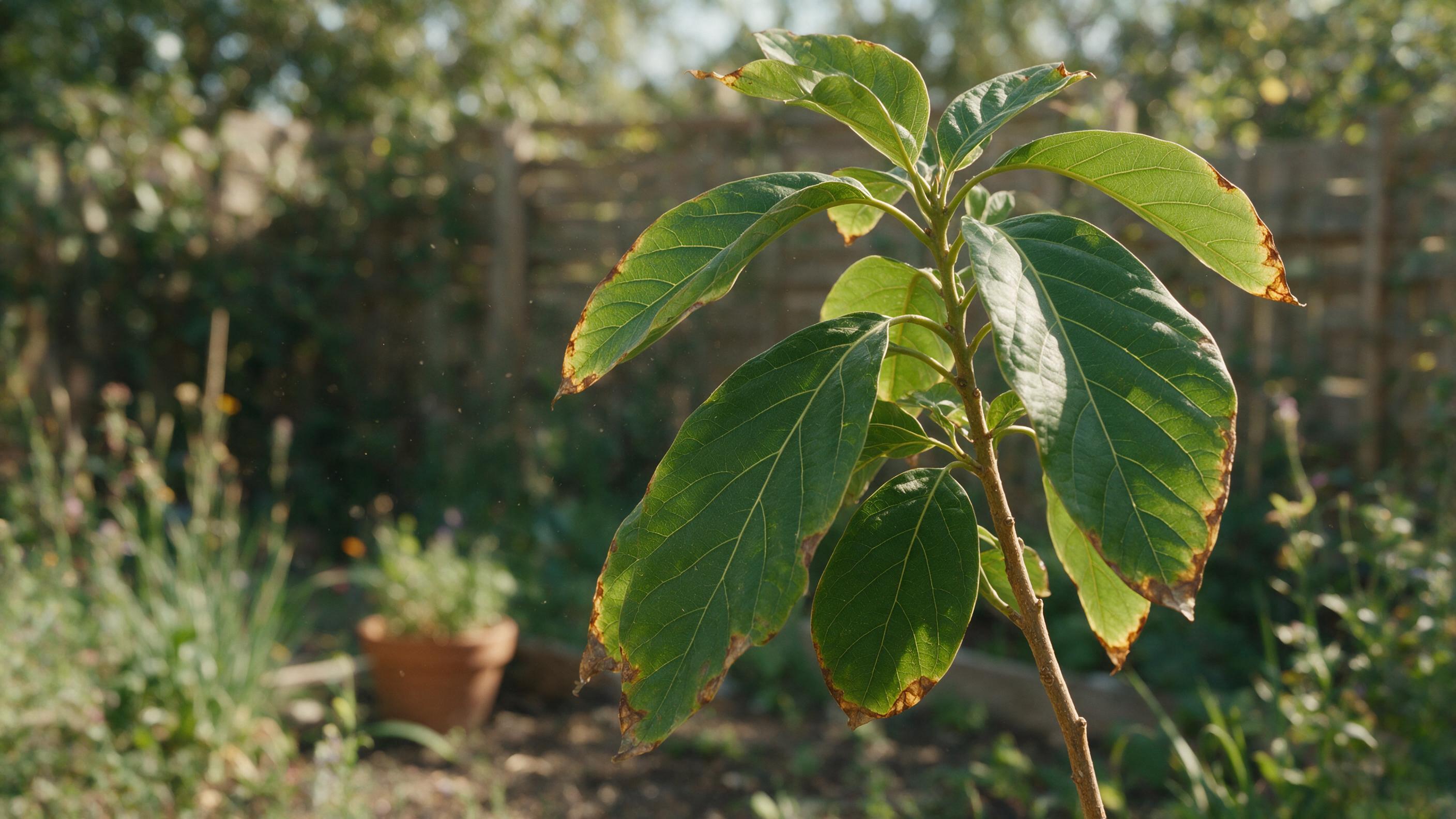
Spotting brown leaves on your avocado tree is one of those moments that stops a gardener in their tracks. You planted it with care, you’ve been watering it, and now the foliage looks scorched, crispy, or spotted — and you’re not sure what went wrong.
The good news is that browning leaves on an avocado tree are almost always diagnosable, and most causes are fixable once you know what you’re looking at. Whether you’re growing a backyard tree in California or Florida, or nursing a potted seedling indoors through a harsh winter, this guide walks you through every major cause, how to tell them apart, and exactly what to do about each one.
What Does It Mean When Your Avocado Tree Leaves Are Turning Brown?
Brown leaves on an avocado tree are a distress signal, but the type of browning matters enormously. The pattern of discoloration reveals crucial diagnostic information: brown tips suggest salt buildup, edge browning indicates underwatering, while scattered brown spots often point to pests or disease. In other words, where the brown starts tells you almost as much as the brown itself.
The avocado tree (Persea americana) is a tropical evergreen that is particularly sensitive to salt accumulation, temperature swings, and waterlogged roots — all common challenges for US home growers. Being tropical evergreen trees, avocados grow better in warm, frost-free zones, but can turn brown when exposed to dry air, which promotes water loss through excessive transpiration.
Understanding which type of browning you’re dealing with is the first step. The sections below break down every major cause and how to identify each one by its specific pattern.
Pro Tip: Always look at both sides of the leaf. Check the bottom side of the avocado leaves — if you see brown dots that are getting bigger day by day, the most likely reason is a fungal infection like anthracnose.
Is Brown Discoloration in Avocado Trees Always a Sign of a Problem?
Not always. Some leaf browning is completely normal and does not require any intervention at all. It’s normal for your avocado tree to have 10% of its leaves turn brown at any given time, but you must initiate action if the brown spots start taking over your tree entirely.
Minor tip burn on avocados is no big deal. More specifically, if less than about ten percent of a tree’s canopy is brown, there should be no reduction in fruit yield. In other words, if a tree has only a little tip burn, it will still produce as much fruit as if it had perfect foliage.
It’s also worth knowing how natural leaf death looks different from problem browning. An avocado leaf that dies a natural death from old age (called senescence by botanists) does not die starting at the tip, nor does it turn brown before it falls — it turns uniformly yellow. If your leaves are yellowing evenly before dropping, that’s normal aging, not a crisis.
You can learn more about how different types of leaves age and drop across plant species, which helps put avocado leaf behavior in broader context.
Watering Issues Causing Avocado Tree Brown Leaves
Watering is the single biggest lever you have over your avocado’s leaf health — and getting it wrong in either direction causes browning.
Overwatering leads to yellowing leaves and root rot, while underwatering results in wilting and browning leaf edges. The tricky part is that both problems can look similar at first glance, so you need to check the soil, not just the leaves.
Overwatering drowns the roots and stops oxygen uptake, while underwatering causes leaves to wilt and crisp up fast. To tell them apart, push your finger about two inches into the soil near the base of the tree. If it feels soggy, you’re overwatering. If it’s bone dry, you’re underwatering.
One of the most overlooked watering mistakes is where you apply the water. Mature avocado trees have a canopy that spreads far in all directions, and the roots extend as far as the canopy and sometimes farther. To water these roots, you need to irrigate at the outside edges of the canopy, not near the trunk.
Salt buildup from tap water is another watering-related cause of browning. Municipal water contains chlorine and chloramines, and avocados are sensitive to chloride specifically. Over the irrigation season, the chloride level builds up in the avocado leaf until it reaches a toxic level and the leaf tissue begins dying, starting at the tip — that’s the brown: chloride-induced death.
A good way of preventing avocado leaf burn from salt is to give the tree regular deep waterings — that washes the salt out of the soil. Forget light irrigation; it doesn’t offer sufficient water to leach out the accumulated salts.
Pro Tip: If you let chlorinated tap water sit for several days, the chlorine will dissipate. You can also use chlorine-removing drops sold for aquariums. For potted trees, filtered or collected rainwater makes a noticeable difference.
Light Conditions Behind Avocado Tree Brown Leaves
Too much direct sun — especially during the hottest part of the day — is a real threat to avocado leaves, particularly on young or recently transplanted trees.
Intense summer sun can cause bleached patches on exposed avocado leaves, and young trees need protection from midday sun. Avocado leaf scorch looks like large bleached patches on upper leaves, and this symptom happens when the plant cannot transpire fast enough to cool down.
It’s also possible for avocado trees to have their leaves burned by intense sun, and that will cause them to brown in a different fashion compared to the chloride issue. Sun scorch tends to appear as large, irregular bleached or tan patches on the sun-facing side of leaves, rather than the crispy brown tip pattern typical of salt burn.
On the flip side, avocados grown indoors or in shaded spots may not receive enough light to support healthy photosynthesis, leading to weak, pale growth that can eventually develop brown areas. If you’re growing a potted avocado indoors, check out this guide to best houseplants for low-light areas to understand how light requirements differ between species.
To protect outdoor trees from sun scorch, paint the trunk with white latex paint to prevent sunscalding, and use 30 percent shade cloth during peak summer months. This is especially helpful for young trees in USDA zones 9–11 during July and August.
Soil, Nutrients, and Root Health Causing Avocado Tree Brown Leaves
What’s happening underground often shows up first in the leaves. Avocados are sensitive to both nutrient deficiencies and poor soil conditions, and each deficiency leaves its own visual signature.
Avocado trees need iron, zinc, magnesium, phosphorus, potassium, and nitrogen to thrive, and a deficiency of these can cause the leaves to turn brown. Here’s how the most common ones look:
- Nitrogen deficiency: Nitrogen deficiency causes pale green leaves that brown later.
- Iron deficiency: Iron deficiency shows as yellowing between veins before browning.
- Zinc deficiency: Zinc deficiency is much more common than other deficiencies. Small brown spots and discoloration on the leaf margins may appear, and the leaves will look more distorted.
Testing your soil and applying the correct fertilizer can help your avocado tree thrive and produce fruit. Your local cooperative extension office can often provide low-cost soil testing, and the results will tell you exactly which nutrients are missing rather than forcing you to guess.
Root rot is the most severe soil-related problem. Phytophthora root rot (Phytophthora cinnamomi) is arguably the most destructive disease affecting avocado trees worldwide. Root rot caused by fungal infections like Phytophthora can lead to abrupt symptoms, especially in younger trees under water stress conditions. If you suspect root rot, look for wilting that doesn’t respond to watering, yellowing leaves that drop suddenly, and dark, mushy roots when you inspect below the soil line.
According to the UC Statewide IPM Program , to avoid and manage avocado root rot, use an integrated pest management (IPM) approach that emphasizes prevention, including certified disease-free nursery stock and root rot-resistant cultivars from a reputable supplier.
Key Insight: Moderate amounts of nitrogen fertilization promote good growth that helps make avocado trees more tolerant to root rot — but avoid applying excessive amounts of fertilizer.
Over-fertilizing is just as damaging as under-fertilizing. Avocado leaf burn can also be caused by excessive fertilizer applications, but deep watering helps leach out excess fertilizers too.
Environmental Stress Triggering Avocado Tree Brown Leaves
Environmental factors — temperature extremes, humidity, and wind — are among the most common triggers for browning in US home gardens, especially outside of California and Florida.
Avocado leaves damaged by cold turn brown in a different pattern than tip burn caused by chloride. Cold temperatures can make young leaves curl up and brown while older leaves take on a mottled browning. If the air gets extremely cold, say into the low 20s, avocado leaves completely brown and dry up within days and they don’t even drop from the tree.
Harsh weather conditions such as frost can cause avocado tree leaves to turn brown. The USDA hardiness zones 9 to 11 are the optimum zones for growing avocado trees. If the tree suffers damage over winter and leaves and branches brown, wait until spring to prune any damage. Many times new growth will sprout from what looks like a brown and dead branch.
Low humidity is another environmental stressor. The avocado comes from a humid tropical region where air humidity is typically in the 70–80 percent range and frequently exceeds it. Dry indoor air in winter, or hot, arid conditions in states like Arizona or Nevada, can cause leaf edges to dry out and brown even when watering is adequate.
Dry winds can also desiccate the foliage, and frost may play a part as well. If you’re in a windy location, a windbreak or strategic planting near a fence or wall can reduce desiccation stress significantly.
For gardeners in colder states growing avocados in pots, cover your tree with frost cloth when the forecast dips below 35 degrees Fahrenheit.
Pests and Disease Leading to Avocado Tree Brown Leaves
When browning doesn’t match the patterns for salt, drought, or temperature stress, pests and fungal disease move to the top of the suspect list.
Avocado lace bugs are one of the most common pest culprits in the US. Avocado lace bugs (Pseudacysta perseae) are small, delicate insects with lace-like wings that feed on the undersides of leaves, leaving behind yellow stippling on the upper surface and shiny, tar-like spots on the underside. Heavy feeding can cause leaves to turn brown and drop prematurely.
Mites and scale insects also cause browning. Mites cause fine webbing or distorted new growth, while thrips and scales cause distorted leaves and sticky honeydew. Check the undersides of leaves with a magnifying glass if you suspect mites — they’re tiny but visible.
Anthracnose is the most common fungal disease that causes brown spots. Caused by the fungus Colletotrichum gloeosporioides, anthracnose affects both the foliage and the fruit of the avocado tree and is particularly prevalent during warm, humid weather. Symptoms include dark, sunken lesions on leaves and premature fruit drop.
When leaves show small dark brown spots with a yellow halo or circular brownish-black spots that ultimately become sunken, they could indicate Cercospora spot and anthracnose diseases, respectively.
For pest control, the UC IPM Avocado Pest Management Guidelines recommend an integrated approach. Introduce beneficial insects such as ladybugs that feed on lace bug populations, and use insecticidal soap or horticultural oil applications to control heavy infestations. Neem oil helps with pests that weaken the leaves — mix it with water and spray in the early morning. Do not apply during the heat of the day, or you will damage the leaves.
Avocado trees share some pest and disease pressures with other tree species. If you’re curious about bark-related symptoms, our guide to different types of tree bark explains how bark damage and disease entry points relate to overall tree health.
How to Diagnose Why Your Avocado Tree Is Turning Brown
A systematic approach saves you from guessing — and from applying the wrong fix. Work through this process before taking any corrective action.
- Identify the browning pattern. Brown tips suggest salt buildup, edge browning indicates underwatering, while scattered brown spots often point to pests or disease. Start here — the pattern narrows your suspect list immediately.
- Check the soil moisture. Push your finger two inches into the soil. Soggy = overwatering. Bone dry = underwatering. Both cause browning but require opposite fixes.
- Inspect both sides of the leaves. Avocado lace bugs cause stippling and bronzing on leaves — look for lace-like patterns on the underside. Fungal spots tend to appear on the upper surface and grow over time.
- Review your recent care history. Track changes in watering, fertilizing, or location over the past two weeks — browning often follows a care change by one to two weeks.
- Assess the environment. Check temperature lows, wind exposure, and recent weather. Cold snaps and heat waves frequently precede browning episodes.
- Test your soil if nutrient deficiency is suspected. The soil can be tested for nutritional deficiencies, as poor iron, nitrogen, and zinc levels can lead to brown leaves.
If you’re unsure whether what you’re seeing is a pest problem, a plant identification app can help. Our roundup of the best iPhone apps for identifying plants includes tools that can help you identify leaf damage patterns and common diseases.
Important Note: Once avocado leaves turn brown, the damaged tissue cannot revert to green. Focus on correcting the underlying issue to prevent further browning and encourage new healthy growth.
How to Fix an Avocado Tree That Is Turning Brown
Once you’ve identified the cause, here’s how to address it directly.
For salt buildup and chloride tip burn: It’s important to water deeply and slowly. At least once a month, water deeply enough to “leach” or push salts well below the root zone. Getting a salinity test done is another way to verify your prognosis. For potted trees, flush the pot thoroughly until water runs freely from the drainage holes.
For underwatering and drought stress: If avocado trees aren’t correctly watered, they develop brown leaves since the roots cannot hold enough water to nourish and cool the leaves. Increase watering frequency and depth, and apply a 3–4 inch layer of organic mulch around the drip line to retain soil moisture between waterings.
For overwatering and root rot: Phytophthora root rot is the number-one killer in poorly drained soils. Prevention and treatment involve planting on mounds or raised beds, ensuring excellent drainage, and avoiding overwatering. For potted trees with advanced root rot, propagation from healthy cuttings becomes the most viable option for preserving your avocado plant.
For nutrient deficiencies: Suitable fertilizers can be added to the soil based on soil test results. For zinc specifically, utilizing kelp extract or a foliar spray is a preferred solution to overcome zinc deficiency.
For sun scorch: Use 30 percent shade cloth during peak summer months. For young trees in the ground, temporary shade structures during the first two summers dramatically reduce the risk of leaf scorch.
For anthracnose and fungal disease: Spray a fungicide designed for anthracnose fungus, available at most US garden centers or online. Remove and dispose of heavily infected leaves to reduce spore spread. Avoid overhead watering, which keeps foliage wet and encourages fungal growth.
For frost damage: If the tree suffers damage over winter and leaves and branches brown, wait until spring to prune any damage. Pruning too early can expose new tissue to further cold injury.
You can also explore the benefits of avocado fruit and seeds — understanding what a healthy, productive tree looks like can help motivate the care steps needed to get yours back on track.
How to Prevent Avocado Tree Brown Leaves Going Forward
Prevention is far easier than recovery. These habits, built into your regular care routine, will keep browning to a minimum year-round.
- Water deeply and consistently. Avocado trees get brown leaves from a lack of water or a buildup of salts in the soil. These salts are typically caused by hard water or too much fertilizer and can be flushed out with soft water. For best results, use rainwater and avoid fertilizing in the winter.
- Mulch the root zone. Apply 4 inches of mulch every 3–6 months around the drip line (not against the trunk) to retain moisture and moderate soil temperature.
- Fertilize carefully. Avoid applying excessive amounts of fertilizer, and avoid large amounts of animal manures or other products high in ammonia or salts. Avocado roots are sensitive to ammonia and salts, which can increase root susceptibility to Phytophthora.
- Protect from frost. In USDA zones 8–9, cover trees with frost cloth when temperatures are forecast to drop below 35°F. It is generally advised not to let avocado trees be exposed whenever the chance exists for temperatures to drop below 25°F.
- Inspect for pests regularly. Regular pest inspections for invaders like lace bugs, optimizing soil and container environments, ensuring adequate light exposure, and correcting any nutrient imbalances are essential strategies for keeping your tree healthy.
- Choose the right variety. Avocado varieties differ in their tolerance to chloride. Hass is particularly sensitive to chloride, while Reed and Fuerte show more tolerance. If you’re planting a new tree in an area with hard water, variety selection matters.
- Ensure proper drainage. Ensure proper drainage to prevent standing water around the crown — this is the single most effective step against Phytophthora root rot.
Growing avocados successfully in the US often comes down to matching the right tree to the right spot. For a broader look at what trees thrive in your region, our guide to types of trees covers a wide range of species and their care requirements.
| Browning Pattern | Most Likely Cause | Key Fix |
|---|---|---|
| Brown tips, crispy texture | Salt/chloride buildup | Deep leaching watering monthly |
| Brown leaf edges, wilting | Underwatering or drought | Increase watering depth and frequency |
| Yellowing then browning, soggy soil | Overwatering or root rot | Improve drainage; reduce watering |
| Large bleached patches on top of leaf | Sun scorch | Shade cloth or windbreak |
| Mottled or soft brown, curling | Cold/frost damage | Frost cloth; wait until spring to prune |
| Dark spots growing larger over time | Anthracnose fungal disease | Fungicide spray; remove infected leaves |
| Stippling, bronzing, tar-like spots under leaf | Avocado lace bug | Neem oil or insecticidal soap |
| Yellowing between veins, then browning | Iron or zinc deficiency | Soil test; targeted foliar or soil amendment |
Frequently Asked Questions
Can brown avocado leaves turn green again?
Once avocado leaves turn brown, the damaged tissue cannot revert to green. Focus on correcting the underlying issue to prevent further browning and encourage new healthy growth. Trim away the brown portions if you’d like the plant to look tidier — cutting just before the green tissue resumes won’t harm the leaf.
Should I remove brown leaves from my avocado tree?
Leaves with minor tip burn can stay on the tree. Remove severely affected leaves to redirect the plant’s energy toward recovery. Leaves with fungal spots should be removed and disposed of (not composted) to prevent spreading spores to healthy foliage.
Why are only the tips turning brown and not the whole leaf?
This is called “tip burn” and it’s caused by chloride in irrigation water. Browning usually occurs on the old leaves first. Excess salt accumulates in the leaf edges, where it kills the tissue and the leaf dries out and turns brown. Deep, monthly leaching waterings are the most reliable fix.
My avocado is indoors — why are its leaves turning brown?
Avocado plants in pots are very susceptible to leaf tip burn from either sodium or chloride salts, far more so than many other plants, so other plants receiving water from the same source may not show any signs of stress. Low humidity from indoor heating is also a common culprit in winter. Try misting the leaves or placing a humidifier nearby.
What USDA zones are best for growing avocado trees?
Avocado trees grow best in USDA hardiness zones 8–11, which typically range from subtropical to tropical. Growers outside these zones — particularly in the Southeast and Southwest — can still grow avocados in pots and bring them indoors during cold snaps.
Does the Hass variety brown more than others?
Avocado varieties differ in their tolerance to chloride. Hass is particularly sensitive to chloride, while Reed and Fuerte show more tolerance. If you’re in an area with high-chloride municipal water, choosing a more tolerant variety at planting time can significantly reduce tip burn.
For more on growing and caring for plants throughout your home and garden, explore our guides on types of plants and different types of aloe vera plants — both are excellent companions to an avocado in a home garden or on a sunny patio.