
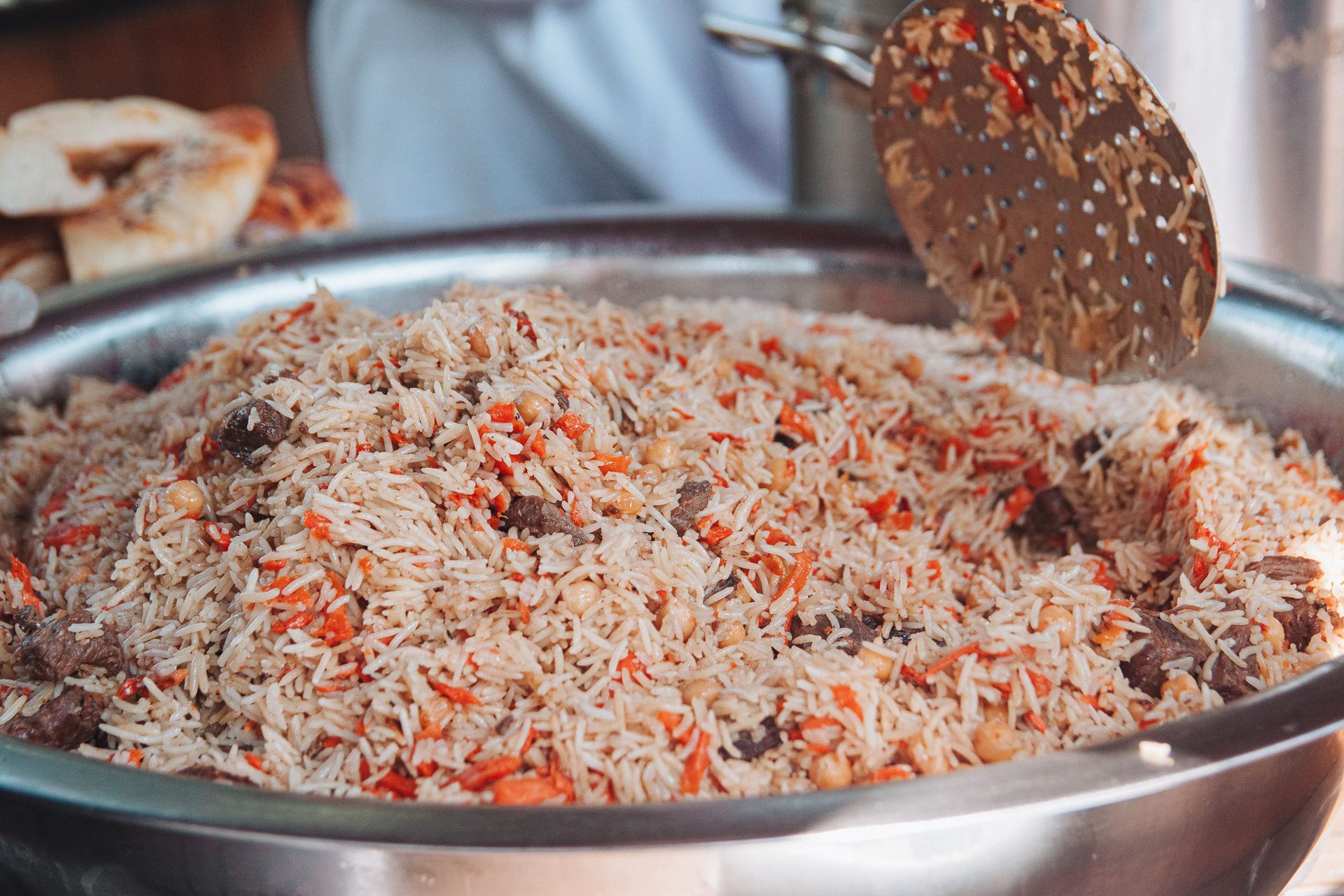
A traditional Uzbek breakfast rarely looks like a quiet bowl of cereal eaten alone. On an ordinary morning in Tashkent or Samarkand, the table might hold little more than fresh bread and a pot of green tea, but step into wedding season or a bazaar at dawn and the picture changes completely.
Two dishes anchor that larger spread: nahor oshi, the ceremonial morning plov served to wedding guests before sunrise, and samsa, the tandoor-baked pastry eaten standing up on the way to work. Both show how Uzbekistan treats breakfast less as a quick refuel and more as an extension of hospitality. Much like other regional breakfast traditions found from the Balkans to East Asia, the specific foods change from place to place, but the instinct to welcome guests with a full table stays constant.
1. Nahor Oshi
Nahor oshi translates loosely to “morning plov,” and the name describes the dish exactly. Nahor oshi, or “morning plov”, is served in the early morning (between 6 and 9 am) to large gatherings of guests, typically as part of a wedding celebration. Some sources spell it the other way around, as oshi nahor, but both forms point to the same wedding-morning ritual.
Important Note: You may see this dish written as both “nahor oshi” and “oshi nahor” across different sources. Uzbek word order varies by region and dialect, so either spelling refers to the same ceremonial breakfast plov.
The pace of a nahor oshi gathering moves fast once guests sit down. Newcomers are seated immediately by young helpers, and the hosts waste no time: green tea appears within minutes, with the rice dish following close behind. Turning down an invitation is not treated lightly, either, since guests who skip the “oshi nahor” risk offending their hosts, and in wedding season a household might send out several such breakfast invitations in a single day.
On an average day, a family might cook plov at home, but a wedding-morning crowd calls for a specialist. Palov is made on special occasions by the oshpaz, or the osh master chef, who cooks the dish over an open flame, sometimes serving up to 1,000 people from a single cauldron on holidays or occasions such as weddings. That scale is part of the point: nahor oshi is a public display of a family’s ability to host, not a private meal.
The dish itself follows a familiar formula found across Central Asian cooking. Uzbek plov is made with meat, typically fatty lamb cuts, julienned carrots, onions, garlic, rice, and cumin powder, all cooked together in oil or fat. Rice-forward breakfasts are not unique to Uzbekistan, either; a similar instinct toward rice as a morning staple shows up in traditional Indian breakfast dishes, even though the seasoning and technique differ sharply.
Plov’s standing in Uzbek cuisine runs deeper than everyday cooking. The mixed rice dish is so important to Uzbek food culture that the making of plov was recognized as the country’s UNESCO Intangible Cultural Heritage of Humanity in 2016. Nahor oshi, as plov’s wedding-morning form, shares in that recognition. None of it arrives without tea, since green tea is the national hot beverage taken throughout the day, and teahouses, or chaikhanas, are of real cultural importance. For a closer look at how one wedding-morning gathering actually runs, this account of the nahor oshi tradition walks through the seating, timing, and social obligations in detail.
Pro Tip: If you are invited to a nahor oshi while traveling in Uzbekistan, arrive close to the stated time. Seating fills quickly, and hosts treat punctual guests as a sign of respect for the occasion.
2. Samsa
Where nahor oshi is occasional and ceremonial, samsa is the Uzbek breakfast that happens every single day. A samsa is a light pastry filled with meat such as lamb, beef, or chicken, or sometimes a vegetarian filling like cheese, potato, or pumpkin, and baked in a traditional tandoor oven. Uzbek street vendors and bakers turn these out from early morning, and buying one on the way somewhere is as routine as grabbing toast elsewhere.
Visitors often assume samsa is just a baked version of the Indian samosa, and the two pastries do share a common ancestor. The real difference is in the seasoning: the Uzbek version is closely related to the Indian samosa, but it earns a distinct flavor from a heavier hand with cumin, both black and red pepper, and a scattering of sesame seeds. The dough itself also behaves differently once it hits the oven, which is where the tandoor comes in.
| Samsa Filling | Main Flavor Notes | Common Context |
|---|---|---|
| Lamb and onion | Fatty, peppery, heavy on cumin | Most traditional, bazaar staple |
| Beef | Milder than lamb, still onion-forward | Everyday bakery version |
| Pumpkin | Sweet, soft filling | Autumn and winter months |
| Potato or cheese | Mild, vegetarian-friendly | Offered alongside meat versions |
The cooking method explains why a good samsa has such a distinct bite. Outside, it comes out dry, blistered, and faintly smoky, sometimes sprinkled with sesame or nigella; inside, the filling stays fatty, peppery, and heavy on cumin. That contrast happens because bakers slap the raw dough directly onto the scorching inner wall of a clay tandoor rather than frying it, which is also what separates baked samsa from its deep-fried samosa cousin. You can read more about the tandoor technique and ingredient ratios in this guide to samsa as a centerpiece of Uzbek cuisine .
Uzbek cookbooks and food writers rarely list samsa on its own. Uzbek cuisine groups samsa with manti and chuchvara as stuffed pockets of dough served as either an appetizer or a main course, which is part of why it moves so easily between breakfast, a mid-afternoon snack, and a full meal depending on the hour. That same flexibility shows up in other hand-held, stuffed pastries around the world, including the fillo-wrapped options found in some traditional Egyptian dishes, even though the dough and spicing take a very different direction. If you want a reference point on the other end of the spectrum, a traditional Japanese breakfast tends toward rice, fish, and pickles rather than anything baked in an open flame, which makes the contrast with samsa fairly stark.
For a fuller technical picture of where samsa fits among dumplings, pastries, and other stuffed dough traditions across the region, the Wikipedia entry on samsa traces its spread from Central Asia into neighboring Tajik, Kyrgyz, and Turkmen kitchens, each with its own small variations on filling and shape.
| Feature | Nahor Oshi | Samsa |
|---|---|---|
| Occasion | Weddings, special gatherings | Everyday, any morning |
| Who prepares it | Professional oshpaz for large crowds | Home bakers, street vendors, bakeries |
| Cooking method | Simmered in a large cauldron over open flame | Baked against the inner wall of a tandoor |
| Typical setting | Seated indoor gathering, early morning | Standing at a stall, eaten on the go |
Put side by side, nahor oshi and samsa cover both ends of what breakfast in Uzbekistan can mean: a slow, communal rice feast reserved for milestones, and a fast, flaky pastry built for a normal Tuesday. Readers curious about how other cultures handle this same stretch between everyday meals and festive ones can find more comparisons among traditional Malaysian dishes, where street-food breakfasts sit alongside their own set of celebration foods.