18 Traditional Middle Eastern Breakfast Dishes That Define the Morning Table

November 23, 2026
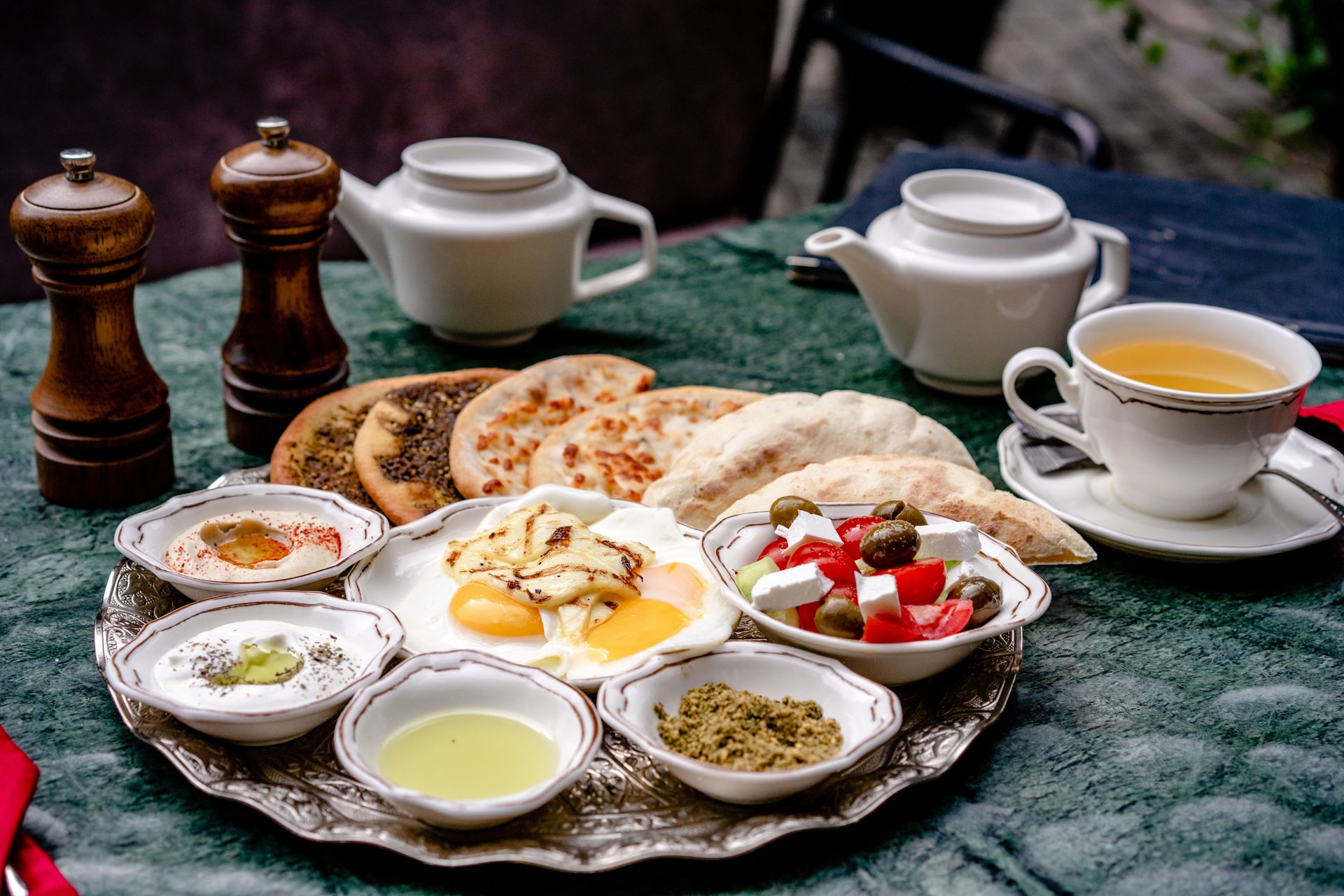
A traditional Middle Eastern breakfast rarely means one plate. It means a table crowded with small bowls of beans, cheese, warm bread, olives, and tea, meant to be shared slowly rather than rushed through on the way out the door.
From Cairo’s fava bean stalls to Istanbul’s sesame-bread carts, the region’s morning meals share a few constants: legumes for lasting energy, fresh dairy for tang, and bread for scooping up everything else. Some of these dishes also share roots with breakfast traditions found well beyond the Middle East, including the Balkans, where Ottoman-era trade routes left their own mark on the morning table.
Below are 18 dishes that show how varied — and how connected — this morning meal really is, from Egypt’s oldest breakfast stew to the mint tea that closes the meal.
1. Shakshuka
Shakshuka is eggs poached directly in a skillet of simmering tomato and pepper sauce, usually scooped up with warm bread straight from the pan. Its exact birthplace is genuinely disputed, with sources tracing it to the Maghreb, the Ottoman Empire, or Yemen, depending on who tells the story.
What most food historians agree on is that shakshouka is a dish of poached eggs on a type of tomato puree, built from onion, garlic, and often a hit of turmeric or paprika. The dish became closely tied to Israeli breakfast culture after Jews of the Maghreb left Tunisia and Libya for Israel in the 1950s and brought their egg traditions with them, according to food writer research published on Kitchen Bee .
Important Note: Morocco, Tunisia, Libya, Yemen, and Turkey all claim shakshuka as their own, and no single written record settles the argument. Treat any definitive origin story with a little skepticism.
Shakshuka also isn’t alone in its technique. It has similar cousins elsewhere in the Mediterranean and beyond, including huevos rancheros in Mexico, eggs in purgatory in Italy, and menemen in Turkey, a reminder that eggs simmered in sauce are a nearly universal breakfast solution. You can read more on the dish’s disputed roots at Simple Wikipedia .
2. Ful Medames
Ful medames is a stew of fava beans, slow-cooked until creamy and dressed with cumin, garlic, lemon, and olive oil. It holds the title of Egypt’s national dish, and its history stretches back far longer than most breakfast foods manage to survive.
The dish is even mentioned in the Jerusalem Talmud, which indicates it was already being eaten in Middle Eastern countries by the fourth century, per Wikipedia’s entry on ful medames . The name itself hints at the old cooking method: fava beans were once buried in hot coals to simmer overnight, and “medames” is a Coptic word meaning buried, referring to the way Egyptians once cooked the beans directly in buried pots of hot coals.
Today the dish is enjoyed throughout the Middle East, from Sudan to Syria, Israel, and Yemen, according to Sous Chef’s breakfast guide , with each country adding its own twist. In Egypt, the dish is still closely tied to daily Egyptian food traditions, served at street carts before most other breakfast stalls even open.
Common garnishes include:
- Tahini sauce or a drizzle of olive oil
- Chopped tomato, parsley, or spring onion
- A boiled egg on the side
- Fresh lemon juice and a sprinkle of Aleppo pepper
3. Labneh
Labneh is strained yogurt, thickened until it sits somewhere between yogurt and soft cheese. The tangy spread is typically served drizzled with olive oil, scattered with zaatar or fresh mint, and eaten with torn flatbread rather than a spoon.
It usually shows up as one of several small dishes on a Levantine breakfast tray, alongside olives, tomato, and a boiled egg, rather than standing alone as the main event. The same straining technique appears in Greek cooking, where strained yogurt plays a similarly central role at the morning table.
Pro Tip: To make labneh at home, salt plain full-fat yogurt lightly, then let it drain in cheesecloth over a bowl in the refrigerator for 24 to 48 hours. The longer it strains, the firmer and more spreadable it becomes.
4. Manakeesh
Manakeesh are round, hand-stretched flatbreads baked fresh each morning and topped before baking rather than after. Bakeries across Lebanon, Syria, and Jordan turn them out by the dozen, and the toppings decide the whole character of the bread.
The most common versions are topped with a thick blend of dried thyme, sesame, and sumac known as zaatar, though cheese (often akkawi) and spiced minced meat are just as popular. Most are folded in half like a taco and eaten by hand on the walk to work or school, a habit that puts manakeesh closer to a French boulangerie pastry grabbed on the go than a sit-down meal.
5. Fatteh
Fatteh is a layered dish built specifically to use up day-old bread, which makes it as practical as it is comforting. The name itself comes from the Arabic word for crumbled, a nod to the toasted or fried pita that forms its base.
The dish is typically assembled in this order:
- Toasted or fried pieces of pita bread spread across the bottom of a dish
- A layer of cooked chickpeas, meat, or eggplant
- A garlicky yogurt-tahini sauce poured generously over the top
- A finish of toasted pine nuts or almonds and a drizzle of browned ghee or butter
Regional variations swap the middle layer freely, so fatteh hummus (chickpeas), fatteh djaj (chicken), and fatteh makdous (fried eggplant) can all appear on the same breakfast menu depending on the household, echoing the same bread-and-stew logic found in a German eintopf.
6. Kishk
Kishk starts as cracked wheat mixed with yogurt or buttermilk, left to ferment, then dried into a coarse powder that can be stored for months. When breakfast calls, the powder is reconstituted with water or milk into a warm, tangy porridge or thin soup, often finished with caramelized onions and a pool of olive oil.
The fermentation method behind kishk isn’t unique to the Levant. Dried fermented grain-and-dairy mixtures show up under different names across the wider region tied to Ottoman trade, including tarhana in Turkey and trahana in the Balkans, which is why kishk is often cited as a textbook example of a shared regional breakfast tradition rather than a single country’s invention.
Key Insight: Fermented grain-and-yogurt breakfasts form a loose culinary family stretching from the Levant through Anatolia into the Balkans, including traditional Balkan breakfast staples built on the same preserve-now, eat-later logic. The method also echoes the fermentation at the heart of a traditional Japanese breakfast, where miso and natto rely on a similar principle, just with soybeans instead of wheat.
7. Simit
Simit is a ring-shaped bread with a crackly, deeply golden crust, achieved by dipping the dough in grape molasses before it’s crusted in sesame seeds and baked. Street vendors in Istanbul sell it from glass-topped carts, often alongside tea, white cheese, olives, and jam for a full spread.
The bread’s reach extends well past Turkey’s borders. Thessaloniki’s koulouri, a close cousin discussed alongside other traditional Greek foods, follows nearly the same recipe, and similar sesame-ring breads turn up across former Ottoman territory in the Balkans, including Albania, where shared bakery habits outlasted the empire that spread them.
8. Kaymak
Kaymak is a thick, almost spreadable clotted cream, traditionally made by slowly simmering water buffalo or cow’s milk and skimming off the rich layer that forms on top. It’s usually served alongside honey, jam, or fresh bread rather than eaten plain.
The cream carries the same Ottoman-era footprint as simit and börek, appearing as kajmak in Albanian, Serbian, and Bosnian kitchens as well as Turkish ones. Authentic Albanian recipes for a morning spread frequently pair kajmak with honey in almost the same way Turkish households serve kaymak, making it one of the clearest overlaps between Albanian food culture and the wider Middle Eastern breakfast table. A similar richness shows up in the malai cream found in Pakistani food traditions, built from the same slow-skimming technique.
9. Börek
Börek is a pastry built from thin, layered dough, filled with cheese, spinach, minced meat, or potato, then rolled, coiled, or stacked before baking or frying until the layers turn flaky and golden. Lebanese, Syrian, and Turkish bakeries all have their own version, often sold warm by weight rather than by the piece.
The pastry travels under its own name well outside the Middle East. In Albania it’s called byrek, and it holds a similar everyday status there as it does across Turkey and the Levant, eaten for breakfast, as a snack, or as a full meal depending on the hour.
Key Insight: Among Albanian breakfast dishes, byrek is considered close to a point of national pride, with family recipes passed down for generations, much the way börek fillings vary by household across the Middle East.
Typical fillings include:
- Salty white cheese, sometimes mixed with egg
- Sautéed spinach or wild greens
- Spiced minced lamb or beef
- Mashed potato or pumpkin, depending on the season
10. Sucuk
Sucuk is a spiced, garlicky cured beef sausage, dark red from paprika and cumin, and it’s most often sliced thick and fried until the edges crisp. The classic breakfast version, sucuklu yumurta, scrambles eggs directly into the hot sausage fat in the same pan.
It’s typically served alongside bread, white cheese, and tomatoes rather than on its own, filling the same protein-forward role that cured sausages play in cooler-climate breakfasts across the wider Ottoman-influenced region.
11. Balaleet
Balaleet is a sweet-and-savory dish built from vermicelli noodles cooked down with sugar, cardamom, saffron, and a splash of rosewater, then topped with a thin, plain omelet laid over the top like a lid. The contrast between the sweet noodles underneath and the savory egg layer is the entire point of the dish.
It’s especially popular across the UAE, Oman, Bahrain, and Qatar, often appearing on the table during Eid mornings or family gatherings. The sweet-vermicelli idea itself isn’t unique to the Gulf; a similar logic shows up in the sweetened vermicelli dishes found in Indian food traditions, though the spicing and presentation diverge sharply from there.
12. Jachnun
Jachnun is a Yemenite Jewish pastry made from a thin dough that’s rolled tightly, coiled, and then baked at a low temperature overnight, which caramelizes the outer layers while keeping the inside soft and slightly sweet. It’s traditionally pulled from the oven on Shabbat mornings, when no new cooking is permitted.
The pastry is served with grated fresh tomato, a hard-boiled egg, and a generous spoonful of skhug, a fiery green chili relish that cuts through the dough’s richness. Because it bakes untouched for so many hours, jachnun doubles as a practical solution to a religious restriction as much as it is a breakfast dish in its own right.
13. Samoon
Samoon is Iraq’s everyday bread, shaped into a distinctive diamond or boat form and baked quickly in a scorching-hot oven until the crust turns crisp and the inside stays soft and airy. It’s torn by hand rather than sliced, which suits its role as a breakfast scoop for cream, jam, or eggs.
Placed next to its regional cousins, the differences in Middle Eastern breakfast breads become clear:
| Bread | Region | Defining Feature |
|---|---|---|
| Manakeesh | Lebanon and the Levant | Topped before baking with zaatar, cheese, or meat |
| Simit | Turkey | Sesame-crusted ring dipped in grape molasses |
| Samoon | Iraq | Diamond-shaped, baked hot and fast for a crisp crust |
| Jachnun | Yemen | Coiled dough baked slowly overnight until caramelized |
14. Khabeesa
Khabeesa is a thick, sweet porridge made by toasting flour or semolina in ghee until fragrant, then simmering it with sugar or date syrup and water until it thickens into a smooth, spoonable mass. Cardamom is a common addition, lending the dish a warm, slightly floral note.
It turns up as a comfort breakfast across parts of the Gulf, Sudan, and Yemen, often served to children or anyone needing something gentle and filling before a long day. The same toast-the-grain-first technique shows up in slow-cooked porridges and one-pot stews from entirely different climates, built on the same instinct to stretch simple pantry staples into something substantial.
15. Asida
Asida is a thick, smooth dumpling made from wheat flour cooked slowly in water until it forms a stretchy, dough-like mass. It’s typically shaped into a shallow bowl right on the serving plate, with a well pressed into the center to hold honey, ghee, or a savory stew.
The dish appears across Sudan, Yemen, Libya, and parts of the wider Gulf, usually eaten by tearing off small pieces and dipping them directly into whatever filling sits in the center. Its texture and presentation put it closer to a utensil than a traditional porridge, since the dough itself becomes the scooping tool.
16. M’shewsha
M’shewsha is a dense, date-based dish made by working mashed dates together with ghee or sesame oil until the mixture turns smooth and slightly glossy. In parts of Yemen and the wider Gulf, it’s rolled into small portions and eaten as a concentrated source of morning energy rather than a leisurely dish.
Its simplicity reflects an older, practical approach to breakfast: dates and fat together provide quick calories without requiring a stove, which made the dish useful for farmers, travelers, and anyone needing fuel before the day’s work began.
17. Mint Green Tea
Mint green tea pairs gunpowder green tea leaves with a generous handful of fresh mint and a notable amount of sugar, brewed strong and poured from height to raise a light foam on top. It’s less a single cup and more an all-day ritual, though it anchors the breakfast table across North Africa and the Levant just as firmly as coffee does elsewhere.
The tea itself traveled a long way to get here. Green tea originated in East Asia long before it became a North African staple, a cross-continental journey not unlike the tea customs discussed in traditional Chinese drinks. Closer to home, it sits alongside the coffee and tea rituals covered in traditional Egyptian drinks, where the morning cup is just as central to hospitality.
Pro Tip: For the classic foam, pour the tea from a height into small glasses rather than straight down. The height aerates the liquid and builds the thin layer of bubbles that signals a well-made pot.
18. Manoucheh Zaatar
Manoucheh zaatar is the most iconic single version of the broader manakeesh family, built specifically around the dried thyme, sumac, and sesame blend mixed with olive oil. Where other manakeesh varieties lean on cheese or meat, this one stays entirely plant-based and herbaceous, which is part of why it’s the version most bakeries sell fastest in the morning.
The zaatar paste is spread thickly across stretched dough before baking, left to blister in a hot oven until the edges turn crisp and the center stays slightly chewy. It’s folded in half and eaten with fresh mint, cucumber, or olives on the side, a grab-and-go breakfast that has outlasted plenty of trends precisely because it asks so little preparation of the person eating it.
Across all 18 of these dishes, a few threads repeat: bread as a utensil, legumes and dairy as the protein backbone, and tea as the glue that holds the meal together socially rather than nutritionally. Readers curious how these habits compare to breakfast elsewhere can look at a traditional Japanese breakfast, where fermentation and rice play a similar structural role to bread and legumes here, just shaped by an entirely different pantry.