Traditional Greek Clothing for Women: 20 Garments of the National Costume

November 17, 2026
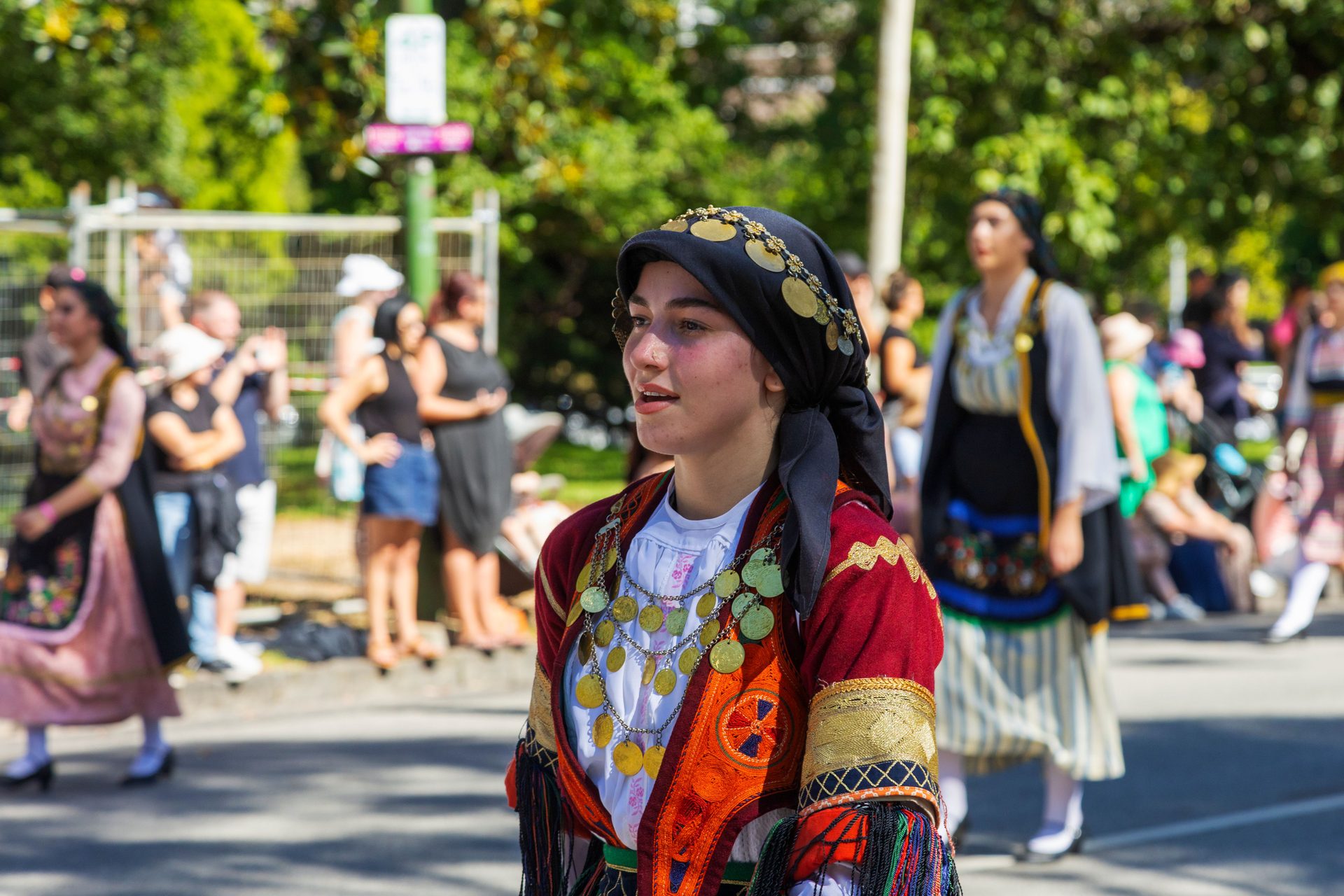
Traditional Greek clothing for women is built in layers, and every layer has its own name, fabric, and reason for existing. A chemise goes on first, then a fitted dress, then a short jacket or apron, then a sash, then a scarf or cap — and each regional costume in Greece arranges these pieces a little differently. Learning the twenty garments below is the fastest way to recognize which region a historic photograph, museum piece, or folk-dance costume actually comes from.
Many of these names trace back to Byzantine, Ottoman, and Western European influences layered onto each other the same way the clothing itself is layered. The Amalia dress alone shows how a nineteenth-century queen reshaped half a dozen regional garments into one court costume still seen at national parades today. From the simple poukamiso shirt to the pompom-topped tsarouchia shoes, this walkthrough covers each piece roughly in the order a woman would have put them on. For readers comparing folk dress more broadly, the clothing and style section covers traditional garments from other cultures as well.
1. Foustani
The foustani is the main overdress worn over the chemise, and in most mainland costumes it is the piece that carries the richest fabric and embroidery. Regional descriptions from Epirus note that it hangs as a long garment with an opening at the front and long slit sleeves, traditionally cut from fine silk brocade so the layers underneath show through at the cuffs and collar.
When Queen Amalia designed her court costume in the 1830s, the foustani was one of the pieces she adapted rather than replaced. Research into the Amalia costume found that the Amalia Costume was synthesized from traditional Greek garments and Biedermeier styles, with specific pieces like the foustani and kondogouni seamlessly merging Eastern and Western influences. That blending is part of why the foustani looks slightly different in Athens, Epirus, and the islands, even though the name stays the same.
Pro Tip: If you are trying to identify a regional costume from a photograph, start with the foustani’s fabric and sleeve shape before looking at accessories — the dress usually narrows down the region faster than jewelry or headwear does.
2. Poukamiso
Underneath the foustani sits the poukamiso, a long chemise that forms the base of nearly every Greek women’s costume. One overview of mainland folk dress notes that most of the mainland costumes in particular feature a cotten chemise (poukamiso) as the basic garment, usually in white linen or cotton so it stays cool under the heavier dress on top.
The garment has a long documented history. Research into the costume of the Mani peninsula traces the poukamiso back further, noting that a common feature among all the Greek garments, civic or rural, is the poukamiso (shirt), that origins from the heirodoto heitona, common in all Mediterranean people already from the mycenaic period, with the ancient form developing through Byzantine styles into the modern chemise. Only the collar, cuffs, and hem were meant to show, so these edges were often the most heavily embroidered part of the whole outfit. Readers who enjoy comparing layered undergarments across cultures might also look at how base layers function in traditional Japanese clothing, where a similar under-layer sits beneath the kimono.
3. Amalia Dress
The Amalia dress, also called the Amalia costume, is probably the single most recognizable piece of traditional Greek clothing for women outside folklore circles. It takes its name from Amalia of Oldenburg, the first queen of modern Greece, who combined a Biedermeier-style fitted bodice with pleated silk skirts and a velvet jacket borrowed from regional dress. According to Wikipedia, to Amalia is attributed the creation of the “romantic folksy court dress,” which became Greece’s national costume.
What makes the story interesting is how deliberate the design was. Academic analysis of the costume describes it as closer to an invented tradition than a direct survival of village dress — a court-commissioned synthesis meant to give the new kingdom a unifying symbol rather than simply preserving one existing regional outfit. The name Amalia itself later became common across Greece, in the same way many names explored in our Greek baby girl names guide carry royal or historical roots.
Key Insight: The Amalia dress is often described as Greece’s “national costume,” but it was assembled from several regional garments rather than inherited whole from any single village tradition — a reminder that national dress is frequently a curated blend rather than an unbroken original.
4. Satakrouta
The satakrouta belongs to the smaller category of regional ornamental pieces that rarely make it into English-language costume guides, which makes it harder to pin down with the same precision as the foustani or Amalia dress. In the villages where the term survives, it generally refers to a decorative chest or bodice ornament worn over the dress on festive occasions, often incorporating coin work or metallic thread in the same spirit as other Greek costume jewelry.
Names like this one sit alongside dozens of other highly specific regional terms in Greek folk dress — the kind of unusual vocabulary that readers interested in unusual Greek terminology might enjoy exploring further in our piece on complex Greek terminology.
Important Note: Several of the garment names in this list, including satakrouta, bamboukli, kavouki, aeras, and kondoures, are documented mainly in regional and dialect sources rather than widely translated academic texts. Spelling and exact use can vary by village, so treat these descriptions as general regional context rather than a single fixed definition.
5. Bodia
The bodia is the apron worn over the foustani, usually tied at the waist and often the most colorfully woven piece in the whole costume. A regional overview of Greek dress lists it plainly among the core components of women’s folk costume, describing the main pieces of a female traditional costume are: a long chemise called poukamiso, a sleeveless vest called segouni, an apron called bodia, a sash called zonari, a scarf called mandili, and shoes as the backbone of the outfit.
Aprons like the bodia served a practical purpose as well as a decorative one, protecting the more expensive dress fabric underneath during daily wear. On festival days, a plainer everyday bodia was typically swapped for one with heavier embroidery or woven stripes reserved for weddings and church holidays.
6. Zonari
The zonari is the long sash or belt that cinches the costume at the waist, usually wrapped several times and finished with tassels, fringe, or a metal buckle depending on the region. It sits at the point where nearly every layer of the costume overlaps, which is why it often carries the costume’s heaviest embellishment even though it is a relatively narrow piece of fabric.
Putting together a complete regional costume generally follows a set order, with the zonari arriving near the end of the process:
- Poukamiso (chemise) goes on first, against the skin.
- Foustani (dress) is layered over the chemise.
- An outer jacket or overcoat, such as a kondogouni, doulamas, anderi, or pirpiri, is added depending on the region.
- Bodia (apron) is tied over the dress and jacket.
- Zonari (sash) cinches everything at the waist, followed by headwear and shoes.
Belts and sashes play a similar structural role in other folk costumes, including the apron-and-sash combination seen in traditional German clothing, where the dirndl apron ties in a comparable way.
7. Mandili
The mandili is the headscarf or kerchief that covers a woman’s hair, and in many regions it doubled as a marker of marital status or age. Descriptions of Epirus costume mention that for the most important occasions, such as weddings, the hair is braided and wrapped around the head, and the older, more elaborate headdress is used, with the mandili arranged over the braids rather than worn loose.
Scarves used this way are common across folk dress traditions outside Greece as well, including the draped head coverings found in traditional Pakistani clothing, where a dupatta serves a similar combination of modesty and decoration.
8. Fez
The fez is a brimless felt cap, usually red with a long tassel, that entered Greek women’s costume through centuries of Ottoman-era contact and stayed on well after independence. As part of the Amalia costume specifically, record of the court dress notes that married women wore a tasselled fez which they covered with black lace when they went to church, turning what started as everyday headwear into a more formal accessory for religious occasions.
Brimless caps with strong regional identity show up across many folk costume traditions, including some of the structured hats documented in traditional American clothing from various immigrant and frontier communities.
9. Kalpaki
The kalpaki is a taller, often fur-trimmed cap related to the fez but cut with more height and structure, and it appears in several of the more formal regional costumes alongside embroidered jackets. Descriptions of the Amalia costume specifically mention that the cap is a kalpak (“kalpaki”), placed at an angle and secured with decorative bands rather than sitting flat on the head.
Tall structured caps carry similar symbolic weight in other cultures too, including the formal headwear seen in traditional Chinese clothing, where cap height and decoration often signal status or occasion.
10. Kondogouni
The kondogouni is a short, close-fitting jacket worn over the foustani, typically in dark velvet with heavy gold embroidery concentrated around the edges and sleeves. It became one of the signature outer layers of the Amalia costume, chosen specifically because its tight cut suited the Biedermeier silhouette the queen was aiming for.
Short, richly embroidered jackets worn over a base dress are a recurring idea in folk dress worldwide, including the embellished jackets and vests catalogued in traditional Indian clothing, where similar gold-thread work decorates bridal and festival wear.
11. Pirpiri
The pirpiri is a women’s overcoat associated with the Ioannina area of Epirus, worn as the outermost layer over the foustani on cooler days or for more formal occasions. Like the kondogouni, it is typically finished with gold-thread embroidery, though cut longer and looser so it functions more as a coat than a fitted jacket.
The idea of a decorated outer coat layered over a fitted dress reappears in many traditions, including the structured overcoats found in traditional Japanese clothing, where the haori jacket plays a comparable finishing role.
12. Anderi
The anderi is one of several regional names for a sleeved overcoat that replaced the earlier Byzantine cloak in women’s dress. Research on the garments of Mani explains that the analogous modern overcoats in the popular garments are called kavadia or sagiades or segounia or anderia, meaning the same basic silhouette carries different names depending on the village or region.
This naming overlap is common throughout Greek folk costume, where a near-identical garment can be called by three or four different regional words, which is part of why cataloguing traditional Greek clothing for women requires looking at village-level sources rather than a single national list.
13. Doulamas
The doulamas is a short colored jacket worn over the chemise in the Pogoni district of northern Epirus, a mountainous area close to the Albanian border. Documentation of the local costume describes a short colored jacket, dulamas, as used in the Pogoni region to the north, with long sleeves slit toward the cuff so the embroidered sleeve of the chemise underneath stays visible.
Because Pogoni sits right against the border, its layered jackets echo elements found in Albanian national dress further north. Anyone comparing traditional Albanian costumes with Greek Epirus dress will notice similar visible cuffs and contrasting jacket colors; the history of Albanian clothing and the regional garments of southern Albania share enough common ground with Epirus costume that Balkan folk attire rarely stops cleanly at a modern border.
14. Sayas
The sayas (also written sayia) is a fitted overdress closely related to the foustani, documented especially in Greek Cypriot and island costume traditions. Descriptions of related Greek Cypriot clothing note that a traditional dress — foustani is fitted and open at the front, which is similar to another Greek Cypriot dress — sayia, showing how the two garments essentially share a construction with slightly different regional names.
Where the foustani tends to dominate mainland costume terminology, sayas is the term more often used in island and Cypriot contexts for what is functionally the same type of overdress.
15. Samaraki
The samaraki is a short, fitted vest variant worn as part of several regional costumes, generally shorter and simpler in cut than the heavily embroidered kondogouni. Costume inventories listing the components of formal Greek dress commonly include a velvet vest among the core pieces, alongside the dress, blouse, and cap.
Fitted vests like this one serve the same purpose across many folk traditions: adding structure and color at the chest without the weight or cost of a full jacket, a role that waistcoats play in traditional Australian clothing as well, particularly in colonial-era formal wear.
16. Bamboukli
The bamboukli is a light cotton garment, and the name itself points to its material — “bambaki” is the Greek word for cotton. In costumes where it appears, it typically functions as a soft undergarment or petticoat layer, adding volume under the foustani without the weight of wool or silk.
Cotton underlayers used purely for volume and comfort show up in plenty of other traditions too, including some of the lighter-weight foundation pieces found in traditional Indian clothing, where cotton petticoats serve a nearly identical purpose beneath a sari.
17. Kavouki
The kavouki is a small, rounded cap that sits close to the head, often functioning as a base layer for a larger headdress rather than being worn alone. The name reflects a Balkan-wide family of padded cap styles that were common across the region during the Ottoman period, with each area adapting the shape slightly for local headdress traditions.
Rounded structural caps that anchor larger headwear are documented in museum collections devoted to regional dress, including the holdings described at the traditional German clothing guide, where Alpine caps play a similar supporting role under more elaborate festival headwear.
| Headwear | Style | Typical Occasion |
|---|---|---|
| Mandili | Draped scarf or kerchief | Everyday wear, weddings when elaborately tied |
| Fez | Flat, tasselled cap | Formal and church occasions, often covered with lace |
| Kalpaki | Tall, structured cap | Court and formal regional dress |
| Kavouki | Small rounded base cap | Worn under larger headdresses |
18. Aeras
The aeras takes its name from the Greek word for “air” or “breeze,” fittingly describing a sheer, lightweight veil or neck covering used in some regional costumes. Rather than a structural garment, it functions as a finishing accessory, adding movement and softness around the collar or headdress without adding visible weight.
Gauzy finishing pieces like this are more about silhouette than warmth, serving the same decorative purpose that sheer overlays and veils serve in many other folk costume traditions around the world.
19. Kondoures
The kondoures is a regional term for a short boot or ankle-high shoe, distinct from the flatter tsarouchia and typically reserved for colder mountain regions where more coverage was practical. The name draws on the Greek root for “short,” distinguishing it from longer boots worn by men in some of the same areas.
Short, practical boots built for mountain or working wear appear across many folk costume traditions as a counterpart to more decorative festival footwear, filling a function closer to daily utility than display.
20. Tsarouchia
The tsarouchia are the pointed-toe shoes topped with a dark pompom that most people picture when they think of Greek traditional footwear, largely thanks to their continued use by the Presidential Guard in Athens. They close out the layered costume described throughout this list, and one overview of Greek folk dress lists shoes or other foot coverings, the tsarouhia as the final core component of the women’s ensemble alongside the chemise, vest, apron, sash, and scarf.
Traditionally made from leather with a slightly upturned toe, tsarouchia were built sturdy enough for daily wear while still carrying enough decoration for festival use.
Pro Tip: When comparing costume photographs by region, check the pompom color and shoe shape on the tsarouchia — subtle differences in size and trim often match specific regional or ceremonial traditions more reliably than the dress fabric alone.
Traditional Greek clothing for women is less a single outfit than a regional vocabulary, with twenty or more named pieces that recombine differently from Epirus to the islands to the Peloponnese. Tracking the layering order — chemise, dress, jacket, apron, sash, headwear, shoes — makes it far easier to read any given costume correctly, whether it shows up in a museum case, a family photograph, or a folk-dance troupe at a festival. For readers who want to keep exploring Greek culture beyond clothing, our guide to traditional Greek foods covers the dishes that often appear at the same festivals where these costumes are worn.