Traditional Ghanaian Clothing: 16 Iconic Garments from Kente to Ankara

November 17, 2026
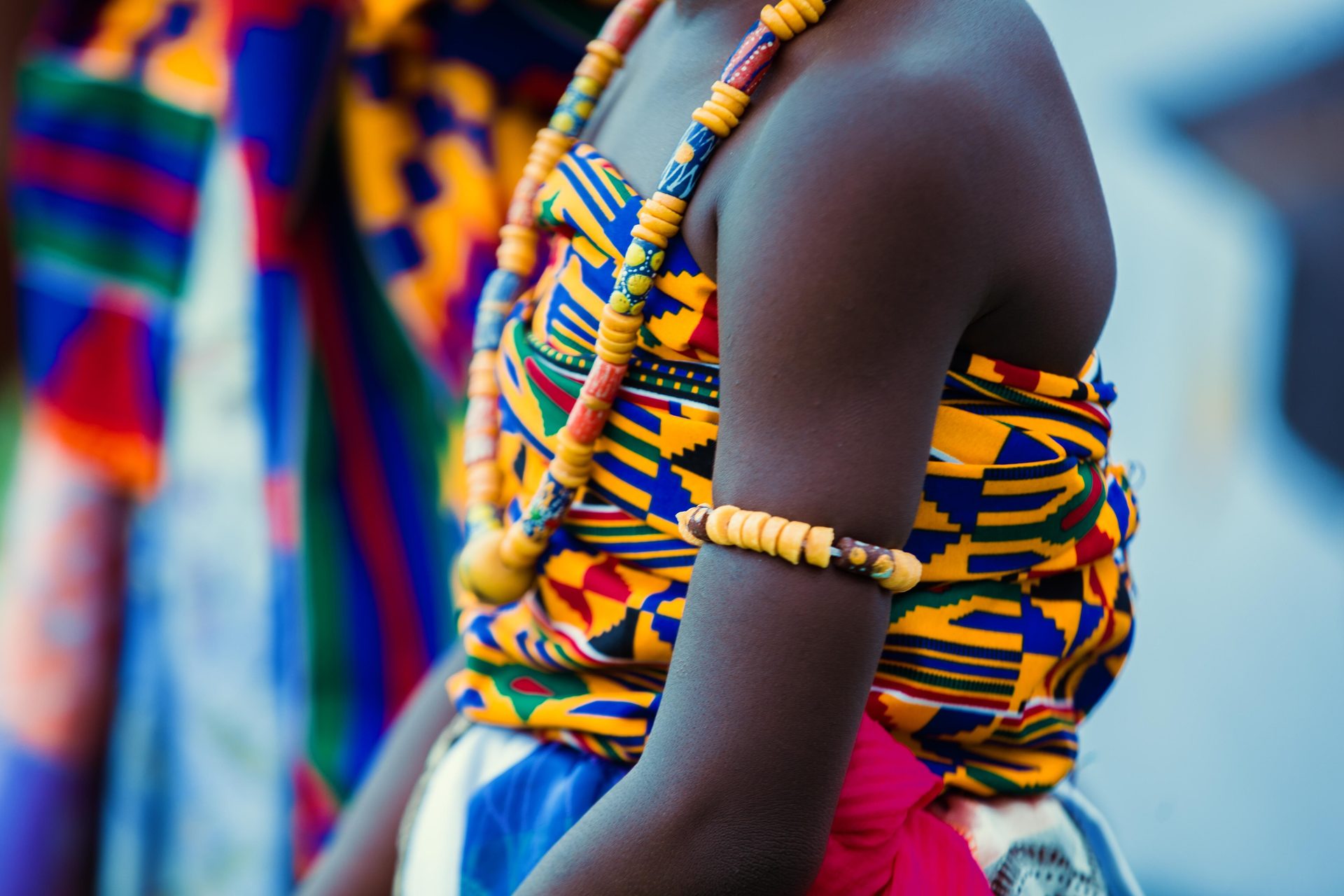
Traditional Ghanaian clothing tells a story before a single word is spoken. A strip of woven cloth can announce royal lineage, a stamped symbol can carry an entire proverb, and the cut of a smock can reveal which region of the country someone calls home.
Ghana is home to dozens of ethnic groups, and each has shaped its own vocabulary of dress. From the silk-and-cotton Kente of the Ashanti court to the handwoven smocks of the north and the tailored elegance of kaba and slit, these garments remain central to weddings, funerals, festivals, and everyday pride. This guide walks through sixteen of the country’s most recognized traditional garments and the meaning stitched into each one.
1. Kente
Kente is a handwoven textile made from strips of silk and cotton, and it is officially recognized as a geographical indication of Ghana , a status meant to protect its authenticity and origin. Historically, the fabric was worn in a toga-like fashion among the Asante, Akan and Ewe people, and according to Asante oral tradition, it originated from Bonwire in the Ashanti Region of Ghana.
The name itself carries meaning. The term Kente means basket and refers to the checkerboard pattern of the cloths. Oral tradition also ties the craft to nature: according to a well-known Ashanti legend, two farmers from the village of Bonwire came across a spider spinning a web, and amazed by its beauty, returned home eager to recreate it.
Color is never decorative alone. As interpreted in Ashanti tradition, red represents sacrifice, blue represents peace, green represents growth, yellow represents wealth, and gold represents royalty. The Asantehene adopted the fabric as a royal cloth, and its prestige was encouraged and enhanced by reserving it for special occasions. Today, as the Lam Museum of Anthropology notes , Kente cloth is universal to all the tribes in Ghana and is worn in traditional ways while also being made into hats, bags, and home accessories.
Pro Tip: Genuine handwoven Kente is assembled from narrow strips sewn together, so look for faint seam lines running the length of the cloth. A single uninterrupted printed pattern usually signals a factory-made imitation rather than strip-woven Kente.
Readers curious how other cultures turn woven textiles into status symbols may also enjoy comparing Kente with the handwoven silk traditions covered in our guide to traditional Indian clothing.
2. Adinkra Cloth
Adinkra are symbols from the Akan people of Ghana that represent concepts or aphorisms, and they are stamped rather than woven into cloth. Among the Asante, adinkra and kente cloth are both associated with royalty, but adinkra is distinguished from kente in that its patterns are stamped onto the fabric rather than woven into it.
The name has a layered history. In the Akan language, Adinkra means “saying goodbye” when parting, and according to Asante legend the name comes from a Bono leader, the King of Gyaman, named Nana Kofi Adinkra. While adinkra and kente can both be worn for important occasions, adinkra cloth is associated with mourning and worn primarily at funerals.
Each symbol carries its own proverb. The best-known is Gye Nyame: as Smarthistory explains , it has an “S” or “Z” shape with two parallel lines in the middle and additional lines at the top and bottom, and the symbol means “(I fear no one) except God.” Production is still a hand craft: the dye is made by stamping strips of selected fabric with traditional Akan symbols using dye made from the bark and roots of trees that grow in Northern Ghana’s savannah regions.
Important Note: Adinkra’s funerary roots mean the cloth is still worn with care at formal events. Many Ghanaians reserve certain colorways, particularly black and red combinations, strictly for mourning rather than celebration.
3. Kuntunkuni
Kuntunkuni is a plain, dark cloth traditionally dyed black or deep brown and worn as mourning attire among Akan communities. Unlike the brightly patterned Kente reserved for festivals, kuntunkuni’s somber tone signals grief at funerals, where it is often paired with adinkra-stamped accents rather than bold color blocking.
The dye used to darken kuntunkuni cloth comes from the same tree bark used in adinkra stamping, which is part of why the two textiles are so often worn together at funeral gatherings. Close relatives of the deceased typically wear the darkest, plainest kuntunkuni, while more distant mourners may choose lighter shades or add small amounts of red.
4. Fugu
Fugu is one of several names for the handwoven smock that originated in Northern Ghana and has since spread across the country as formal and ceremonial wear. The garment is built from narrow strips of cotton sewn into a wide, loose-fitting top, traditionally made without exact measurements so it can be worn comfortably over other clothing.
Fugu is worn by men for durbars, funerals, and political and cultural ceremonies, often paired with loose trousers and a traditional cap. Its boxy silhouette and breathable cotton construction make it practical for the hotter, drier climate of the savannah belt, where it originated long before becoming a national symbol of pride.
Readers interested in how other regions dress for heat and ceremony alike may want to compare fugu with the tunic-and-trouser sets described in our overview of traditional Pakistani clothing.
5. Batakari
Batakari is the most widely used name for the Northern Ghanaian smock outside its region of origin, and it refers to the same handwoven garment known locally as fugu. The cloth used to make batakari is typically hand-spun and hand-woven on narrow looms, then stitched into panels wide enough to drape loosely over the shoulders.
Key Insight: The same Northern Ghanaian smock carries different names depending on who is speaking about it. Batakari is the term most commonly heard in the south and in national media, while fugu and tani reflect local usage closer to the garment’s origin.
Batakari ranges from plain, undyed cotton versions worn for everyday occasions to elaborately embroidered styles reserved for chiefs and dignitaries. Embroidered batakari often features geometric stitching around the neckline and chest, a detail that signals rank and occasion much the way Kente’s color combinations do in the south. Many of the same formal-wear principles appear in traditional German clothing, where regional embroidery similarly marks status and occasion.
6. Tani
Tani is the Dagbani-language name for the fabric used to make the Northern Ghanaian smock, tying the garment directly to the Dagomba people of the Northern Region. Where “fugu” and “batakari” describe the finished garment, tani more precisely refers to the woven cloth itself before it is cut and sewn into its final shape.
The distinction matters within Dagbani-speaking communities, where the quality and density of the tani weave can indicate how much labor went into a particular smock. Thicker, tightly woven tani is generally reserved for chiefs and elders, while lighter weaves are common for everyday wear among younger men.
7. Bin’gmaa
Bin’gmaa is the Dagbani term for the men’s version of the Northern Ghanaian smock, distinguishing it from the women’s equivalent worn in the same communities. The garment follows the same wide, strip-woven construction as fugu and batakari, but the term specifically identifies the male-cut smock within Dagomba tradition.
Bin’gmaa is typically worn with matching trousers and a cap, forming a complete ceremonial outfit for festivals, naming ceremonies, and chieftaincy events. The looseness of the cut allows freedom of movement during traditional dances performed at these gatherings, a practical feature that has kept the silhouette largely unchanged for generations.
8. Bin’mangli
Bin’mangli is the Dagbani name for the women’s counterpart to bin’gmaa, part of the same smock family worn across Ghana’s Northern Region. While it shares the handwoven cotton base and loose construction of the men’s version, bin’mangli is typically shorter and may be styled with a wrap skirt rather than trousers.
Like bin’gmaa, bin’mangli is worn for festivals and ceremonies rather than daily errands, and the specific cut can vary by village and by the weaver’s individual style. Together, tani, bin’gmaa, and bin’mangli make up the core vocabulary describing who wears what within the broader fugu and batakari tradition.
| Garment | Region/Group | Typical Wearer | Occasion |
|---|---|---|---|
| Kente | Ashanti, Ewe | Men and women | Festivals, weddings, state events |
| Adinkra cloth | Akan | Men and women | Funerals, ceremonies |
| Fugu / Batakari | Northern Ghana | Primarily men | Durbars, political events |
| Tani | Dagbani (Dagomba) | Fabric, not gender-specific | Base cloth for smocks |
| Bin’gmaa | Dagbani (Dagomba) | Men | Festivals, naming ceremonies |
| Bin’mangli | Dagbani (Dagomba) | Women | Festivals, naming ceremonies |
| Kaba and Slit | Akan, nationwide | Women | Church, weddings, formal events |
9. Dansiki
Dansiki is a sleeveless or short-sleeved tunic worn by men across several West African countries, including Ghana, often as part of a three-piece set with trousers and a matching cap. The garment sits looser and shorter than fugu, making it a common choice for warm-weather formal occasions where a full smock would feel heavy.
In Ghana, dansiki is frequently made from Kente strips, Adinkra-stamped cloth, or brightly patterned wax prints, giving wearers flexibility to dress it up or down depending on the event. Its shared presence across the wider West African region makes dansiki one of the more recognizable traditional garments outside Ghana’s borders, alongside the wax-print tunics seen in traditional Chinese clothing comparisons of regional tunic silhouettes.
10. Kaba
Kaba is a fitted, tailored blouse worn by Ghanaian women, typically cut with a structured bodice, puffed or fitted sleeves, and a neckline styled to the wearer’s preference. Unlike the loose construction of the northern smocks, kaba is custom-sewn to the body, making it one of the most personalized pieces of Ghanaian traditional dress.
Kaba is almost always discussed alongside its companion piece, the slit, and together the pairing is simply called “kaba and slit.” Seamstresses across Ghana build entire businesses around designing kaba styles, and the silhouette has become a benchmark of formal womenswear for church services, weddings, and naming ceremonies. The tailoring tradition behind kaba invites comparison with the structured silhouettes found in traditional Japanese clothing, where cut and fit carry similar cultural weight.
11. Slit
Slit is the long, fitted wrap skirt worn with kaba, cut from the same fabric to create a matching two-piece outfit. The skirt typically falls to the ankle and is wrapped and tucked at the waist rather than zipped or buttoned, a construction method that allows it to be resewn or resized easily.
Common Mistake: Kaba and slit are often confused with the fabric used to make them. The style refers to the cut and tailoring of the outfit, not the print; the same kaba and slit silhouette can be made from Kente, Ankara, or plain cotton depending on the occasion.
Because the slit is wrapped rather than fitted with elastic or a zipper, it can be styled several ways, from a straight silhouette to a fuller, gathered shape at the hip. This flexibility is part of why kaba and slit has remained a wardrobe staple for generations of Ghanaian women rather than falling out of fashion.
12. Kurugu
Kurugu refers to a style of smock associated with communities in Ghana’s Upper East and Northern Regions, built from the same hand-spun cotton strips used for fugu and batakari but distinguished by its own local weave pattern and finishing. As with many Northern Ghanaian garment names, kurugu reflects local terminology that sits alongside, rather than replaces, the broader fugu and batakari vocabulary used nationally.
Like other smocks in this family, kurugu is worn for festivals, funerals, and chieftaincy events, with the specific styling, trim, and embroidery varying from one community to the next. The garment underscores how much regional variation exists within what outsiders often lump together as a single “Ghanaian smock.”
13. Zipligu
Zipligu is another regional name within the Northern Ghanaian smock tradition, used among communities where local dialect shapes how each garment variant is described. The construction follows the same strip-weaving method common to fugu, batakari, and kurugu, with differences showing up mainly in proportion, trim, and the occasions for which it is considered appropriate.
As with kurugu, zipligu is best understood as part of a shared family of Northern Ghanaian garments rather than a wholly separate style. The persistence of these localized names, even as “batakari” becomes the catch-all term nationally, reflects how strongly ethnic identity remains tied to dress in Ghana’s north.
14. Bobga
Bobga refers to the loose-fitting traditional trousers worn underneath the smock in Northern Ghanaian men’s ceremonial dress. Cut wide through the leg and tapered toward the ankle, bobga is designed to move easily with the body during the energetic dancing that accompanies festivals and durbars.
Bobga is almost never worn alone; it functions as part of a complete outfit alongside the smock and cap, filling the same role trousers play in formal wear elsewhere. The loose cut and breathable cotton reflect the same practical, climate-driven design logic seen throughout Northern Ghana’s traditional wardrobe.
15. Muɣri
Muɣri is the traditional cap worn to complete a Northern Ghanaian ceremonial outfit, typically paired with a smock such as fugu, batakari, or bin’gmaa and trousers like bobga. The cap is usually close-fitting and made from the same woven cotton used elsewhere in the ensemble, though more elaborate versions may include embroidery matching the smock.
Headwear carries its own signals of status in many Ghanaian traditions, much as it does in the broader category of traditional clothing and style covered elsewhere. A plain muɣri suits everyday festival attendance, while a finely embroidered one is reserved for chiefs, elders, or honored guests at a durbar.
16. Ankara
Ankara is the vividly patterned wax-print cotton fabric found throughout West Africa, including Ghana, where it has become a staple for both everyday and formal wear. Though its wax-print production technique has roots in Dutch and Indonesian textile trade, Ankara has been thoroughly absorbed into Ghanaian fashion, used for kaba and slit, dansiki, and modern reinterpretations of older silhouettes.
Unlike Kente or Adinkra, Ankara’s bold, large-scale prints are produced industrially rather than hand-woven or hand-stamped, which makes it more affordable and accessible for daily wear. It is common to see Ankara worn at the same festivals and family gatherings where Kente and batakari also appear, often layered or paired within the same outfit, and tailors frequently use it to make matching family sets, much as patterned fabrics are used for coordinated family dress in traditional American clothing for holidays and reunions.
Ankara’s affordability and bright visual language have also made it a favorite for everyday fashion far beyond ceremonial use, appearing in office wear, casual dresses, and accessories across Ghana and the wider region.
From the royal strips of Kente to the humble cotton cap known as muɣri, Ghana’s traditional clothing reflects a country where dress is rarely just decoration. Each garment carries a name, a region, and often a specific role in marking grief, celebration, rank, or identity. For readers exploring Ghanaian culture more broadly, pairing this look at traditional dress with a guide to traditional Ghanaian foods offers a fuller picture of how everyday life and ceremony come together, and comparing it against dress traditions like traditional Australian clothing shows just how distinctly regional identity can be woven, literally, into cloth.