Traditional British Clothing: 19 Garments from the Kilt to Wellington Boots

November 18, 2026
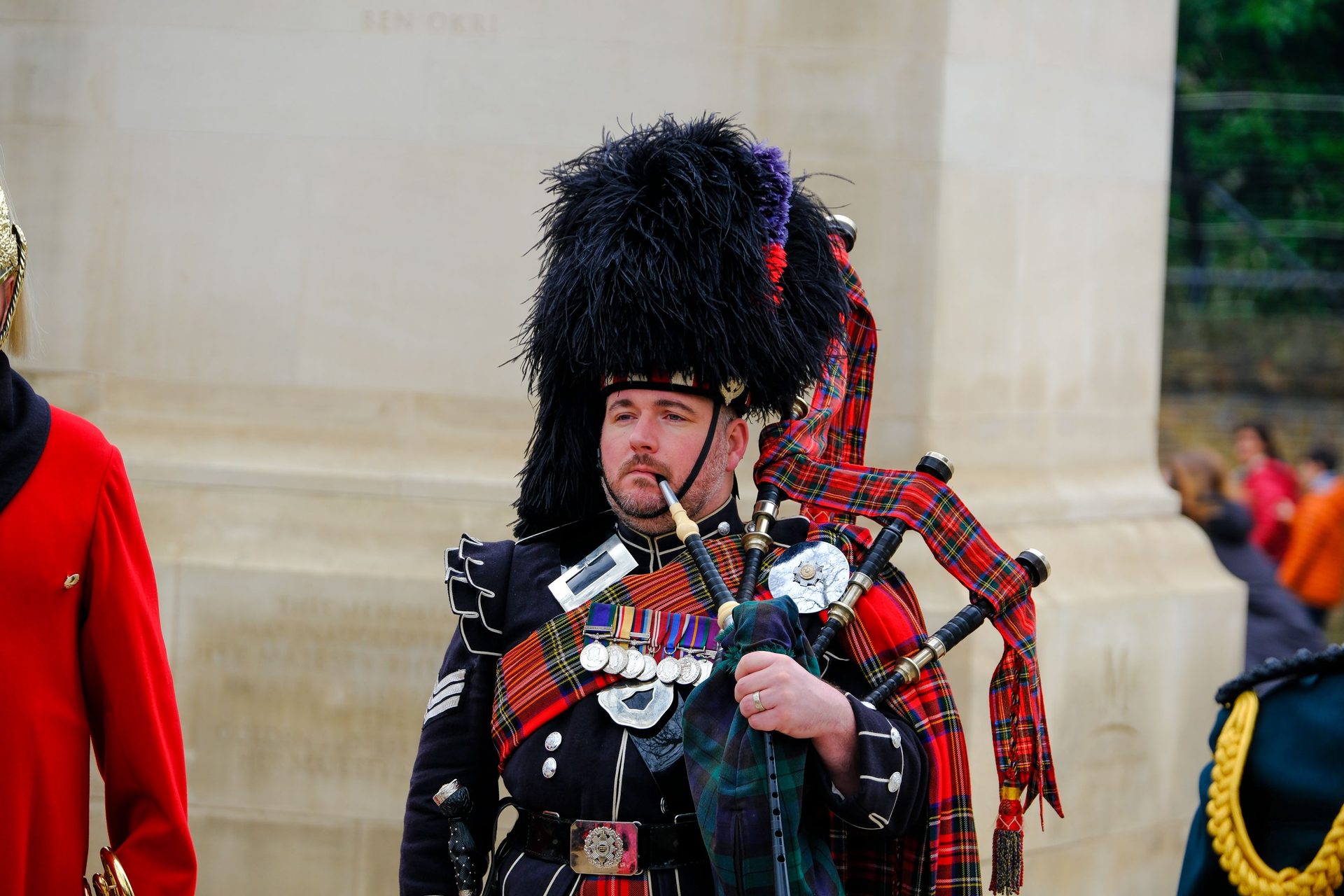
Long before fast fashion, the British Isles were already producing some of the world’s most recognizable garments, pieces shaped by weather, land, and clan identity rather than passing trends. Traditional British clothing spans far more than tartan: it covers rugged country tweeds, practical Highland accessories, and the quiet elegance of a well-cut jacket. Many of these items, from the kilt to the wellington boot, have crossed over from working wear into global fashion staples.
This guide walks through nineteen garments that make up the backbone of British, Scottish, and Welsh traditional dress. Readers curious about how other cultures express national identity through clothing may also enjoy this overview of traditional clothing styles from around the world.
1. Kilt
The kilt is the single most recognizable piece of traditional British clothing, a knee-length pleated garment made from woven wool tartan and wrapped around the waist. Its earliest form, the féileadh mòr or “great kilt,” was a single long piece of cloth that Highland men draped over the shoulder as well as the waist, serving as both clothing and blanket on cold hillsides.
After the 1745 Jacobite rising, Highland dress was banned under the Dress Act for several decades, which pushed the kilt toward near-extinction outside military regiments. Its revival came through the Victorian era, when codified rules around tartan, jackets, and accessories were established and formal and semi-formal Highland dress took the shape still recognized today . Modern kilts are typically tailored from eight yards of tartan cloth, with the specific pattern often tied to a particular clan or region.
Pro Tip: A properly fitted kilt should sit at the natural waist, not the hips, with the hem reaching the center of the kneecap when standing.
2. Sporran
Because a traditional kilt has no pockets, the sporran exists to solve a very practical problem: where to keep coins, keys, and small tools. The word itself comes from the Scottish Gaelic sporan, and the sporran is worn on a leather strap or chain positioned in front of the wearer , hanging just below the belt buckle so its design can echo the buckle and the sgian dubh tucked into the kilt hose.
Early sporrans were simple drawstring pouches made from deerskin or calfskin with no decoration at all. That changed dramatically after King George IV’s 1822 visit to Edinburgh and Queen Victoria’s later enthusiasm for Highland culture, both of which pushed sporran design toward the ornate fur and metal-cantle versions associated with formal Highland dress today. According to Clan.com’s guide to Highland wear accessories , the sporran’s exact origins remain uncertain, though most accounts trace it back to at least the 12th century.
- Day sporran: plain leather, worn for everyday or semi-formal occasions
- Dress sporran: fur-fronted with ornate metal cantle, reserved for formal events
- Hair sporran: full animal-mask front, typically seen in military and ceremonial dress
3. Glengarry
The glengarry is a boat-shaped woollen cap that folds flat, making it far more practical to carry than the bulkier bonnets it eventually replaced. It is decorated with a toorie (pom-pom) on top, often a rosette cockade on one side, and ribbons trailing down the back, and it is worn as part of Scottish military or civilian Highland dress as an alternative to the Balmoral bonnet .
Tradition credits the cap’s creation to the Glengarry Fencibles, a regiment raised in 1794 by Alexander Ranaldson MacDonell of Glengarry, though some historians argue the design may have evolved gradually from earlier bonnet styles rather than being invented outright. By the 1850s, according to The Scotland Kilt Company’s history of Scottish bonnet hats , the glengarry had become standard undress headgear across Scottish regiments of the British Army, a role it still fills today among pipe bands.
4. Balmoral Bonnet
The Balmoral bonnet is a soft, round wool cap that sits flatter and looser than the glengarry, usually finished with a toorie on top and a ribbon band. It takes its name from Balmoral Castle, the royal estate in Aberdeenshire closely associated with Queen Victoria’s fondness for Highland dress and culture.
While most Scottish regiments switched to the glengarry over the twentieth century, the Black Watch kept the Balmoral as full dress headgear after the Second World War, pairing it with their green No. 1 dress jacket. Following the 2006 amalgamation of Scottish regiments into the Royal Regiment of Scotland , the military Balmoral was phased out in favor of the glengarry, though it remains common in Army Cadet Force pipe bands and civilian Highland wear.
| Headwear | Shape | Typical Wearer | Defining Feature |
|---|---|---|---|
| Glengarry | Folds flat, boat-shaped | Pipers, military, civilian Highland dress | Toorie, rosette, trailing ribbons |
| Balmoral Bonnet | Round, soft crown | Black Watch tradition, cadets, civilian wear | Looser fit than glengarry |
| Deerstalker | Peaked front and back | Country shooters, stalkers | Fold-down ear flaps |
| Flat Cap | Rounded, low profile | Working class men, countryside | Stiff peak, tweed or wool body |
| Welsh Hat | Tall, steeple-crowned | Welsh women in national dress | Black felt, worn over a frilled cap |
5. Ghillie Brogues
Ghillie brogues are the traditional shoe worn with Highland dress, instantly identifiable by their missing tongue and long laces that wrap several times around the ankle before tying above it. The design is practical rather than decorative in origin: the open-throated construction let water drain quickly from the shoe when a wearer crossed wet moorland or forded a stream, a near-daily reality for Highlanders working the glens.
Today, ghillie brogues are reserved almost entirely for formal and semi-formal kilt outfits rather than everyday wear, typically made in black or brown leather with decorative perforated (broguing) patterns across the toe. They sit within the broader family of kilt accessories that evolved alongside Highland dress , including the sporran, kilt pin, and sgian dubh.
6. Kilt Hose
Kilt hose are the long, ribbed wool socks that run from the ankle to just below the knee, finishing in a turned-down cuff called the “fold” or “garter flash.” A pair of colored garter flashes, matched to the tartan or jacket, is tucked into this fold and held in place with elastic garters hidden underneath.
Traditionally knitted or machine-made from wool, kilt hose are thick enough to provide warmth against cold Highland winds while standing up to rough outdoor use. As with other elements categorized among traditional kilt accessories , the hose and its garter flashes became more standardized and decorative during the Victorian Highland dress revival.
Key Insight: The color of garter flashes worn with kilt hose is not random. Many clans and regiments assign specific flash colors to match their tartan, turning a small sock detail into a marker of identity.
7. Trews
Trews are close-fitting tartan trousers, essentially the trouser version of Highland dress for occasions or climates where a kilt is impractical. Unlike ordinary trousers cut from plain wool, trews are tailored from the same tartan cloth used for kilts, often cut on the bias so the pattern sits at an angle for a more fitted silhouette.
Historically, trews were associated with Highland cavalry and with clan chiefs who needed trousers for riding, since a kilt offers little protection against saddle chafing. They remain part of formal Highland dress today, particularly in military pipe band uniforms and in cooler weather when a kilt alone is not practical. The concept of a distinct traditional trouser cut to signal regional identity is not unique to Scotland; readers interested in how other cultures approach traditional trousers may want to compare them with the garments covered in this guide to traditional Pakistani clothing.
8. Arisaid
The arisaid was the traditional women’s equivalent of the great kilt, a full-length tartan garment wrapped around the body and pinned at the shoulder with a large brooch, then belted at the waist. Historical accounts describe arisaid tartans as typically lighter and more muted in color than the bold patterns favored for men’s Highland dress, often featuring white or pale backgrounds with fine checks.
Unlike the men’s kilt, the arisaid fell out of everyday use earlier and almost entirely disappeared by the 19th century, surviving mainly in paintings, written descriptions, and occasional ceremonial revivals rather than continuous wear. The idea of a single draped length of cloth forming a complete traditional outfit appears across many cultures; it’s a theme also visible in traditional Indian clothing, where draped garments like the sari serve a similar role.
9. Prince Charlie Jacket
The Prince Charlie jacket is a short, fitted black evening jacket cut to sit just above the waist, worn with Highland dress for formal occasions such as weddings and black-tie events. It is distinguished by silk-faced lapels, three buttons on each cuff, and a cutaway front that leaves the kilt and sporran fully visible.
The jacket’s design descends from Victorian military doublets worn by Highland regiments, part of the broader codification of formal Highland dress that took hold in the 19th century. Because it is cut so short and fitted, the Prince Charlie jacket is almost always paired with a waistcoat, giving the overall look a crisp, formal silhouette comparable to a dinner jacket in mainstream British formalwear.
10. Argyll Jacket
The Argyll jacket is a more versatile cousin of the Prince Charlie, cut from tweed or wool rather than fine black cloth and finished with button or buckle cuffs instead of silk lapels. It works as day Highland dress for weddings, business functions, and semi-formal events where the black-tie formality of the Prince Charlie would be out of place.
Named after the Argyll region of western Scotland, the jacket typically comes in shades of grey, green, or brown tweed, allowing it to be worn with a wider range of tartans than its more formal counterpart. Buttons are usually horn or leather rather than the silver or gilt favored on dressier Highland jackets, reinforcing its practical, daytime character.
11. Pais a Betgwn
The pais a betgwn, literally “petticoat and bedgown,” is the foundation of traditional Welsh women’s dress: a striped or checked woollen petticoat worn under an open-fronted gown that laces or pins at the front. The bedgown typically has a fitted bodice and loose skirt that falls open over the petticoat, allowing the contrasting patterns of both layers to show.
This costume, along with the tall black hat worn above it, became fixed in the public imagination during the 19th century as artists and writers sought to document Welsh rural life. Much like other nations whose formal dress is rooted in regional farm wear rather than court fashion, the pais a betgwn shares a cultural role with iconic garments such as the kimono discussed in this guide to traditional Japanese clothing, where everyday dress became a symbol of national identity.
12. Welsh Hat
The Welsh hat is the tall, steeple-crowned black hat most associated with Welsh national dress, typically made of felt and worn over a white frilled bonnet or cap. Its height and wide brim set it apart from any other traditional British headwear, giving the wearer a distinctly formal, almost ceremonial silhouette.
Despite popular belief that the hat is centuries old, most costume historians agree it was largely a 19th-century creation, popularized alongside the rest of Welsh “national costume” during a period of growing interest in regional identity across Britain. Today it appears mainly on St David’s Day and at cultural festivals rather than in daily wear, much like other ceremonial pieces on this list.
Important Note: Much of what is now presented as “traditional” Welsh national dress, including the tall hat, was shaped and popularized during the 19th century rather than dating back to the medieval period, a pattern similar to the Victorian codification of Highland dress.
13. Flat Cap
The flat cap is a low, rounded cap with a small stiff peak at the front, traditionally made from tweed, wool, or sometimes leather. It rose to prominence as working-class headwear in the 19th and early 20th centuries, worn by farm laborers, factory workers, and eventually country gentlemen out shooting or walking.
Unlike many of the ceremonial pieces on this list, the flat cap never really disappeared from everyday British wardrobes. It remains a staple of country clothing today, often paired with a tweed jacket, and has cycled repeatedly through mainstream fashion as both working-class heritage wear and countryside style.
14. Deerstalker
The deerstalker is a close-fitting wool or tweed cap with peaks at both the front and back and two fold-down flaps that can be tied under the chin or over the crown. It was originally designed for stalking deer across the Scottish Highlands, where the front and back peaks shaded the eyes from sun or rain regardless of which way the wearer was facing.
The cap’s lasting global fame has little to do with hunting and everything to do with fiction: illustrator Sidney Paget dressed Sherlock Holmes in a deerstalker for the Strand Magazine stories, and the image stuck so firmly that the cap is now instantly associated with the detective rather than its original countryside purpose.
15. Norfolk Jacket
The Norfolk jacket is a belted, single-breasted tweed jacket with box pleats running down the front and back, designed to give the wearer extra room to move the arms and shoulders freely. It emerged in the 19th century as sporting wear for shooting and walking on country estates, where freedom of movement mattered more than a slim tailored cut.
The belt, usually matching the jacket’s tweed, cinches at the waist while the pleats allow the chest and shoulders to expand during a gun swing or a long stride across rough ground. Similar rural, function-first jacket designs show up wherever countryside life demands practical outerwear, a theme also present in the rugged bush jackets covered in this look at traditional Australian clothing.
16. Waxed Jacket
The waxed jacket is a cotton outer coat treated with a wax coating, usually paraffin-based, to make it water-resistant without sacrificing breathability the way rubber or plastic coatings do. Developed from the oiled sailcloth jackets used by fishermen in the 19th century, it became a countryside staple for shooting, riding, and farm work across rural Britain.
A properly cared-for waxed jacket needs periodic re-waxing to stay water-resistant, since the coating wears thin with use and exposure to sunlight. The same practical logic, treating natural fiber to withstand harsh outdoor conditions, runs through heritage workwear traditions worldwide, including many pieces explored in this guide to traditional American clothing.
17. Tweed Jacket
The tweed jacket is cut from a coarse, woven wool fabric originally developed in Scotland and the Scottish Borders, prized for being warm, weatherproof, and durable enough for daily countryside wear. Its muted, flecked colors, greens, browns, and greys, were originally chosen for a practical reason: they helped hunters and gamekeepers blend into moorland and woodland.
Different regions developed their own distinctive weaves and color schemes, most famously Harris Tweed from the Outer Hebrides, which is still handwoven by islanders under a protected designation. Wool tailoring traditions tied to land and climate are not unique to Britain, a point worth comparing with the woven wool garments found in guides to traditional German clothing.
18. Breeks
Breeks, short for breeches, are knee-length trousers that fasten just below the knee with a button, buckle, or strap, traditionally worn with long socks and sturdy boots for shooting, riding, or walking. The cut leaves the lower leg free of loose fabric, which matters when walking through heather, bracken, or muddy fields where trouser hems would otherwise drag and soak through.
Breeks are almost always made from the same tweed as the jacket worn with them, creating a matched “shooting suit” look still associated with formal country field sports. While trousers have largely replaced breeks for everyday countryside wear, they remain common at formal shoots and on traditional country estates.
19. Wellington Boots
Wellington boots are knee-high waterproof boots, originally made of leather and later rubber, named after Arthur Wellesley, the first Duke of Wellington, who had his bootmaker adapt the Hessian boot into a sturdier, lower-cut design in the early 19th century. The rubber version that dominates today emerged later in the century once vulcanized rubber manufacturing made mass production practical.
What began as a practical riding and military boot became, over the following two centuries, one of the most widely recognized pieces of British country clothing, worn equally on farms, at music festivals, and on muddy countryside walks. Few garments on this list illustrate the arc from practical necessity to everyday cultural icon as clearly as the wellington boot does.
Taken together, these nineteen garments trace a line from Highland warfare and crofting life to the formal codes of Victorian society and the practical demands of British countryside living. Many, like the sporran, tweed jacket, and wellington boot, moved well beyond their original purpose to become shorthand for British style worldwide. Others, including the arisaid and the pais a betgwn, survive mainly as cultural memory, kept alive through festivals, museums, and deliberate revival rather than daily wear.