Why Are My Fiddle Leaf Fig Leaves Curling? Causes, Fixes, and Prevention

September 7, 2026
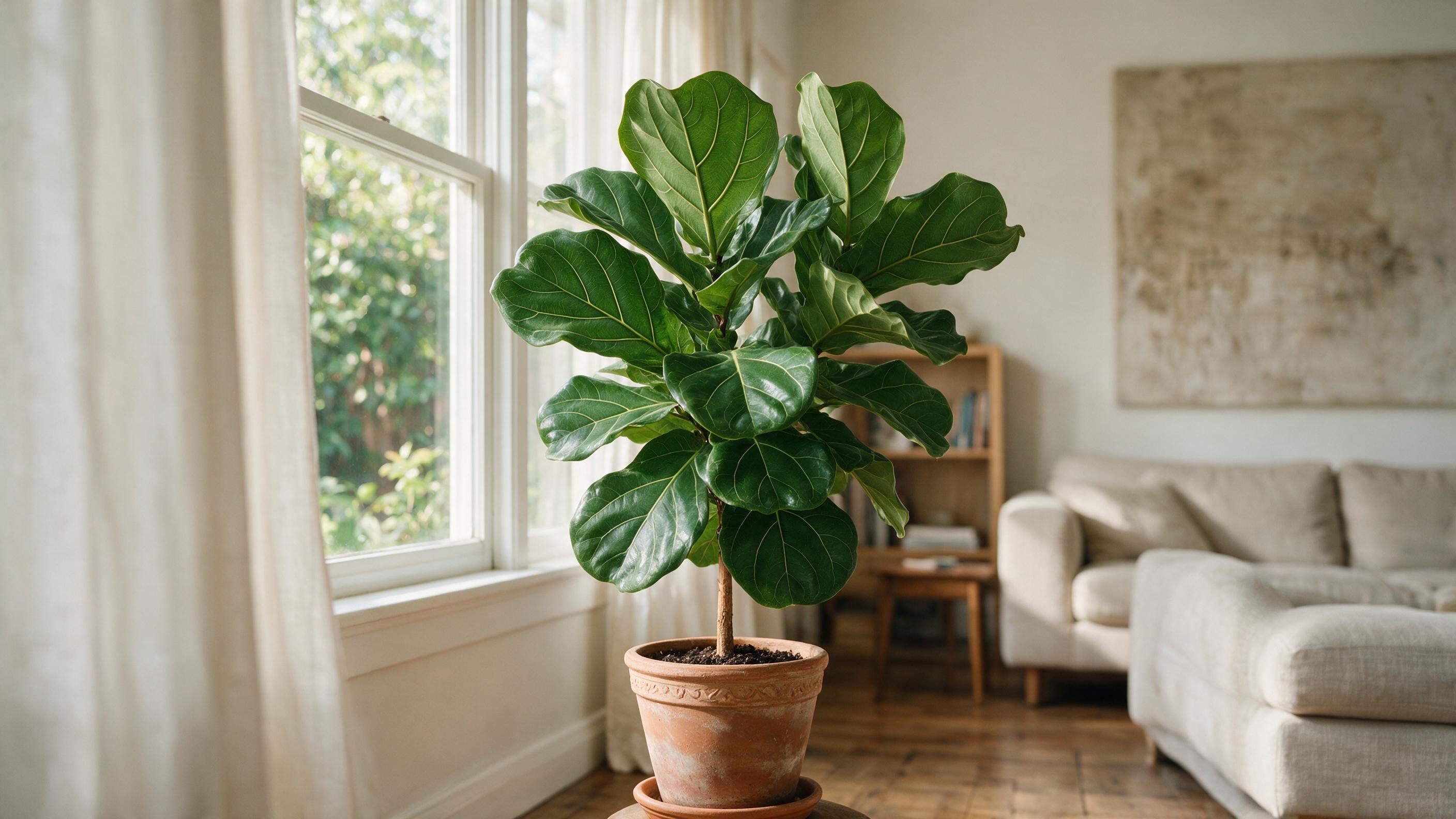
You glance over at your fiddle leaf fig, and something looks off. Those big, bold leaves — the whole reason you brought this plant home — are curling inward, cupping upward, or drooping at the edges. It’s one of the most common distress signals this plant sends, and the good news is that it almost always has a fixable cause.
Leaf curling is a stress response that signals underlying issues in care or environment. The tricky part is that several different problems can produce the same curled-leaf symptom, so a little detective work goes a long way. This guide walks you through every cause, how to tell them apart, and exactly what to do about each one.
What Does It Mean When Your Fiddle Leaf Fig Is Curling?
Fiddle leaf figs (Ficus lyrata) evolved in the humid understory of West African rainforests. Their large, leathery leaves maximize light capture in dappled shade while minimizing water loss — yet they retain zero tolerance for desiccation stress. When you grow one indoors, you’re asking a rainforest plant to thrive in a living room, and any gap between its natural needs and your home’s conditions can show up as curled foliage.
Leaf curling is not a “symptom” in the medical sense; it’s an adaptive turgor response. When cells in the leaf’s epidermis and mesophyll lose water faster than roots can replace it, cell walls collapse inward, pulling the leaf margin upward or downward depending on which tissue layer is most dehydrated.
The direction of the curl often points toward the cause. An upward curl often indicates underwatering or low humidity, while a downward curl typically signals overwatering or nutrient deficiencies. Keeping that distinction in mind as you read through the sections below will speed up your diagnosis considerably.
Is Curling in Fiddle Leaf Figs Always a Sign of a Problem?
Not always — but it usually warrants a closer look. Fiddle leaf figs develop a range of problems at the slightest sign of struggle or change in conditions. They are quite picky, and something as simple as a change in light level or slight overwatering can quickly cause them to show signs of distress.
New leaves sometimes emerge with a slight curl as they unfurl, which is completely normal and resolves on its own within a few days. New growth is more sensitive to environmental stress. Curling new leaves often point to under-humidification, inconsistent watering, or nutrient imbalance. If the curl persists beyond a week or spreads to established leaves, something in the plant’s environment needs adjusting.
One important thing to keep in mind: curled leaves won’t uncurl — but new growth will be flat and taut if conditions stabilize. So your goal isn’t to “fix” the existing curled leaves; it’s to correct the underlying cause so future growth comes in healthy.
Pro Tip: Don’t prune curled leaves unless they turn yellow or brown. As long as they’re still green, they’re still photosynthesizing and supporting the plant’s recovery.
Watering Issues Causing Fiddle Leaf Fig Curling
Curled leaves — often accompanied by yellow leaves — are frequently traced back to water problems. Potential causes include not watering enough, watering too often, and poor soil drainage. Both extremes produce curling, but they look a little different up close.
Underwatering is the most common culprit. When the soil is dry and the fiddle leaf fig leaves are curling inward, that is a sign that the plant is not getting enough water. This can also lead to the plant’s leaves feeling dry and crumbling, leaf drop, stunted growth, and wilted stems and leaves. You’ll typically notice the curl starting at the leaf margins, and the edges may feel papery or crispy.
Overwatering curls leaves in a different direction. While underwatering can cause leaves to curl upwards, curling or bending downwards is usually a sign of overwatering. Fiddle leaf figs are prone to root rot when overwatered, causing roots to become soft and leaves to wilt, curl, and drop off the plant.
Never water your fiddle leaf fig when the soil is still moist. Wait until around half the soil has dried out before watering again. This time will differ based on your environmental conditions and the performance of the plant, so avoid watering on a schedule and test the soil every few days instead.
As a general seasonal guide, most fiddle leaf figs need watering every 7–10 days in summer and every 10–14 days in winter. But always let the soil, not the calendar, be your guide. Stick your finger two inches into the soil — if it still feels moist at that depth, wait a few more days.
Pro Tip: Water thoroughly until excess drains from the bottom. Use room-temperature water and allow topsoil to dry slightly between waterings. Avoid using cold water straight from the tap, which can shock the roots.
Light Conditions Behind Fiddle Leaf Fig Curling
Although fiddle leaf figs can handle some direct sunlight during the day, they grow better when given bright indirect light indoors. As they are grown in greenhouses before being sold, these plants are not used to high sun exposure and can burn when left in the path of intense direct sun during midday or afternoon.
When the light levels are too high, your fiddle leaf fig may begin to curl in order to conserve moisture and protect itself from damage. High light can also cause the moisture in the soil to evaporate much quicker, making the curling worse. If the curling leaves also show brown, scorched patches, too much direct sun is almost certainly the issue.
Too little light is also a problem. Bright, indirect light is ideal. Too little light can cause leaf drop, while direct sun may scorch the leaves. A plant sitting in a dim corner of a room will slowly decline, with curling and eventual leaf drop as the warning signs.
Fiddle leaf figs require 6–8 hours of bright, indirect light daily. Position your fiddle leaf fig within 3–5 feet of a south- or west-facing window. Rotate monthly for even growth. Avoid direct midday sun, which can scorch leaves. In US homes with south- or west-facing windows, a sheer curtain during peak afternoon hours makes a big difference, especially in summer.
If you’ve recently moved your plant to a brighter spot and curling started shortly after, expose it to direct light slowly over a few weeks so it can get used to the conditions. Gradual acclimation prevents shock.
Soil, Nutrients, and Root Health Causing Fiddle Leaf Fig Curling
The health of your fiddle leaf fig’s root system directly controls what the leaves look like. Healthy roots are the cornerstone of a thriving plant. If your fiddle leaf fig’s roots are unhealthy, it can lead to all sorts of problems, including leaf curl.
Poor soil drainage is a silent contributor. If your watering schedule is on track, poor soil drainage could be to blame. Fiddle leaf figs require fast-draining soil to ensure excess moisture doesn’t pool around the roots. Use a well-draining potting mix designed for indoor plants. A mix with peat, perlite, or coco coir is great for avoiding soggy roots.
Root bound conditions also restrict water uptake. Compacted roots restrict water uptake, which means even a correct watering schedule won’t deliver enough moisture to the leaves. If your plant hasn’t been repotted in two or more years and the roots are circling the bottom of the pot, it’s time to size up. Repot every 2–3 years in spring using well-draining soil — a mix of potting soil, perlite, and orchid bark works well. Choose a pot only 1–2 inches larger in diameter to prevent water retention.
Nutrient deficiencies contribute to curling too. A common deficiency is nitrogen, which is essential for leaf growth and color. Without enough nitrogen, leaves might curl and turn yellow. On the flip side, one of the causes of too much fertilizer is curling leaves, as the residual nutrient salts can toxify the soil and damage the roots. This can result in fiddle leaf fig tree leaves curling and browning as the roots become unable to deliver what the plant needs.
The fix for overfertilization: flush the soil until it runs clear and stop fertilizing for several months to give the plant time to recover. For ongoing nutrition, fertilize monthly in the growing season — spring through summer — with a balanced 3-1-2 NPK formula. Skip fertilizing entirely in fall and winter when growth slows. You can learn more about choosing the right soil environment by browsing our guide to big-leaf indoor plants.
Pro Tip: If you suspect tap water is contributing to salt buildup or nutrient lockout, switch to filtered or distilled water. Curling can signal nutrient lockout from alkaline water — a common issue in many US cities with hard tap water.
Environmental Stress Triggering Fiddle Leaf Fig Curling
Your home’s environment — temperature, humidity, airflow, and location stability — plays just as large a role as watering and light. This plant from tropical Western Africa can be a bit fussy, reacting to even the slightest change in its surroundings.
Low humidity is one of the most overlooked triggers in American homes, especially during winter when central heating drops indoor humidity well below comfortable levels for tropical plants. Fiddle leaf figs thrive in an environment where humidity levels are 40% to 60%. When the humidity levels are below this percentage, the plant can begin to experience the same symptoms as not getting enough water, which include curling leaves.
Curling here typically starts at leaf margins and progresses inward. Unlike underwatering curling (which affects entire leaves uniformly), low-humidity curling often appears as subtle upward cupping — like a shallow spoon shape.
To raise humidity effectively: use a cool-mist ultrasonic humidifier placed 3–4 feet away, running 8–10 hours daily. Avoid warm mist — heat accelerates evaporation. Misting offers minimal humidity boost and can promote fungal issues if leaves stay wet. A humidifier or pebble tray is more effective and safer for long-term care.
Temperature swings and drafts are equally damaging. Never place your fiddle leaf fig near heat vents, drafty windows, or exterior doors — even brief exposure to very cold air triggers immediate curling. Keep the temperature steady, ideally between 65–75°F. Most US homes stay in this range naturally during spring and summer, but winter drafts near windows or doors can cause sudden leaf curl overnight.
Relocation stress is another common cause. Changes in environment, whether it’s moving to a new home or shifting from indoors to outdoors, can cause stress-induced leaf curling. Try to keep your plant in a stable spot. If you need to move your plant, do it slowly over a few days.
Pests and Disease Leading to Fiddle Leaf Fig Curling
Fiddle leaf figs are prone to a number of pest infestations found indoors, particularly spider mites and mealybugs. Scale is also a possibility, along with flying pests like fungus gnats. Damage from any of these bugs feeding on your plant can cause leaves to curl irregularly and become deformed.
Spider mites are especially common in dry indoor environments during winter. Spider mites are notorious for leaving fine webbing and stippled leaves, while mealybugs appear as cotton-like masses on leaves and stems. Check the undersides of leaves carefully — that’s where both pests prefer to hide. Common pests like spider mites, mealybugs, and scale can cause fiddle leaf figs to curl up. These pests all feed on sap found in plant leaves. Your fiddle leaf fig’s foliage will become more and more dehydrated as the infestation worsens.
For treatment: if pests are present, isolate the plant immediately. Treat with insecticidal soap or neem oil every 7 days for 3 weeks. Wipe down the leaves with a damp cloth after each treatment to remove residue and eggs. You can find helpful plant identification tools in our roundup of the best iPhone apps for identifying plants and best Android apps for identifying plants — some of these apps also help identify common pest damage.
On the disease side, there are several different types of fungal diseases, and just about all of them can cause the leaves of your fiddle leaf fig to curl upward. Fungal diseases are notorious for being difficult to get rid of and can even spread from one plant to another. Fungal issues typically follow periods of overwatering or poor airflow. If you spot irregular brown or black patches with yellow halos alongside curling, remove affected leaves immediately and improve air circulation around the plant.
Pro Tip: When bringing home a new plant, always quarantine it for two weeks before placing it near your fiddle leaf fig. Many infestations start with newly purchased plants that carry hidden pest eggs.
How to Diagnose Why Your Fiddle Leaf Fig Is Curling
Diagnosing the cause of curling leaves on fiddle leaf figs can be a little frustrating, as there are quite a few different causes that can have the same impact. The best thing to do is to go through the list and eliminate the causes one by one until you find which best fits your plant and what’s going on.
Work through this step-by-step process:
- Check the curl direction. An upward curl often indicates underwatering or low humidity, while a downward curl typically signals overwatering or nutrient deficiencies.
- Check soil moisture at depth. Push your finger two inches into the soil. Bone dry = underwatering. Still wet after 10+ days = overwatering or drainage issue.
- Check leaf color alongside the curl. Leaf color provides additional clues. Yellowing leaves may suggest overwatering or a nutrient deficiency, whereas browning edges are likely a sign of underwatering or low humidity.
- Inspect for pests. Use a magnifying glass to check leaf undersides for webbing, sticky residue, or tiny moving dots.
- Assess the environment. Is the plant near a vent, a drafty window, or in a room with low humidity? Has it been moved recently?
- Review your fertilizing history. Did curling start shortly after you fertilized? Overfertilization is often the culprit when the timing lines up.
- Check the roots. If the roots have started to rot, they will be mushy and dark in color. Healthy roots are pale and firm to the touch.
Once you’ve identified the most likely cause, focus on correcting that single issue first before changing multiple variables at once. Making too many changes simultaneously makes it impossible to know what actually helped.
How to Fix a Fiddle Leaf Fig That Is Curling
The right fix depends entirely on the cause, but here’s a practical action plan organized by the most common scenarios:
| Cause | What You’ll See | Fix |
|---|---|---|
| Underwatering | Upward curl, dry crispy edges, bone-dry soil | Water thoroughly until it drains from the bottom; establish a soil-check routine |
| Overwatering | Downward curl, yellowing, soggy soil, odor | Let soil dry out; check drainage; trim rotten roots and repot if needed |
| Too much direct sun | Curl + brown scorched patches on exposed leaves | Move 3–5 feet from window or add a sheer curtain |
| Low humidity | Shallow spoon-shaped upward cup, margin curling | Run a cool-mist humidifier 3–4 feet away for 8–10 hours daily |
| Root bound | Curl despite correct watering, roots circling pot | Repot in spring into a pot 1–2 inches larger with fresh well-draining mix |
| Overfertilization | Curl + browning tips after recent feeding | Flush soil thoroughly; withhold fertilizer for several months |
| Pests | Irregular curl, webbing, sticky residue, visible bugs | Isolate plant; treat with neem oil or insecticidal soap weekly for 3 weeks |
| Root rot | Drooping curl, mushy dark roots, yellowing lower leaves | Unpot, trim rotten roots, repot in dry fresh soil, reduce watering |
When dealing with root rot specifically, if you find the root system has started to rot, trim away the infected parts and add fresh, dry soil. Moving forward, to prevent the issue from happening again, adjust your watering schedule so that you are either watering less frequently or more deeply. Either will help give your fiddle leaf fig tree enough time to dry out.
For pest-related curling, you can control mild infestations by spraying your fiddle leaf fig with a strong stream of water to knock pests off the plant. Neem oil and similar treatments help prevent and manage infestations. Chemical pesticides should be a last resort and are almost never necessary when dealing with indoor plants.
Remember that recovery takes time. A healthy fiddle leaf fig produces 1–2 new leaves monthly during the growing season. Track this metric — it’s the best indicator of systemic recovery. If you’re seeing new flat leaves emerging, you’re on the right track even if the older curled leaves never fully recover. You might also enjoy our guide to types of leaves to better understand your plant’s foliage anatomy. For more types of plants that might thrive alongside your fiddle leaf fig, our plant library is a great resource.
How to Prevent Fiddle Leaf Fig Curling Going Forward
Prevention comes down to consistency and monitoring. When it comes to indoor plant care, prevention is generally best, followed by treatment once you identify the issue. Building a few simple habits into your routine eliminates most of the conditions that cause curling in the first place.
- Check soil moisture weekly. Use a moisture meter or your finger at two inches depth. Never water by a fixed schedule alone.
- Monitor humidity year-round. Measure humidity with a calibrated digital hygrometer — not your phone app. Place it 12 inches from the plant at leaf height. Aim for 40–60% RH.
- Keep the location stable. Avoid sudden temperature changes or relocating frequently. Pick a bright, draft-free spot and leave the plant there.
- Rotate monthly. Rotate monthly for even growth and to prevent the plant from leaning toward the light source.
- Fertilize on a seasonal schedule. During the growing season — spring and summer — feed your plant every 4–6 weeks. Stop completely in fall and winter.
- Refresh the soil periodically. Every spring, gently loosen the top 1 inch of soil and replace it with fresh mix to replenish nutrients and improve drainage.
- Inspect for pests regularly. Regularly inspect leaves for pests and quarantine new plants before introducing them to your collection.
- Dust the leaves monthly. Dust leaves monthly to support photosynthesis. A damp microfiber cloth works perfectly and takes less than a minute.
If you keep cats in your home, check out our tips on how to keep cats out of house plants — curious cats can physically damage fiddle leaf fig leaves and cause mechanical stress that mimics curling from other causes.
For US plant owners in particularly dry climates — like the Southwest or Mountain West — running a humidifier during both summer (air conditioning dries indoor air) and winter (heating does the same) is often the single most impactful preventive step you can take. If you’re exploring other low-maintenance options for your home, our guide to the best houseplants for low-light areas offers great alternatives that are far more forgiving than the fiddle leaf fig.
Pro Tip: Consider installing a Wi-Fi-enabled sensor that alerts you when soil moisture drops below 25% or humidity falls under 42%. Automated monitoring removes the guesswork and catches problems before they escalate to visible leaf curling.
FAQ
Why are my fiddle leaf fig leaves curling inward?
When the soil is dry and the fiddle leaf fig leaves are curling inward, that is a sign that the plant is not getting enough water. Low humidity can produce the same effect. Check soil moisture first, then assess your home’s humidity level with a hygrometer.
Why are my fiddle leaf fig’s new leaves curling?
New growth is more sensitive to environmental stress. Curling new leaves often point to under-humidification, inconsistent watering, or nutrient imbalance. Adjust conditions promptly to protect emerging foliage.
Will curled fiddle leaf fig leaves go back to normal?
Curled leaves won’t uncurl — but new growth will be flat and taut if conditions stabilize. Focus on fixing the root cause, and judge recovery by the quality of new leaves rather than hoping old ones flatten out.
Can I mist my fiddle leaf fig to stop the leaves from curling?
Misting offers a minimal humidity boost and can promote fungal issues if leaves stay wet. A humidifier or pebble tray is more effective and safer for long-term care. Skip the misting bottle and invest in a small cool-mist humidifier instead.
Should I remove curled leaves from my fiddle leaf fig?
Only remove leaves that are yellowing, brown, or falling off. Mildly curled but green leaves still photosynthesize and support the plant. Pruning should focus on damaged tissue to improve appearance and health.
How often should I water my fiddle leaf fig to prevent curling?
Most fiddle leaf figs need watering every 7–10 days in summer and every 10–14 days in winter. Always check soil moisture first — overwatering is more dangerous than underwatering. Use the finger test at two inches depth as your primary guide.
Can I grow a fiddle leaf fig alongside other large-leafed plants?
Yes — grouping it with other tropical plants can actually raise local humidity by several percentage points, which helps prevent curling. Browse our guide to big-leaf indoor plants for compatible companions, and check out our overview of different types of rubber plants, which share similar care requirements and thrive in the same conditions.