Traditional Bavarian Breakfast Explained: Weisswurst, Weissbier, Pretzel, and Sweet Mustard

November 23, 2026
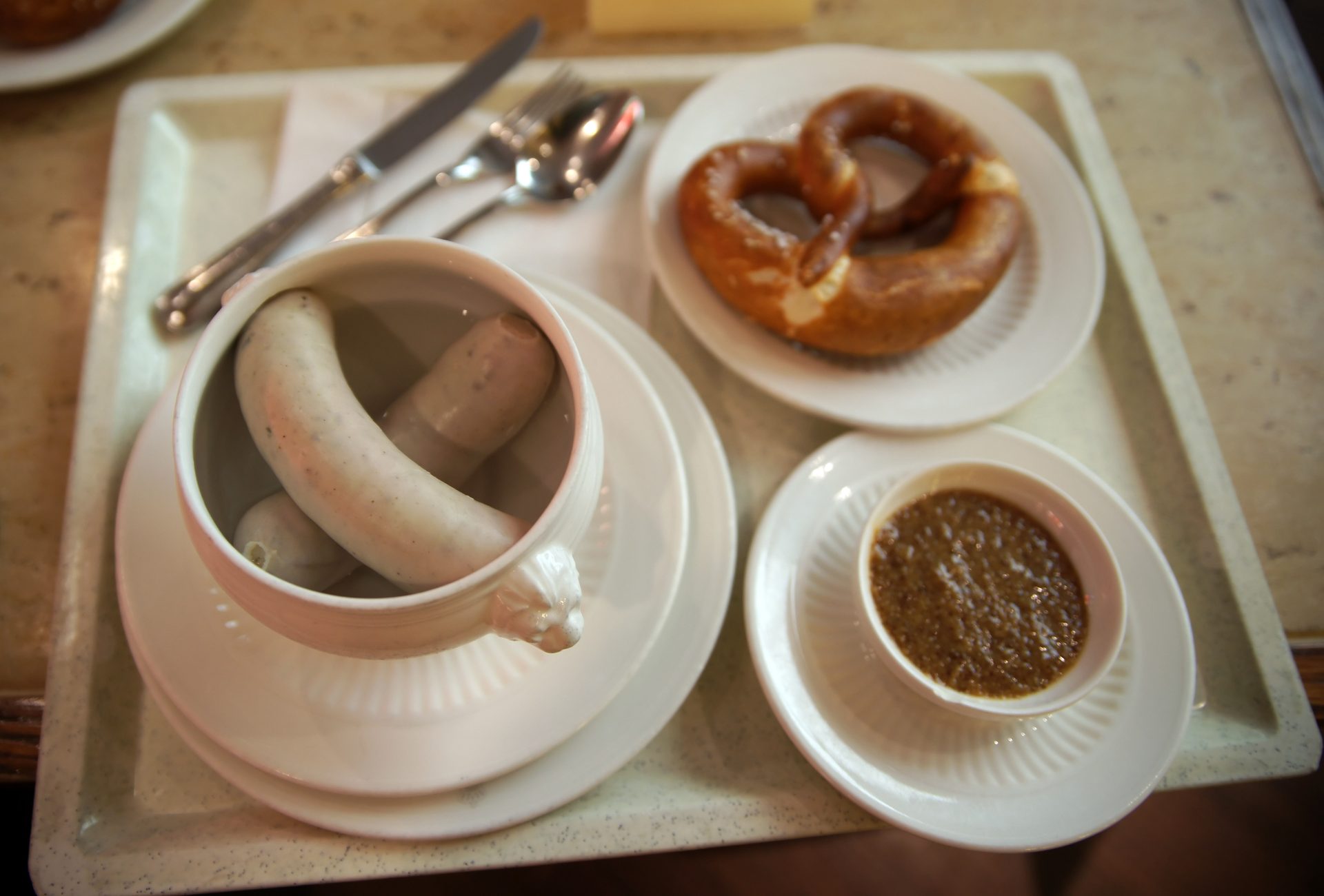
In Munich, breakfast has a deadline. Locals say the sausage must never hear the church bells strike noon, and that one rule shapes everything about how a traditional Bavarian breakfast comes together. Four items anchor the meal, and each one carries its own history, its own etiquette, and its own reason for showing up on the table before lunch.
This spread, known locally as the Weisswurstfrühstück, is less a meal than a social ritual tied to a specific window of the morning. Below is a look at the four components that make it recognizable anywhere in the world: the sausage, the beer, the pretzel, and the mustard.
| Component | Role in the Meal | Typical Pairing Notes |
|---|---|---|
| Weisswurst | The centerpiece sausage | Eaten before noon, peeled rather than bitten |
| Weissbier | The traditional drink | Unfiltered wheat beer, served in a tall glass |
| Pretzel | The bread component | Torn by hand, no butter needed |
| Sweet mustard | The only accepted condiment | Coarse, mild, and distinctly sweet |
1. Weisswurst
Weisswurst is a traditional Bavarian sausage
Wikipedia’s entry on Weißwurst notes that Weisswurst is
Weisswurst gets its name from what it leaves out rather than what it contains. The sausage is
According to Wikipedia’s entry on the dish, Weisswurst is a traditional Bavarian sausage made from minced veal and pork fatback , typically seasoned with parsley, lemon, mace, and other mild spices rather than smoke or paprika. That pale, un-smoked look is where the “white sausage” name comes from. Most culinary histories trace the sausage to Munich on February 22, 1857, when butchers working with leftover veal trimmings created what was originally called “Fleischwurst” before the name shifted to reflect its color.
The timing rule around Weisswurst is not a modern marketing gimmick. An old Bavarian saying holds that “no Weisswurst should ever hear the afternoon church bells” , and the reason is practical rather than superstitious. Before refrigeration was reliable, sausages made from fresh veal in the early morning had to be sold and eaten before the afternoon heat turned them, so the noon cutoff became a public health habit that outlived the technology that made it necessary.
Eating the sausage correctly matters almost as much as eating it on time. The traditional method, called zuzeln, involves sucking the meat out of the casing rather than biting into it directly , though most restaurants today slice the sausage lengthwise and let diners peel the skin away with a fork. Either approach keeps the delicate veal filling intact instead of squeezing it out through a bitten end.
Pro Tip: If a restaurant serves Weisswurst after 1 p.m., treat it as a tourist-menu item rather than an authentic Weisswurstfrühstück. Many traditional Gasthäuser in and around Munich stop serving it once the lunch menu starts.
2. Weissbier
No traditional Bavarian breakfast is complete without a glass of Weissbier, the cloudy, top-fermented wheat beer that Bavaria has guarded for centuries. Known as Hefeweizen outside its home region, Weissbier has a documented history dating back to Bavaria in the 16th century , when it was brewed by a small number of licensed producers tied to the ruling family.
That restriction was not accidental. Bavaria’s Reinheitsgebot, the beer purity law adopted in 1516, limited brewing to barley, water, and hops, which should have excluded wheat beer entirely. Instead, only beer made from barley was allowed to be brewed in Bavaria until 1548, when William IV, Duke of Bavaria, granted Baron Hans VI von Degenberg a special privilege to brew and sell wheat beer . For roughly two centuries, wheat beer stayed a royal monopoly rather than a drink any brewery could produce.
The style nearly disappeared once pale lagers took over German drinking habits in the 19th century. It survived largely because of one brewer: the Schneider brewery was founded in 1872 by Georg Schneider I and his son, after they acquired the Weisses Brauhaus in Munich, the oldest wheat beer brewery in the city . That single business decision is why Weissbier is still poured alongside Weisswurst today instead of being a forgotten historical footnote.
Important Note: Weissbier typically runs 50 to 70 percent wheat malt rather than the barley-heavy recipe used in most German lagers, which is part of why it pours cloudy and carries a slightly fruity, clove-like flavor instead of a crisp, clean one.
3. Pretzel
The pretzel served at a traditional Bavarian breakfast is not the hard, shelf-stable snack found in supermarket bags elsewhere. A Bavarian Brezn is a soft, yeasted roll shaped into its distinctive knot, dipped briefly in a lye solution before baking to give it that glossy brown crust, and finished with coarse salt. The lye bath is what separates it from an ordinary bread roll; without it, the exterior would stay pale and soft instead of developing its characteristic chew and color.
Within the German-speaking world, the pretzel’s place at this particular meal is non-negotiable. A regular German breakfast might include any type of bread roll, but the traditional Bavarian breakfast always includes a Brezel specifically, torn apart by hand rather than sliced and left unbuttered since the sausage and mustard already provide plenty of richness.
Researchers studying regional food customs classify this pairing under the term Frühschoppen, a late-morning tavern tradition. In Lower Bavaria and most of Upper Bavaria, Frühschoppen is understood to be a specific kind of brunch consisting of Weisswurst, sweet mustard, pretzels, and Weissbier , confirming that the pretzel is not an optional side but one of four fixed components recognized in Bavarian food culture.
4. Sweet Mustard
The fourth element, sweet mustard, is the only condiment considered acceptable with Weisswurst. Coarse in texture and noticeably sweeter than the sharp Dijon or English styles found elsewhere, it is designed to soften the mild, delicate flavor of the sausage rather than compete with it. Ketchup or a spicier mustard would be seen as a mismatch at a proper Weisswurstfrühstück table.
The style traces back further than most diners realize. While the iconic brand today is Händlmaier, the sweet mustard style itself was popularized by Johann Conrad Develey in 1854 , just a few years before Weisswurst itself is said to have appeared on Munich tables. That timing is not a coincidence. The two were developed in the same culinary moment and have been served together for so long that most Bavarians would consider any other mustard a departure from tradition.
Pro Tip: A small spoonful goes further than it looks. Sweet mustard is meant to be dabbed onto each bite rather than spread across the whole sausage the way yellow mustard is used on a hot dog.
Taken together, these four items explain why a traditional Bavarian breakfast reads so differently from breakfast customs elsewhere. It is worth comparing against other regional breakfast traditions around the world, from a traditional Japanese breakfast built around rice and fish to a traditional French approach that favors pastry and coffee. Few other regional spreads tie themselves this tightly to a single clock-based rule.
Bavaria’s food culture extends well past breakfast, of course. Dishes like Eintopf show the same hearty, unfussy character later in the day, and the traditional German clothing worn at festivals where Weisswurst is served adds another layer to the region’s identity. Whether encountered at a Munich beer garden or recreated at home, the combination of sausage, wheat beer, pretzel, and sweet mustard remains one of the clearest windows into how Bavarians actually eat.