Traditional Zulu Clothing: 16 Garments and Their Cultural Meaning

November 20, 2026
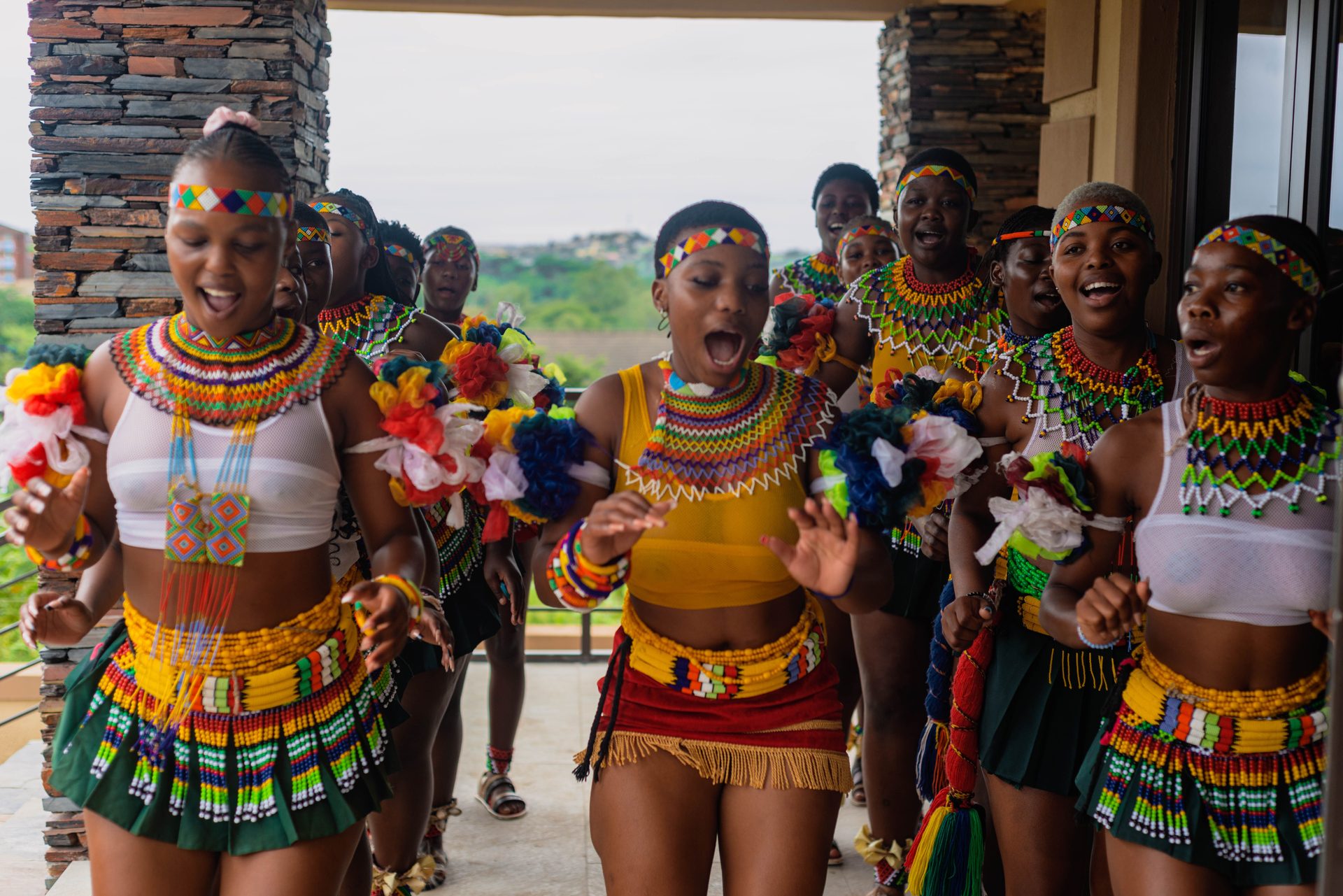
Long before a Zulu man or woman speaks a word, their clothing has already told a story. A hide apron, a beaded belt, or the height of a woven hat can announce whether someone is married, mourning, ready for courtship, or descended from royalty. Traditional Zulu clothing works less like fashion and more like a visual language, built from animal hide, grass fiber, and glass beads passed down through generations.
This guide walks through sixteen garments and accessories that make up that language, from the towering isicholo headdress worn by married women to the umqhele fur headband once reserved for warriors. Each piece carries its own history, construction method, and social rule about who may wear it and when.
| Garment | Worn By | Primary Role |
|---|---|---|
| Isicholo | Married women | Status headdress |
| Isidwaba | Married/betrothed women | Leather skirt |
| Ibheshu | Men | Rear hide apron |
| Umqhele | Men (historically soldiers/elites) | Fur headband |
| Isicoco | Married men | Head-ring |
1. Isicholo
The isicholo is the wide, often flat-topped hat traditionally worn by married Zulu women. Women who had a traditional Zulu wedding may wear a special wide hat called “isicholo” as a status symbol. Historically it was shaped by weaving a woman’s own hair with fiber and grass, though many versions today use cloth or cotton.
It symbolises a woman’s marital status and is made from a variety of materials, including cloth and hair. Historically, the Isicholo was a large structure, but over time it has evolved into a smaller, more convenient size. Some sources describe the hat as measuring close to a metre across in its older forms, built wide enough to shade the wearer from the sun.
Pro Tip: If you see an isicholo at a wedding or Reed Dance ceremony, its size often hints at the region and era of the style rather than the wearer’s personal rank alone.
The isicholo pairs naturally with other everyday clothing and styling traditions that mark important life transitions across cultures, though few headpieces carry quite as much social weight as this one does within Zulu communities.
2. Isidwaba
The isidwaba is the leather skirt at the center of a married Zulu woman’s wardrobe. The isidwaba, a traditional Zulu leather skirt worn by married women, is made from the hide of animals that belonged to the woman’s father. The isidwaba, which is also known as isikhakha, is a traditional Zulu leather skirt worn by a betrothed and married woman, made of cowhide or goatskin.
The predominant dyed colour of the isidwaba is black, achieved through softening and treating the hide until it drapes like fabric. The skirt must fit precisely enough that a woman stays fully covered even while performing traditional dance movements.
Because the garment is tied to major life stages, questions about adjusting fit and comfort naturally arise around pregnancy and body changes, a topic covered in general terms in resources on clothing choices during pregnancy. Within Zulu tradition, the isidwaba remains a lifelong garment rather than a one-time ceremonial piece.
3. Ibhayi
The ibhayi is a cloak or shawl draped over the shoulders, and its meaning has less to do with warmth than with respect. “Ibhayi” is the cloak or shawl worn around the shoulders as a sign of respect to the in-laws. A new bride typically wears one when visiting her husband’s family for the first time.
Married women are usually covered with shawls, known as Ibhayi. The garment often appears during family ceremonies and celebrations, the kind of gatherings where traditional South African food is shared alongside traditional dress as part of the same cultural occasion.
4. Izincu
Izincu are the twisted strings of beads that mark out unmarried girls and young women within the Zulu beadwork tradition. Unmarried girls’ clothing include long strips of twisted beads called “izincu” around their ankles, elbows and waists.
- Ankles — worn as decorative bands during dance and ceremony
- Elbows and wrists — signal age and courtship readiness
- Waist — often paired with a short beaded skirt
An unmarried girl is often bare-chested and wears a short, beaded skirt, colourful beads around her head and waist, as well as twisted beads known as izincu around her ankles and wrists, according to a South African government heritage feature . The colors chosen for izincu often carry their own coded meanings within a given community or family.
5. Isigcebhezana
The isigcebhezana belongs to the same family of waist and hip accessories that accompany the isidwaba ensemble, sitting alongside pieces like the isifociya and isibamba. Documentation on this specific item is limited in English-language sources compared to better-known garments such as the isicholo or ibheshu.
Within the broader logic of Zulu women’s dress, smaller accessories like this one typically serve a dual purpose: holding the main garment in place and adding a layer of beaded or hide decoration. As with much of Zulu material culture, exact construction and styling can vary by region and family tradition.
6. Isibamba
Isibamba refers to a fastening or gripping accessory used within the women’s skirt ensemble, functioning alongside the isifociya belt to help secure the isidwaba in place. The name draws from the Zulu verb for holding or grasping, which fits its practical role in keeping a heavy hide skirt positioned correctly.
Important Note: Smaller accessory terms like isigcebhezana and isibamba are not extensively documented in English-language ethnographic sources, so descriptions here reflect their general function within the broader isidwaba ensemble rather than precise historical specifications.
7. Isifociya
The isifociya is a practical belt with an essential job: holding the isidwaba firmly around the waist. The grass made belt, called isifociya, is tied around the waist to keep the isidwaba in position. Without it, the heavy hide skirt would shift during the vigorous footwork of traditional dance.
Made from woven grass fiber, the isifociya sits beneath the visible layers of the outfit, doing structural work rather than decorative work. It reflects a broader pattern in Zulu dress where function and status are built into even the least visible layers of an outfit.
8. Impempe
Unlike the isifociya, the impempe belt leans toward decoration rather than structure. Another belt called an impempe is left on the side to hang as decoration. It adds visual movement to the hip area of the isidwaba outfit, swinging slightly as the wearer moves.
The impempe demonstrates how even small, easily overlooked pieces of Zulu clothing carry a specific intended effect, in this case a flourish of motion rather than a marker of rank.
9. Itete
The itete is a tube-like undergarment worn beneath the isidwaba, and it solves a practical problem that hide alone cannot. The uncoloured isidwaba is worn over a lace garment that is tube-like called itete, which also extends to cover the isidwaba on top, used for protection and hygienic purposes.
According to the Wikipedia entry on the isidwaba , this layering system shows that Zulu women’s dress was engineered with comfort and hygiene in mind long before any beadwork or dye was added. The itete sits closest to the body, with the leather skirt layered on top.
10. Isinene
The isinene is the front apron worn by Zulu men to cover the genitals, paired with the ibheshu at the back. A front apron (isinene) and a rear apron (ibheshu) are worn to cover the genitals and buttocks. According to the Culture Trip’s overview of South African dress , men also traditionally wear tufts of cow tail called amashoba on the upper arms and below the knees to build a more imposing silhouette.
One supplier describes the construction directly: the front known as isinene is the front apron, consisting of long rolled rope-like hide strings sewn closely together to add weight and cover the male genitals. The weight and density of these hide strings is part of the design, not an accident.
11. Ibheshu
The ibheshu is the rear apron that completes a man’s traditional outfit, and the type of hide used says a great deal about who is wearing it. The ibheshu is a traditional leather apron worn by Zulu men, typically around the waist, crafted from cowhide and often signifying manhood and readiness for marriage.
Its length and the type of hide used often indicate the wearer’s status. Warriors, for instance, might wear ibheshu made from cattle hide, while chiefs would sport the prestigious leopard skin. One artisan supplier notes that around the neck is the top apron bib that, traditionally, is made from various animal hide depending on rank, with chiefs using leopard hide, though modern wearers often substitute springbok or impala hides dyed to resemble leopard or cheetah markings, a shift tied partly to leopard conservation concerns noted by craft sellers .
| Hide Type | Traditional Wearer |
|---|---|
| Leopard skin | Chiefs and royalty |
| Cattle hide | Warriors |
| Springbok or impala | Modern general wear |
This hide hierarchy is not unlike how rank is visually encoded in some forms of traditional Australian clothing, where material and ornamentation signal community role rather than personal wealth alone.
12. Umutsha
The umutsha is the front covering worn by married Zulu men, distinct from the smaller version worn by boys. The front coverings for married men is called “umutsha” and differs from those worn by boys, which are smaller and called “iqoyi”.
One wedding-focused source describes it plainly: men wear hide aprons around their waists, including the umutsha, a beaded waist belt. The garment functions as a visible marker that a man has crossed into married adulthood, much as other cultures use specific accessories, including pieces found in traditional American clothing, to mark comparable life transitions.
13. Umqhele
The umqhele is a circular fur headband historically tied to military rank and elite status among Zulu men. An umqhele is a traditional Zulu circular headband made of fur. Imiqhele were worn by Zulu men prior to colonization of South Africa, especially by soldiers and elites.
The garment has not disappeared from modern Zulu life. Imiqhele are worn by male members of the Nazareth Baptist Church, according to the Wikipedia entry on the umqhele , showing how a pre-colonial military accessory found continued relevance within a modern religious community.
Headbands carry comparable rank significance in other dress systems too, from certain ceremonial pieces in traditional Japanese clothing to formal headwear traditions elsewhere in the world.
14. Isicoco
The isicoco is the head-ring worn by married Zulu men, functioning as the male equivalent of the isicholo worn by married women. The isiCoco head-ring worn by married Zulu men is symbolic of ultimate wisdom, and the equivalent traditional attire for married women is the isiCholo.
Key Insight: The isicholo and isicoco form a matched pair in Zulu dress, each marking marriage for its respective gender, which shows how deliberately the clothing system was built around life-stage signaling rather than decoration alone.
According to Wikimedia Commons’ record of the isiCoco , historical photographs from the late 1800s and early 1900s document Zulu chiefs and headmen wearing the ring as part of formal portraiture, underlining its long-standing role as a marker of maturity and standing. Age-marking headwear of this kind has parallels in other dress systems, including certain pieces within traditional Chinese clothing that signal similar life transitions.
15. Imbhata
The imbhata is a circular cowhide ornament worn around a man’s neck, and its history is tied directly to combat. “Imbhata” is a circular cowhide skin worn around a man’s neck. It used to be worn only by men who had killed another in battle.
According to the same government cultural feature , this garment sat alongside other battle regalia, including arm and ankle bands made of animal hide and a shield called ihawu. Together, these pieces formed a visible record of a warrior’s history rather than simple decoration.
16. Iziqu
Iziqu are traditionally understood as necklaces or ornaments awarded for distinguished conduct, most closely associated with bravery and achievement within Zulu social and military life. The concept of marking individual accomplishment through a wearable token runs through much of Zulu dress, echoing the honor system built into pieces like the imbhata and the isicoco.
Interestingly, the term has carried forward into modern isiZulu in a different context, where “iziqu” is commonly used to describe an academic degree or graduation, a linguistic extension of the older idea that a visible token should mark a significant personal achievement. The thread connecting both uses is the same: recognition made visible.
Taken together, these sixteen garments show that traditional Zulu clothing was never just about covering the body. Every hide apron, bead strand, and woven hat carried information about age, marital status, rank, or personal history that a community could read at a glance, a quality shared by many heritage dress systems around the world, including those documented in guides to traditional Indian clothing and traditional German clothing. Even as modern fabrics and faster closures replace some older materials, the underlying logic of Zulu dress, that clothing should say something true about the wearer, remains very much alive at weddings, the Reed Dance, and cultural ceremonies across South Africa today.