Traditional Bulgarian Clothing: 13 Garments and Regional Costumes Explained

November 19, 2026
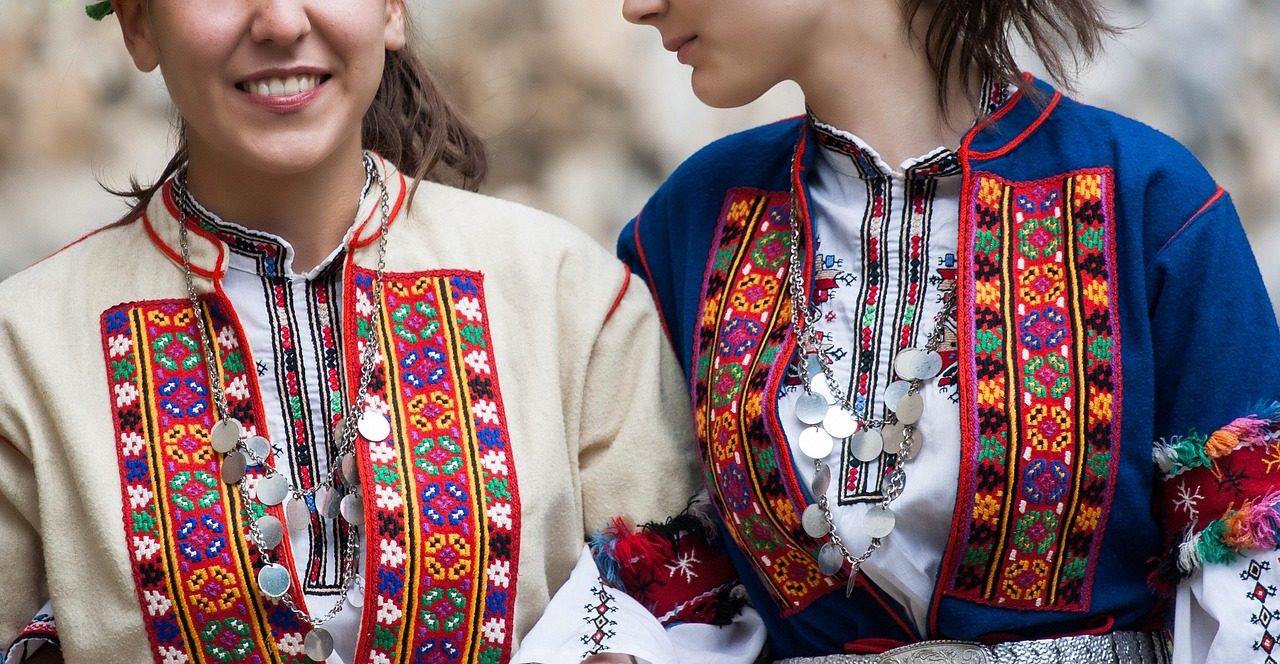
Traditional Bulgarian clothing was never just decoration. A woman’s apron pattern could announce her village, her marital status, and her family’s standing, all stitched into cloth passed down through generations. Bulgarians call this inherited wardrobe носия (nosiya), and Wikipedia’s entry on the Bulgarian national garb notes that it conveys information about the person wearing it via embroidery of diverse symbols, with Bulgarians themselves calling it ‘носия’ (nosiya).
No two regions dressed quite the same way. From the sleeveless sukman worn across the central lowlands to the open-fronted saya favored in the southwest, each garment and each regional costume tells a slightly different story about who wore it and why. This guide walks through the core pieces of Bulgarian folk dress, piece by piece, before moving region by region through the country’s best-known regional costumes.
1. Saya
The saya is an open-fronted outer garment worn over a chemise, and it ranks among the three main types of Bulgarian women’s folk dress alongside the sukman and the double-apron costume. According to Nationalclothing.org’s overview of Bulgarian folk dress , saya is another variant of the main women’s garment in Bulgaria, made from woolen, cotton, or linen fabric, long or knee-length with a round neckline and various sleeve lengths, with sides that are often slit, dyed in a single color or striped, and worn over the chemise with a front apron on top of it.
Two broad designs dominate: a plain, knee- or calf-length version with short sleeves, and a longer striped version with long sleeves, often reserved for colder months or more formal occasions. Wealthier families added braid edging and metallic thread around the neckline and cuffs, turning an everyday tunic into a festival piece. This pattern of regional dress built around a single signature garment is not unique to Bulgaria; traditional German clothing shows a similar logic, with distinct regional dress forms carrying their own names and cuts.
2. Soukman
The soukman was the single most common women’s garment in Bulgaria, and the National Ethnographic Museum’s costume overview describes it directly: the soukman dress was the most widely spread female costume. It is a tunic-like, low-necked dress, usually sleeveless, worn over a chemise and closed in front or pulled on over the head depending on the region.
Scholars generally group soukman dresses into three main regional varieties:
- Kasoklinest – cut with low, slanted wedges, typical of Western Bulgaria
- Visokoklinest – cut with high wedges, more common in Central Bulgaria
- Two-piece soukman – paired with a short jacket called a chapak and a long waist-band, found in parts of Eastern Bulgaria
Whichever variety was worn, the soukman dress is worn with a short, woven belt fastened in front with pafti (belt buckle), and the dark fabric made an ideal backdrop for colorful embroidery along the hem and sleeves. Readers interested in how a single garment type can dominate an entire national wardrobe might also compare notes with traditional Chinese clothing, where regional ethnic dress follows a similarly layered logic.
3. Chernodreshnik
Men’s traditional dress in Bulgaria splits into two broad categories defined by color rather than region. As the Eliznik pages on Bulgarian men’s clothing explain, Bulgarian men’s folk costume can be divided into two main types according to the colour of the trousers and outer garments: belodreshnik or “white dress,” and chernodreshnik, literally meaning “black dress,” but in practice this is more often brown or blue.
Chernodreshnik was the newer of the two styles, and it spread quickly during the 19th century. The chernodreshnik costume spread across Bulgaria from east to west during the National Revival period, with its spread being speeded up by the desire of men to look like townsfolk, as part of the unification process which took place in Bulgarian culture at this time. Wide trousers known as poturi, dark wool fabric, and dense cord braiding called gaitani became the style’s signature features, often paired with a sheepskin kalpak hat and a brightly colored woven sash.
Men’s folk dress built around two competing color traditions appears elsewhere too; traditional Pakistani clothing similarly shows how regional and historical shifts reshape men’s garment styles over generations.
Pro Tip: If you see a Bulgarian male folk costume with narrow trousers and pale, undyed wool, you are likely looking at belodreshnik. Wide, dark, heavily braided trousers point to chernodreshnik instead.
4. Belodreshnik
Belodreshnik is the older of the two men’s dress traditions and is generally considered Slavic in origin. The same Eliznik overview notes that belodreshnik was the older form of dress, considered to have Slavic origins, made from thick white homespun woollen cloth called aba, and originally worn throughout Bulgaria before being replaced by chernodreshnik in central, south, and north east Bulgaria during the 19th century.
Despite losing ground elsewhere, belodreshnik persisted longest in the country’s western and northwestern corners, where narrow trousers and vests trimmed with subtle red or black braid remained standard dress well into the early 20th century. Both belodreshnik and chernodreshnik were worn with the same supporting pieces: a white shirt, a wide sash, a lambskin hat, and leather sandals, which gave Bulgarian men’s dress a shared foundation even as the outer garments diverged. The persistence of an older, simpler style alongside a newer, more elaborate one is a pattern also visible in traditional American clothing, where homespun frontier garments coexisted for decades with more fashionable imported styles.
5. Zabun
The zabun is a sleeveless outer vest or jerkin worn over the chemise or shirt, and it appears in regional variations across the Balkans, Bulgaria included. Typically cut from wool, velvet, or felted cloth, the zabun was decorated according to the wearer’s means: simple braid trim for everyday versions, and dense metallic embroidery, coins, or appliqué for festival pieces.
Because it layered easily over a chemise or shirt without restricting arm movement, the zabun worked equally well for fieldwork and formal occasions, with the decoration level signaling which was which. Women’s versions tended to follow the fitted, waist-length cut common to the surrounding regional costume, while men’s zabuns were often looser and worn beneath a heavier coat in colder months. This kind of practical, layerable vest shows up in folk dress well beyond the Balkans; traditional Japanese clothing uses a comparable logic in garments like the haori, layered over a kimono for both warmth and visual effect.
6. Riza
Every Bulgarian woman’s costume, whatever the regional style, started with the riza, a long linen or hemp chemise worn as the base layer. As KnowBulgaria’s guide to Bulgarian folk costumes summarizes, women typically wear a long white linen chemise (riza) richly embroidered, with a pinafore-dress (sukman) or a tunic (saya) over it, a woven apron (prestilka), a belt and head covering, and plenty of jewellery.
Because the riza was visible mainly at the neckline, cuffs, and hem once the sukman or saya went over it, embroidery concentrated in those spots, often in red, black, or indigo thread worked into geometric or floral motifs. Simpler rizas were worn for daily chores, while heavily embroidered versions came out for weddings and major holidays. For readers comparing how different cultures treat the humble undergarment as a canvas for craft, the general clothing and style traditions covered elsewhere on this site offer useful points of comparison.
7. Prestilka
The prestilka, or apron, was far more than a practical cover for the dress underneath; it was often the single most decorated piece of the entire outfit. The National Ethnographic Museum’s costume survey puts it plainly: the apron is the central decorative piece of the soukman dress, richly ornamented and colourful, standing out in beautiful contrast with the black soukman.
Patterns and colors varied sharply by region, which made the prestilka one of the fastest ways to identify where a woman was from just by looking at her. Common materials included hand-woven wool in red, orange, or striped patterns, finished with fringe or tassels along the bottom edge. Some regions favored a single front apron, while others wore a matching double-apron set, one in front and one behind, an arrangement that distinguished entire regional costume traditions from one another. A comparable emphasis on apron-style garments as a symbol of regional identity also appears in traditional Indian clothing, where draped and wrapped pieces similarly vary village by village.
Key Insight: A Bulgarian woman’s apron pattern functioned almost like a regional ID card. Specific colors, stripe widths, and embroidery motifs could identify her home village to anyone familiar with local costume traditions.
8. Shopluk Costume
Before looking at each regional costume individually, it helps to see how they compare side by side. The table below highlights the garment or detail that most clearly distinguishes six of Bulgaria’s best-known regional costumes.
| Regional Costume | General Area | Defining Feature |
|---|---|---|
| Shopluk costume | Sofia and surrounding western lowlands | Black sukman called a litak, trimmed with gold or red piping |
| Pirin costume | Southwestern mountains near Macedonia | Saya tunic over a long riza with heavy embroidery |
| Dobrudzha costume | Northeastern plains near the Black Sea | White linen base with a double-apron arrangement |
| Thracian costume | Central lowlands around Plovdiv | Black sukman with a bright apron and red embroidery |
| Strandzha costume | Southeastern forested hills | Dark sukman paired with a brightly woven apron |
| Rhodope costume | Southern mountain range | Dark woolen pinafore worn over a white dress, with wide woven belts |
Starting with the Shopluk costume itself: this is the folk dress of the Sofia region and its surrounding villages, and it stands out for one distinctive piece. According to Outfiten’s guide to Bulgarian traditional clothing , women in the Shopska (Sofia) region wear a distinctive black sukman called a litak with gold or red piping, while men wear the white-garment style.
That combination of a dark, close-fitted women’s sukman against men’s lighter belodreshnik dress gives the Shopluk look its particular contrast. Heavy silver jewelry and large, coin-decorated headpieces often finished the women’s outfit for festivals. As with many of Bulgaria’s regional looks, the name itself ties the costume directly to its home territory, a naming pattern also seen in traditional German clothing, where garments like the dirndl are closely tied to specific Alpine regions.
9. Pirin Costume
The Pirin costume comes from the mountainous southwest, close to the border with North Macedonia, and it leans on the saya rather than the sukman as its defining garment. Talkpal’s vocabulary guide to Bulgarian garments notes that the saya is especially characteristic of the traditional costumes in the Pirin region, where it is typically made from wool and finished with weaving, embroidery, or sequins.
Layered over a long riza and paired with heavy metallic jewelry, the Pirin costume carries a noticeably different visual weight than the dark, close-fitted sukman costumes found farther east. The embroidery style also reflects the region’s proximity to North Macedonia, blending Bulgarian motifs with patterns more common across the wider southwestern Balkans. Aprons here tend to run narrower than in the Shopluk region, letting more of the saya’s own decoration show through.
10. Dobrudzha Costume
Dobrudzha sits in Bulgaria’s far northeast, a flat agricultural plain bordering the Black Sea, and its folk costume reflects a different set of regional roots than the mountain costumes further south. The Eliznik overview of Bulgarian traditional clothing notes that the double apron and belodreshnik (white men’s) costume were displaced from the foothills of the Stara Planina and parts of north east Bulgaria as fashions shifted over the 19th and early 20th centuries, which places the double-apron tradition squarely in this part of the country historically.
Where the double-apron costume survived, it paired a white linen chemise with two woven aprons, one worn front and one back, both decorated with bold geometric motifs in red and black thread. This northern plains look stands in clear contrast to the dark, fitted sukman dresses that dominate further south, giving Dobrudzha one of the lighter, more linen-forward silhouettes among Bulgaria’s regional costumes.
Important Note: Bulgarian ethnographic sources sometimes use slightly different spellings for the same garments, such as “sukman” versus “soukman” or “chernodreshno” versus “chernodreshnik.” These reflect transliteration choices rather than different garments.
11. Thracian Costume
The Thracian costume comes from the lowlands around Plovdiv and Stara Zagora, one of the regions where the sukman remained dominant even as other parts of Bulgaria shifted toward the saya. FolkCostume & Embroidery’s overview of Bulgarian Thrace explains that for the most part, the women’s costume of Thrace is that of the sukman, a black wool outer garment which pulls over the head, as seen in groups from around Elkhovo.
Festive versions of the Thracian sukman carried floral motifs worked in gold thread, paired with a vividly colored apron that broke up the dark background of the dress. Men’s Thracian dress followed the broader shift toward chernodreshnik during the National Revival period, with dark wool trousers and heavy braid detailing. Pockets of the southern Plovdiv and Stara Zagora provinces favored the open-fronted saya instead, showing that even within Thrace the line between sukman territory and saya territory was not absolute.
12. Strandzha Costume
Strandzha, the forested hill country in Bulgaria’s southeastern corner near the Turkish border, produced one of the country’s more visually striking regional looks. Women’s dress here centered on a dark, close-fitted sukman offset by an apron woven in bright, saturated colors, a combination that stood out against the region’s otherwise muted, practical wardrobe.
The isolation of the Strandzha hills helped preserve older weaving and dyeing techniques longer than in more accessible lowland areas, and the region’s apron patterns often ran brighter and more varied than those seen farther north. Headwear in Strandzha also diverged slightly from neighboring Thrace, with distinct scarf-tying methods marking married versus unmarried women. Readers curious about how geographic isolation shapes folk dress elsewhere might find a useful parallel in traditional Japanese clothing, where mountainous and island regions similarly developed distinct local variations.
13. Rhodope Costume
The Rhodope Mountains in southern Bulgaria produced one of the country’s most practical regional costumes, shaped directly by the demands of shepherding and mountain terrain. Outfiten’s guide to Bulgarian traditional clothing describes the sukman costume here as characteristic of southern mountain regions like the Rhodopes and Pirin, a sleeveless dark woolen pinafore worn over a white dress, designed for the practical needs of mountain shepherding.
Belts in the Rhodope costume also stand out by comparison with the rest of the country. The Eliznik pages on Bulgarian belts note that belts worn with saya in western Bulgaria were around 6 cm wide whereas in the Rhodopes wider belts up to 15cm wide were worn. That extra width, combined with heavy wool fabric suited to cold mountain winters, gives the Rhodope costume a noticeably sturdier, more weather-ready silhouette than the lighter saya costumes found in the lowlands. Pomak communities within the Rhodopes add their own distinct embroidery traditions on top of this base, further diversifying the region’s folk dress.
Taken together, these garments and regional costumes show that traditional Bulgarian clothing was never a single uniform look but a patchwork of local answers to climate, terrain, and custom. The saya, sukman, zabun, and riza supplied the shared building blocks, while regional details, from the Shopluk litak to the Rhodope’s wide woven belt, let every village stitch its own identity into the finished outfit. Readers interested in how other nations built similarly layered, regionally distinct wardrobes can continue exploring folk dress traditions through the clothing and style collection featured elsewhere on this site, or compare notes with traditional Indian clothing for another example of regional variation built around a shared set of core garments.