



Most people picture Kentucky and immediately think of two things: horse racing and bourbon. Both are absolutely worth your time, but they’re just the opening act. This state stretches from the rolling bluegrass pastures of the central plateau all the way east into rugged Appalachian terrain, packing more variety into a single road trip than travelers often expect.
You can spend a morning underground in the world’s longest cave system, an afternoon watching thoroughbreds train on a legendary track, and an evening sipping small-batch whiskey at a working distillery — all within the same 24 hours.
Whether you’re chasing outdoor adventure, diving into American history, or simply looking for your next great road trip destination, Kentucky delivers on every front. These 34 tourist attractions in Kentucky make a compelling case that the Bluegrass State deserves far more credit than it typically gets.
1. Mammoth Cave National Park
No list of tourist attractions in Kentucky would be complete without starting here. Mammoth Cave National Park is home to the longest known cave system in the world, with more than 426 miles of surveyed passageways — and geologists believe the true extent could be far greater. The cave system began forming roughly 330 million years ago in thick limestone strata, and humans have been exploring it for at least 5,000 years. Native Americans mined its upper levels for gypsum and other minerals long before European settlers arrived.
Key Insight: The park earned a UNESCO World Heritage designation in 1981 and was later recognized as an International Biosphere Reserve in 1990, underscoring its global significance.
The park offers a range of guided cave tours to suit different comfort levels, from leisurely lit routes featuring iconic formations like Frozen Niagara and the Mammoth Dome — nearly as tall as a 20-story building — to wild, lantern-lit crawls through unmapped passages. The Kentucky cave shrimp (Palaemonias ganteri), a federally endangered and fully cave-adapted freshwater crustacean, lives only in the immediate vicinity of the park. Aboveground, more than 100 miles of trails, waterways, and campgrounds give you plenty to explore once you’ve come back up for air. Reserve cave tour tickets in advance, especially in summer, as popular tours sell out quickly.
2. Churchill Downs (Kentucky Derby)
Churchill Downs in Louisville has been hosting the Kentucky Derby on the first Saturday of May every year since 1875, making it America’s longest-running major sporting event. The race itself lasts barely two minutes, but the spectacle surrounding it — the elaborate hats, the mint juleps, the pageantry, the roar of the crowd — lingers for a lifetime.
| Experience | Details |
|---|---|
| General Admission | Available on most racing days |
| Kentucky Derby tickets | Sold as two-day packages; prices range from several hundred to thousands of dollars |
| Racing Season | Spring (early May to early July) and Fall (late September to late November) |
| Off-season visits | Grounds and Kentucky Derby Museum open year-round |
Even outside Derby week, a visit to Churchill Downs gives you a genuine feel for what makes this track so legendary. You can walk the grounds, visit the Kentucky Derby Museum on-site, and take in the sweeping grandstand views that have framed iconic moments in thoroughbred history for 150 years. For budget-conscious visitors, general admission on regular race days is quite affordable and still puts you right in the middle of the action.
3. Louisville Slugger Museum & Factory
One of Louisville’s most iconic attractions lends itself away immediately: a 120-foot steel baseball bat leans against the building’s exterior on West Main Street, making it nearly impossible to miss. The Louisville Slugger Museum & Factory tells the story of the bat that has been swung by legends of the game for over a century, from Babe Ruth to Derek Jeter.
Tours run throughout the day and take you onto the actual factory floor, where you watch raw billets of wood transform into finished bats through the full production process — chiseling, sanding, staining, branding, and all. You’ll hold game-used bats belonging to baseball’s all-time greats, step into a batting cage, and walk away with a souvenir mini bat included in your admission. The museum also offers sensory-friendly tours designed for visitors on the autism spectrum, with machinery powered down for a quieter, more relaxed experience.
Pro Tip: Visit the Barrels & Billets Bourbon Experience co-located within the museum complex for a uniquely Louisville double-feature — baseball history and bourbon craftsmanship in the same building.
4. Muhammad Ali Center
Louisville is also the birthplace of Muhammad Ali, and the Muhammad Ali Center pays tribute to a man who transcended sport to become a global icon for justice, courage, and humanitarian values. The center is far more than a sports museum. Its exhibits weave together Ali’s athletic career with his deeply held convictions — his refusal to be drafted during the Vietnam War, his advocacy for racial equality, and his post-boxing humanitarian work around the world.
A large window on the upper level overlooks the Ohio River and the bridge from which, according to local legend, Ali threw his Olympic gold medal in protest after being denied service at a Louisville restaurant because of his race. The center’s interactive galleries challenge you to consider your own core values alongside Ali’s, making it one of the most thought-provoking stops on any Kentucky trip.
5. Kentucky Derby Museum
Connected directly to Churchill Downs, the Kentucky Derby Museum is a year-round destination dedicated to the race known as the “most exciting two minutes in sports.” The museum’s centerpiece experience is a 360-degree film presentation that puts you right in the middle of Derby Day — the noise, the crowd, the speed — delivering a visceral sense of what makes the race so compelling.
Beyond the film, the museum covers the Derby’s full history, including in-depth exhibits honoring the Black jockeys who dominated the race’s earliest editions — a part of the story that had long been overlooked but is now rightfully featured. Interactive exhibits let you test your horse-picking intuition, explore the science of thoroughbred training, and even try on a historic jockey silks display. Plan at least 90 minutes here, and consider combining it with a Churchill Downs backstretch breakfast to watch morning workouts up close.
6. Bourbon Trail (Kentucky Bourbon Trail)
Kentucky produces roughly 95 percent of the world’s bourbon supply, and the Kentucky Bourbon Trail is your passport to exploring that extraordinary legacy. The official trail spans dozens of distilleries across the state, ranging from massive operations like Maker’s Mark and Buffalo Trace to intimate craft producers tucked into countryside hollows.
Each distillery offers its own personality. Some are grand historic estates with Chihuly glass installations in their rickhouses. Others put you face-to-face with the master distiller in a small-batch facility. Many allow you to dip your own bottle in signature wax, blend a custom barrel, or take home a hand-labeled souvenir.
Pro Tip: Pick up a Kentucky Bourbon Trail passport at the Frazier History Museum in Louisville — it serves as the official trail welcome center and stamps your passport as you go, adding a satisfying collectible element to your distillery tour itinerary.
A few distilleries worth prioritizing: Woodford Reserve for its beautiful stone distillery set in a creek valley; Heaven Hill for its deep Kentucky heritage; and Buffalo Trace in Frankfort, which has been producing bourbon on the same site continuously since 1787.
7. Keeneland Race Course
If Churchill Downs is Kentucky’s most famous racetrack, Keeneland in Lexington might be its most beloved. Race meets run just two weeks in April and three in October, but the brevity is part of what makes Keeneland so special — it feels like a genuine community event rather than a commercial spectacle.
The limestone grandstand, built in 1936, gives Keeneland its old-world character, and the surrounding horse farm landscape makes the setting feel unlike any other track in the country. General admission is accessible and family-friendly, and the infield becomes a lively social gathering during race days. Even off-season, you can visit for morning training workouts, where the track is open to spectators as horses and riders work through their paces in the cool morning mist.
8. Abraham Lincoln Birthplace National Historical Park
Kentucky’s most famous native son was born in a one-room log cabin on Sinking Spring Farm in Hodgenville, and the Abraham Lincoln Birthplace National Historical Park preserves that origin story with fitting reverence. A neoclassical memorial building, modeled on Lincoln’s character and the era’s architectural ideals, houses a symbolic symbolic cabin on the original birthplace site.
The park sits about 60 miles south of Louisville and makes for an easy day trip or a meaningful stop on a wider Kentucky road trip. A second unit of the park, Knob Creek Farm about 10 miles away, preserves the site where Lincoln spent his early childhood years and first encountered the physical labor that shaped his worldview. The grounds are peaceful, well-maintained, and surprisingly moving — there’s something profound about standing at the literal starting point of one of history’s most consequential lives.
9. My Old Kentucky Home State Park
In Bardstown — widely regarded as the Bourbon Capital of the World — Federal Hill mansion inspired Stephen Foster to write what became Kentucky’s state song. My Old Kentucky Home State Park preserves the Federal Hill estate and offers guided tours of the antebellum house, with costumed interpreters bringing the mid-1800s setting to life.
Bardstown makes the visit even richer, since it pairs naturally with the nearby Bardstown Bourbon Company, Heaven Hill’s Bourbon Heritage Center, and the Oscar Getz Museum of Whiskey History — all within a few miles of each other. Each summer, the Stephen Foster Story outdoor drama plays on the grounds at the park’s amphitheater, one of the longest-running outdoor dramas in American history. If you’re building a bourbon-and-history route through central Kentucky, this is one of your anchor stops.
10. Cumberland Falls State Resort Park
Called the “Niagara of the South,” Cumberland Falls in Whitley County produces one of the few places on Earth where you can witness a moonbow — a rainbow formed in the mist of a waterfall by the light of a full moon. This rare natural phenomenon makes Cumberland Falls a legitimate bucket-list item and draws visitors from around the world on full-moon evenings throughout the year.
The falls themselves drop 68 feet across a 125-foot width of the Cumberland River, creating a thunderous natural spectacle that’s impressive at any time of day. The surrounding state resort park offers hiking trails, horseback riding, whitewater rafting on the river below the falls, and a comfortable lodge if you want to time your visit around a moonbow evening. Check the Kentucky State Parks website for the moonbow calendar before you book your trip.
11. Natural Bridge State Resort Park
One of Kentucky’s four original state parks, Natural Bridge State Resort Park sits adjacent to the Red River Gorge in Powell County and centers on a natural sandstone arch that spans 78 feet and stands 65 feet high. Wind and rain sculpted this arch over millions of years, and today it’s one of the most recognized natural landmarks in the state.
You can reach the arch by a half-mile hiking trail from the trailhead, or ride the Sky Lift — an 11-minute ride up the steep hillside — if you prefer a more leisurely approach. The park features more than 20 miles of trails in total, ranging from short family-friendly loops to the challenging 7.5-mile Sand Gap Trail. Features like “Fat Man’s Squeeze” and “Lover’s Leap” add a playful character to the landscape that makes exploring here genuinely fun.
12. Red River Gorge
The Red River Gorge Geological Area in eastern Kentucky is one of the premier outdoor destinations in the eastern United States, drawing rock climbers, hikers, and backcountry campers from across the country. The gorge encompasses about 29,000 acres within the Daniel Boone National Forest and contains more than 100 natural sandstone arches — more than anywhere else in the eastern U.S. <br>
Why outdoor adventurers love the Red River Gorge:
- Over 100 natural sandstone arches to discover
- World-class rock climbing routes on high sandstone cliffs
- The 19.4-mile federally protected Wild and Scenic River corridor
- Dozens of hiking trails ranging from easy walks to strenuous multi-day backpacking routes
- Abundant wildlife, waterfalls, and rock shelters with ancient Native American pictographs
The Gladie Cultural-Environmental Learning Center in Slade is your best first stop, offering trail maps and interpretive exhibits on the gorge’s geology and human history. Come in October for fall foliage that rivals anything in New England.
13. Land Between the Lakes National Recreation Area
Straddling the Kentucky-Tennessee border between Lake Barkley and Kentucky Lake, Land Between the Lakes is one of the largest inland peninsulas in the United States — a 170,000-acre stretch of forests, wetlands, and open grasslands that feels genuinely wild even by regional standards.
The recreation area is a haven for wildlife watching. The Elk & Bison Prairie is a 700-acre fenced restoration area where you can drive through and observe American bison and elk at close range — a remarkable sight in the middle of a Kentucky afternoon. The Homeplace Living History Farm recreates 1850s farm life with authentically dressed interpreters tending period-accurate crops and livestock. And the Golden Pond Planetarium and Observatory offers public astronomy programs, one of the region’s hidden gems.
14. Shaker Village of Pleasant Hill
Harrodsburg’s Shaker Village of Pleasant Hill is the largest restored Shaker community in the United States and a National Historic Landmark, preserving 34 original 19th-century buildings on 3,000 acres of rolling farmland. The Shakers who lived here from 1805 to 1910 built everything to exacting standards of function and beauty — their furniture, architecture, and craftsmanship remain influential to this day.
Key Insight: The twin spiral staircases in the Centre Family Dwelling are an architectural marvel — two staircases that spiral independently upward in the same tower, designed so that men and women could ascend to separate floors without crossing paths.
You can spend a full day here: touring the buildings with costumed interpreters, watching traditional crafts demonstrations, dining at the Trustees’ Table restaurant (which serves farm-to-table meals rooted in Shaker culinary tradition), and hiking or paddling the surrounding landscape. Overnight lodging in restored Shaker quarters is available and makes for a uniquely immersive experience.
15. Kentucky Horse Park
Lexington sits in the heart of the country’s greatest concentration of thoroughbred horse farms, and the Kentucky Horse Park is the world’s only park dedicated entirely to the horse and its relationship with humanity. Situated on 1,200 acres of classic Bluegrass countryside, the park is home to dozens of horse breeds from around the world, two major equestrian museums, and a daily Parade of Breeds show where riders demonstrate horses from Clydesdales to Arabians.
The grave of Man o’ War, considered by many to be the greatest racehorse who ever lived, is located on the grounds and remains a pilgrimage site for horse enthusiasts. The park also hosts major equestrian competitions throughout the year, including world-championship events that draw competitors from dozens of nations. If you’re coming with children, the horse-riding experiences and working farm demonstrations are a major highlight.
16. Big Bone Lick State Historic Site
The name might raise an eyebrow, but Big Bone Lick in Boone County holds a legitimate place in the history of American science. This site in northern Kentucky was once a natural salt lick that drew mastodons, giant ground sloths, and woolly mammoths during the Pleistocene era — and their bones accumulated here in remarkable concentrations. Early explorers and scientists, including a team dispatched by President Thomas Jefferson, excavated fossils that helped establish the concept of extinction as a scientific reality.
The site museum tells that story compellingly, and a small herd of American bison now grazes on the grounds — a living link to the megafauna that once congregated here. The park also features a short walking trail through reconstructed wetland habitat where life-size mastodon replicas stand in the landscape, making this one of the more creatively interpreted historic sites in Kentucky.
17. Blue Licks Battlefield State Resort Park
Blue Licks in Robertson County marks the site of the last battle of the American Revolutionary War, fought on August 19, 1782 — nearly a year after the British surrender at Yorktown. A force of Kentucky settlers, including Daniel Boone, was ambushed by British-allied forces, suffering one of the worst defeats experienced by frontier Kentucky.
The park museum tells the full story of this often-overlooked engagement and its broader context in the struggle for the Ohio Valley. The grounds contain the original battlefield, a monument to the fallen erected by Daniel Boone and his contemporaries, and a museum with artifacts recovered from the site. A small resort lodge, mineral springs, and swimming facilities make it possible to turn a history visit into a longer getaway.
18. Fort Boonesborough State Park
Daniel Boone’s name is woven into the fabric of Kentucky history, and Fort Boonesborough State Park outside Richmond is where much of that story unfolded. Boone helped establish the original settlement here in 1775 and led its defense during one of the longest sieges in frontier history in 1778, when several hundred British-allied warriors and soldiers surrounded the fort for eleven days without success.
A full-scale reconstruction of the fort now stands at the park, staffed by costumed interpreters who demonstrate frontier skills like blacksmithing, candle-making, weaving, and woodworking. The park sits on the south fork of the Kentucky River, and you can also swim, fish, and camp here. It’s a rich combination of living history and outdoor recreation that works well for families.
19. Daniel Boone National Forest
Speaking of Boone — the Daniel Boone National Forest covers roughly 700,000 acres of eastern Kentucky, stretching across 21 counties and containing the Red River Gorge, Natural Bridge State Resort Park, and more than 600 miles of hiking trails. It’s one of the most biologically diverse national forests in the eastern United States, sheltering hundreds of rare plant species and serving as critical habitat for everything from black bears to timber rattlesnakes.
The forest’s official website is your best planning resource. Key destinations within the forest include the Cave Run Lake area for fishing and boating, the Clifty Wilderness for backpacking, and the Yahoo Falls area — home to Kentucky’s tallest waterfall at 113 feet. If you’re spending any meaningful time in eastern Kentucky’s outdoor spaces, Daniel Boone National Forest will be part of your experience whether you plan for it or not.
20. Breaks Interstate Park
Straddling the Virginia-Kentucky border in Pike County, Breaks Interstate Park is sometimes called the “Grand Canyon of the South” — and with the Russell Fork River carving a gorge more than 1,600 feet deep through the Cumberland Plateau, the comparison is not entirely hyperbolic.
The park’s overlooks offer some of the most dramatic scenic vistas in the Appalachian region, and the Russell Fork itself is legendary among whitewater paddlers for its technical Class V rapids during October’s fall drawdown releases from John Flannagan Dam. If you’re not a paddler, the park still offers excellent hiking, fishing, a comfortable lodge, cabins, and a swimming pool — plus some of the best fall foliage viewing in the entire state in mid-October.
21. Bernheim Arboretum and Research Forest
About 25 miles south of Louisville in Clermont, Bernheim Arboretum and Research Forest is a 16,000-acre nonprofit nature sanctuary that mixes curated botanical gardens with a vast expanse of wild forest. Founded in 1929 by Isaac Wolfe Bernheim, the property was gifted to the people of Kentucky as a public green space, and it has grown into one of the region’s most beloved outdoor destinations.
Pro Tip: Bernheim is home to the Forest Giants — a series of massive wooden sculptures scattered through the forest that turn a nature walk into an unexpectedly whimsical adventure. The largest figure stands over 20 feet tall and is genuinely awe-inspiring in person.
The arboretum portion features curated collections of trees, shrubs, and wildflowers, while the surrounding forest offers 40+ miles of trails open to hikers, mountain bikers, and horseback riders. Admission is free on weekdays, with a modest vehicle fee on weekends.
22. Falls of the Ohio State Park
Just across the Ohio River from Louisville in Clarksville, Indiana, the Falls of the Ohio State Park preserves one of the largest exposed Devonian fossil beds in the world — a limestone reef system laid down roughly 390 million years ago. When the river runs low, the fossil-studded bedrock stretches for acres, and you can walk directly across it to examine trilobites, corals, and brachiopods in extraordinary detail.
The interpretive center on the Indiana side explains the fossil record in depth, but you don’t need a science background to be genuinely astonished by what you’re standing on. A visit pairs naturally with Louisville’s waterfront attractions and the Louisville Waterfront Park just across the river. Check water levels before visiting — high river conditions can submerge the fossil beds entirely.
23. Newport Aquarium
Across the Ohio River from Cincinnati in Newport, Kentucky, the Newport Aquarium delivers a full-immersion ocean experience that’s hard to match in the landlocked Midwest. The aquarium’s signature attraction is the Shark Bridge — a 75-foot swinging rope bridge suspended directly above an open shark tank, with no glass or barriers between you and the water below.
Beyond the sharks, the aquarium houses thousands of animals across more than 70 displays, including a penguin exhibit, a touch pool, a massive coral reef tank, and an impressive collection of jellyfish. It’s one of the top family-friendly tourist attractions in Kentucky, making it a natural anchor for a northern Kentucky itinerary that also includes the Creation Museum and Ark Encounter nearby.
24. Creation Museum
In Petersburg, the Creation Museum is a 75,000-square-foot facility built by Answers in Genesis that presents a young-earth creationist perspective on natural history, human origins, and the biblical narrative. Whatever your personal views on its content, the museum is extraordinarily well-produced — its dioramas, animatronic dinosaurs, and multimedia presentations are among the most technically polished in any privately operated museum in the country.
It draws over half a million visitors annually and is clearly meeting a significant demand. The grounds include botanical gardens, zip lines, a petting zoo, and a planetarium, making it a full-day destination for families. It sits about 7 miles from Ark Encounter and tickets can be bundled for visitors interested in seeing both attractions.
25. Ark Encounter
Also operated by Answers in Genesis, Ark Encounter in Williamstown features a full-scale timber-frame reconstruction of Noah’s Ark as described in the Book of Genesis — 510 feet long, 85 feet wide, and 51 feet tall, making it the largest timber-frame structure in the world. The construction alone is a remarkable feat of craftsmanship.
The interior houses three decks of exhibits exploring the biblical narrative, animal care concepts, and ancient woodworking techniques. A petting zoo, zip lines, and a first-century village attraction round out the experience. Like the Creation Museum, Ark Encounter attracts a large faith-motivated visitor base but is designed and built at a scale and quality that rewards a visit on multiple levels.
26. National Corvette Museum
Bowling Green is home to something surprising: the only factory in the world that builds the Chevrolet Corvette, and right next door sits the National Corvette Museum — the definitive celebration of America’s most iconic sports car. The museum displays more than 80 Corvettes spanning the model’s entire history since 1953, from the first fiberglass-bodied prototype to current C8 models.
Key Insight: In 2014, a massive sinkhole opened beneath the museum overnight and swallowed eight Corvettes on display. Some were restored; others were preserved in their damaged state as a permanent exhibit. It’s now one of the most talked-about displays in the building.
Factory tours at the adjacent assembly plant are available on weekdays, and watching a new Corvette come off the line is a genuine thrill for any car enthusiast. Between the museum, the tour, and the gift shop, plan a full half-day here.
27. Patton Museum of Cavalry and Armor
Fort Knox is synonymous with America’s gold reserves, but the installation also houses the Patton Museum of Cavalry and Armor — one of the most important military history museums in the United States. Named for General George S. Patton, the museum covers the full history of U.S. cavalry and armored warfare from the Civil War era through modern combat operations.
The outdoor display areas feature dozens of tanks, armored vehicles, and artillery pieces in various states of preservation, spanning American, German, Soviet, and British equipment. Indoor exhibits cover the evolution of armor tactics, the role of Fort Knox in training American soldiers, and the personal history of General Patton himself. Admission is free, making this one of the best value attractions in the state.
28. Mary Todd Lincoln House
Lexington was home to Mary Todd before she became Mary Todd Lincoln, and the Mary Todd Lincoln House preserves the Federal-style home where she grew up as one of the first historic sites in the United States dedicated to a First Lady. The house was built around 1803 and served as the Todd family residence during Mary’s formative years.
Guided tours explore the domestic life of a prosperous Kentucky family in the antebellum era, Mary’s personal history, and the complicated relationships between her Kentucky roots and her husband’s presidency during the Civil War. Lexington holds several Civil War-era historic sites in close proximity, making the Mary Todd Lincoln House a natural anchor for a broader downtown Lexington history itinerary.
29. Waverly Hills Sanatorium
Built in Louisville in 1926 to treat tuberculosis patients during the height of the epidemic, Waverly Hills Sanatorium is one of the most historically significant — and most famously haunted — buildings in the country. At its peak, the facility housed hundreds of patients, and the mortality rate during the worst years of the epidemic was devastating. A tunnel running beneath the building, used to discreetly remove the deceased, became known as the “Death Tunnel.”
Today, Waverly Hills offers historical day tours, overnight ghost hunts, and special Halloween events that draw visitors from across the country. Whether you’re drawn by the history of tuberculosis treatment in America, the Gothic grandeur of the architecture, or the reported paranormal activity, the building is genuinely fascinating. Book tours well in advance for weekend slots — they sell out consistently.
30. Lexington Historic Downtown
Lexington’s historic downtown is one of the most walkable and culturally rich city centers in Kentucky, anchored by the Victorian Square shopping district, the Lexington Opera House, and the Cheapside Park entertainment area. Main Street and Broadway are lined with independent restaurants, bourbon bars, and boutiques that capture the city’s unique blend of equestrian tradition and modern energy.
The area also connects you easily to the Mary Todd Lincoln House, Keeneland Race Course, and the Kentucky Horse Park — all within a short drive. Grab breakfast at a local spot on Limestone Street, spend the morning exploring the area’s galleries and historic architecture, then head out to the surrounding horse farm countryside where miles of white plank fencing frame landscapes that look like they were painted rather than photographed.
31. Louisville Waterfront
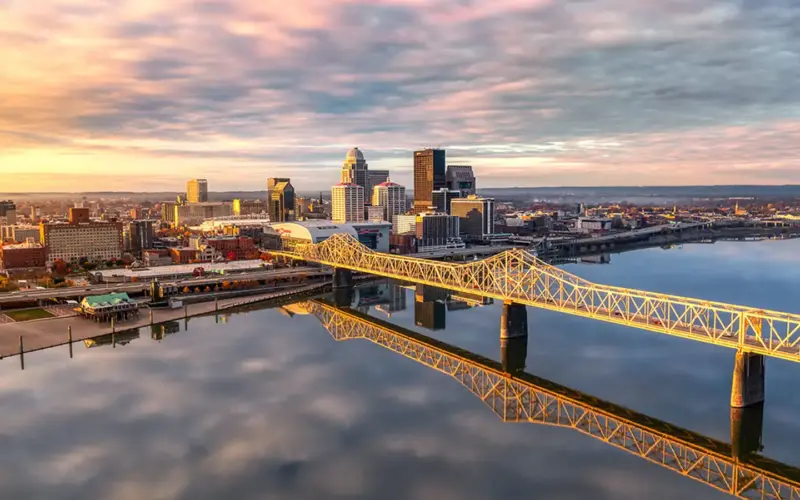
Louisville’s 85-acre Waterfront Park along the Ohio River is one of the most successful urban park projects in the country, transforming a former industrial corridor into a beautiful green space that serves as the city’s living room. The Big Four Bridge — a converted rail bridge now open to pedestrians and cyclists — crosses the Ohio to Jeffersonville, Indiana, and offers spectacular views of the Louisville skyline.
The waterfront connects seamlessly to Louisville’s NuLu arts district and the Museum Row on West Main Street, making it a natural hub for a full day of urban exploration. Summer brings outdoor concerts, festivals, and family events to the park. In winter, the Great Lawn transforms into a skating rink and holiday market. Whatever season you visit Louisville, build time into your itinerary for a walk along the waterfront.
32. Cave Hill Cemetery
Louisville’s Cave Hill Cemetery might not be a conventional tourist destination, but it earns its place on this list. Established in 1848, Cave Hill is a stunning example of the rural cemetery movement — a style of landscape design that shaped America’s first public parks — and its 300 wooded acres hold the graves of some of Kentucky’s most notable figures.
Colonel Harland Sanders, the founder of Kentucky Fried Chicken, is buried here. So is explorer George Rogers Clark and Louisville founder William Christian Bullitt. The grounds include a small lake, native plantings, and one of the best collections of 19th-century funerary sculpture in the South. A self-guided walking tour map is available at the entrance gate and takes about 90 minutes to complete.
33. Kentucky State Capitol
Frankfort, Kentucky’s state capital, is a small city with an outsized architectural legacy. The Kentucky State Capitol, completed in 1910, is one of the most beautiful capitol buildings in the country — its French Renaissance design, 212-foot dome, and elaborate marble interior reflecting the ambitions of a state that wanted its seat of government to make a statement.
Free guided tours are available on weekdays and take you through the House and Senate chambers, the rotunda, and the floral clock on the grounds — a 34-foot landscaped clock that was once one of the most photographed spots in the state. While in Frankfort, the nearby Buffalo Trace Distillery is an easy add-on, and the Liberty Hall Historic Site offers a glimpse into the city’s early federal-era history.
34. Perryville Battlefield State Historic Site
The Battle of Perryville on October 8, 1862, was the largest Civil War engagement fought in Kentucky and the decisive action that ended the Confederate bid to bring the state permanently into the Confederacy. More than 7,600 soldiers were killed, wounded, or captured in a single day of brutal fighting on the rolling farmland outside the town of Perryville.
The battlefield is remarkably well-preserved, with over 1,000 acres of the original terrain protected and interpreted with walking trails and wayside markers. The on-site museum provides excellent context for understanding the battle’s strategic significance. Annual reenactments in October draw thousands of visitors and bring the engagement to life with a level of historical detail that makes Perryville one of the best Civil War sites in the western theater.
Planning Your Kentucky Trip
With 34 tourist attractions in Kentucky spread from the Ohio River to the Appalachian highlands, it helps to cluster your itinerary by region rather than trying to cover the entire state in a single pass.
Regional Groupings to Consider:
- Louisville cluster: Churchill Downs, Kentucky Derby Museum, Louisville Slugger Museum, Muhammad Ali Center, Louisville Waterfront, Cave Hill Cemetery, Waverly Hills Sanatorium
- Lexington cluster: Keeneland Race Course, Kentucky Horse Park, Mary Todd Lincoln House, Lexington Historic Downtown, Shaker Village of Pleasant Hill (45 minutes south)
- Bourbon country loop: Kentucky Bourbon Trail, My Old Kentucky Home State Park (Bardstown), Bernheim Arboretum
- Eastern Kentucky outdoors: Red River Gorge, Natural Bridge State Resort Park, Daniel Boone National Forest, Breaks Interstate Park
- Southern Kentucky: Mammoth Cave National Park, Cumberland Falls State Resort Park
- Northern Kentucky: Newport Aquarium, Creation Museum, Ark Encounter
- History trail: Abraham Lincoln Birthplace, Fort Boonesborough, Perryville Battlefield, Big Bone Lick, Blue Licks Battlefield, Kentucky State Capitol
- Western Kentucky: Land Between the Lakes, National Corvette Museum (Bowling Green), Patton Museum
The Bluegrass State rewards slow travel. Carve out at least five days, and you’ll come home with a fuller picture of a place most travelers have been chronically underestimating.
For current hours, ticket prices, and seasonal programming, visit Kentucky Tourism’s official website before finalizing your plans.