Is It Normal for a Preschooler to Be Bossy? What Parents Need to Know

May 1, 2026
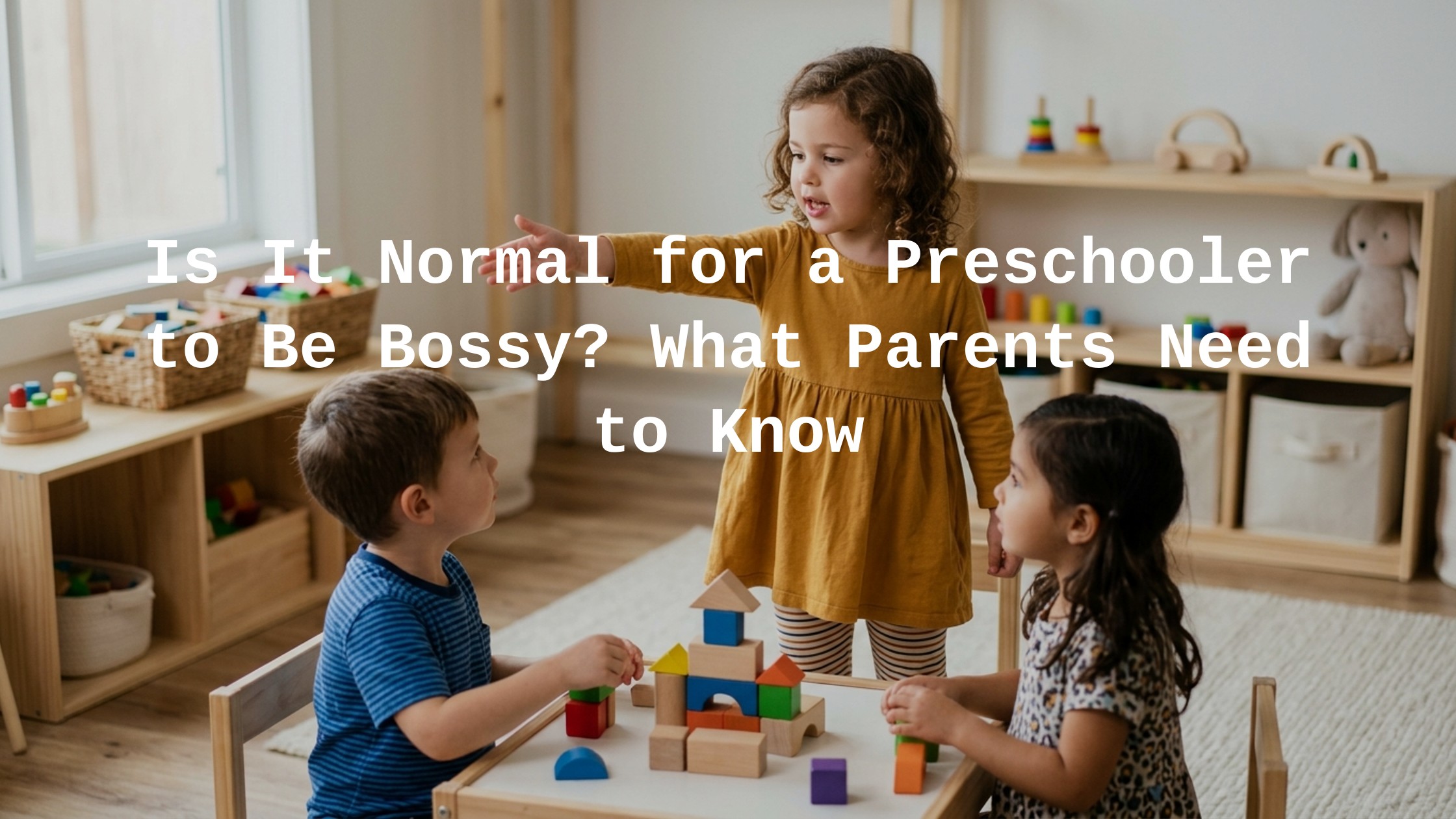
You ask your four-year-old to put on their shoes, and they respond by telling you to get their juice — right now. At the playground, they’re directing every child on how to use the slide. At dinner, they’re issuing orders like a tiny general. If any of this sounds familiar, you’re probably wondering whether something is wrong or whether this is just… preschooler life.
The good news is that bossiness in preschoolers is one of the most common things parents ask about — and one of the most misunderstood. Understanding what’s actually driving the behavior makes it so much easier to respond calmly and guide your child toward better social habits without power struggles or shame.
The Short Answer
Yes — bossiness in preschoolers is actually pretty normal behavior you see in every toddler and young child. Wanting control over their world is a normal developmental milestone. That doesn’t mean you simply ignore it, but it does mean you can take a breath and stop worrying that you’ve raised a tiny tyrant.
Most kids go through a phase where they bark out orders like a drill sergeant, and often it’s simply a reflection of their growing confidence and self-esteem. The key is knowing the difference between healthy developmental bossiness and behavior that needs a closer look — and that’s exactly what this article will walk you through.
Pro Tip: Avoid labeling your child as “bossy” out loud. Calling children bossy may cause them to attach a negative label to themselves and can make them feel bad about themselves. Focus on the behavior, not the identity.
Why Preschoolers Take Charge (The Developmental Reason)
Bossy behaviors appear as children begin to explore power in a social context with peers and within the parent-child relationship. The behaviors of a bossy kid originate from the desire to organize and direct the behavior of others. But to understand why that desire is so strong at this age, it helps to look at what’s happening inside your child’s brain and body.
The brain isn’t built for self-control yet. The prefrontal cortex — the part of the brain responsible for impulse control, empathy, and flexible thinking — is still in its very earliest stages of development during the preschool years. A three- and four-year-old generally doesn’t have the cognitive capacity to fully navigate the social world. They don’t know they are being rude or that the consequences of being rude are real and hurtful.
They’re discovering their own power. A demanding toddler or child is a normal part of development. They are starting to learn that their actions influence the behavior of people around them, and they like feeling in control of their world. Control makes them feel in charge, empowered, and safe.
They’ve been on the receiving end for years. Other people have been telling them what to do and how to do it for their whole lives, and now they want a turn! This is actually a sign of healthy social awareness — they’ve absorbed how direction works and are now experimenting with it themselves.
Imagination fuels the need to direct. Preschoolers are in the peak of imaginative play. When your child is building a dragon’s castle or playing “family,” they have a vivid mental picture of exactly how it should go. Kids with bossy tendencies have a great idea in mind and they need others to bring it to life. The bossiness isn’t selfishness — it’s creative vision without the social filter.
Emotional regulation is still a work in progress. A naturally assertive temperament will become exaggerated when the child is tired, hungry, or stressed in any way. So if your child seems especially bossy before nap time or after a long day at preschool, that’s not a coincidence — their emotional resources are depleted, and control-seeking goes up.
Key Insight: Bossiness is inherent to the preschool age. It kicks in for a variety of reasons, linguistic and social. It’s not a character flaw — it’s a developmental feature.
When It Is Normal (and When It Warrants a Closer Look)
Bossiness exists on a spectrum. Most of the time, what you’re seeing falls squarely in the “completely normal” category. Here’s how to read the situation.
Signs it’s developmentally normal:
- Your child gives orders during play (“You be the baby, I’ll be the mommy”) but can still enjoy the game when things don’t go exactly their way
- The behavior is mostly at home or with familiar people, and eases up in structured settings like preschool
- Your child responds — even if reluctantly — when you hold a boundary calmly and consistently
- They feel important when they make decisions for themselves and for others, but as they get older, they will think about the feelings and needs of others more often
- Friendships are still intact — some bossy kids “seem to have a way with their peers — they do it in a way that their peers accept them as leaders, do what they say, but without there being conflict”
Situations that can trigger a temporary spike in bossy behavior:
- A recent significant change or something outside their ability to control — such as moving, starting school, or getting a new sibling. When significant events occur, they may exert more control over their surroundings to mitigate the discomfort associated with the change.
- Inconsistency in household rules — kids with bossy tendencies are sometimes insecure and unsure about who makes the final decisions in the household, so they assert their own power.
- Mirroring behavior from home — our little people copy what they see. As grown-ups and parents, we often tell our kids to do things or make things happen because of our own needs, routines, and so on. This can feel or look like bossiness to our kids, so they copy what we do.
Understanding different parenting styles and how they shape a child’s sense of autonomy can also help you see why some children push for control more than others.
How to Handle It: 5 Practical Strategies
You don’t need to overhaul your parenting approach — a few consistent, calm shifts make a meaningful difference. Here are five strategies that actually work with preschoolers.
1. Offer Controlled Choices Throughout the Day
One of the most effective ways to reduce bossy behavior is to meet the underlying need for control before it boils over. It’s important to let your child make some small decisions — what shirt to wear, what snack they want — to satisfy their need for control. “The key is to avoid providing too many choices,” because “when you give young kids unlimited options, it confuses and overwhelms them.” Offering two or three things to choose from is best.
You can even build choice into non-negotiable moments. Instead of saying, “It’s time to put on your shoes and brush your teeth,” you could say, “You need to put on your shoes and brush your teeth. Which would you like to do first?” The rule or boundary is still in place, but you give them some sense of control within the situation.
2. Teach Polite Language — In the Moment, Calmly
Teach your child how to ask for what they want politely. Explain the difference between saying, “Can I please have some water?” and “Get me some water now!” When they make a demand, gently pause and model the words you’d like to hear. You don’t need to lecture — a simple redirect works better at this age.
Refuse to give your preschooler what they want when they make demands — but keep your tone warm, not punishing. A phrase like “I’d love to help when you ask nicely” teaches the lesson without shaming. This approach aligns well with gentle parenting principles that focus on guiding rather than controlling.
3. Model the Behavior You Want to See
Your child is watching everything you do. Demonstrate respectful communication, cooperation, and empathy in your own interactions. If you want your child to ask nicely, make sure they hear you asking nicely — of them, of your partner, of the cashier at the grocery store.
One helpful approach is to get down on their level and teach them about bossiness by playing with them. Have some playtime where you simply model cooperative behavior and language with them. Role-play works because preschoolers learn through play far more effectively than through lectures. This is also a core tenet of mindful parenting — staying present and intentional in the small, everyday moments.
4. Acknowledge Their Ideas, Then Redirect
Preschoolers often get bossy because they feel unheard. Before correcting the behavior, try validating the impulse behind it. You can remind your child: “You have some big ideas about how you want to play. Your friend may have an idea, too. Let’s ask.”
If your child is going overboard, take them aside away from others: first acknowledge what they might want. “It looks like you want your friend to play the way you want.” Connection is made when you address where they’re coming from. Continue by acknowledging their frustration. “It’s frustrating when others don’t do what you want them to.” Now you have them — they know you understand.
5. Hold Calm, Consistent Boundaries
Children need to feel like their parents are in the lead, that they’re in charge in a positive way, especially when children are feeling insecure or anxious. When they don’t feel their parent is in charge at any given time, they will instinctively move to be in charge themselves.
This means staying calm and consistent when your child pushes back. Predictability can help children feel secure and reduce anxiety, which can contribute to bossiness. A reliable daily routine, clear expectations, and a parent who doesn’t waver under pressure all signal to your child that they don’t need to take control — because you already have it. Exploring peaceful parenting and conscious parenting approaches can give you more tools for holding boundaries without escalating conflict.
Common Mistake: Giving in to bossy demands to avoid a meltdown. You can maybe delay it by making things better for them in the moment, giving in to what they are demanding, but you are only delaying it. When a child is full of frustration, they are much more likely to start getting bossy in a really edgy way.
When It Becomes a Red Flag
Most preschooler bossiness is garden-variety developmental behavior. But there are times when the intensity, frequency, or pattern of controlling behavior points to something that deserves more attention.
Consider reaching out for support if you notice the following:
- The behavior is extreme and constant across all settings. Defiance that makes daily routines unmanageable or ignores safety rules is concerning. A professional assessment can determine whether oppositional defiant disorder or another issue is present.
- Bossiness is paired with aggression. Long, intense tantrums with hitting, biting, scratching others, pulling hair, slamming or throwing objects, damaging property, and hurting others go beyond typical preschooler behavior and warrant professional attention.
- There’s a strong need to control paired with significant anxiety. Children with anxiety may try to control their environment by dictating how things should be. If your child seems driven by fear rather than simply asserting themselves, that’s worth exploring.
- Friendships are consistently falling apart. Over time, children learn that actions have consequences and that bossiness can be detrimental to building friendships. If your child is regularly rejected by peers and can’t seem to sustain play with other children, that’s a signal to look closer.
- The behavior is worsening, not improving, past age five. Five-year-olds are generally less bossy because they feel more introspection and are therefore less focused on exterior control, and because they are smart enough to get their needs met themselves or figure out something to do that’s more pleasing or constructive. If the behavior is intensifying instead of softening as your child approaches kindergarten, it’s worth a conversation with your pediatrician.
- Daily life is significantly disrupted. Consider professional support if behaviors persist for six months or more, despite consistent strategies. Seek help if behaviors significantly impact learning, social relationships, or create extreme family stress.
Important Note: The frequency of aggression and temper tantrums typically peaks around three years of age and, for many children, represents a transient developmental stage rather than a clinically significant problem. Behaviors that are considered normative at age three may indicate a clinically significant problem or disorder at age five. Age context matters.
When to Talk to Your Pediatrician
Your pediatrician is your first and best resource when something feels off. Many parents notice subtle behavioral concerns initially, such as a long-term irritable nature, difficulty concentrating, excessive shyness, or issues with new sounds and textures. You don’t have to wait until things feel out of control to bring it up.
Bring up your child’s behavior at your next well-child visit — or schedule a dedicated appointment — if you’re seeing any of the following:
- Controlling behavior that is paired with significant emotional dysregulation, such as ongoing irritability or anger, including temper tantrums which last more than five minutes
- Your child often lashes out, argues constantly, or gets physical with others — which may signal something deeper, such as oppositional defiant disorder (ODD), ADHD, or anxiety that your child doesn’t know how to express
- You’ve tried consistent strategies for several months and nothing seems to be helping
- Teachers or caregivers are raising concerns about your child’s behavior at preschool
- Your gut is telling you something isn’t quite right
Your pediatrician might recommend you visit a child psychologist or behaviorist for more targeted assistance. These professionals could use play therapy, counseling, or structured sessions to navigate your child’s development and address any behavior issues.
When you go, come prepared. Keep a detailed record of your child’s behavior. Write down how often concerning behaviors happen and how long they last. Note where and when they occur — is it at home, at school, or somewhere else? The more specific you can be, the more helpful the conversation will be.
Understanding your own parenting style differences — especially if you and a co-parent approach discipline differently — can also be worth discussing. Co-parenting with consistency is one of the most protective factors for children navigating big feelings and testing boundaries.
Key Insight: Trust your instincts. If something feels off, consult your pediatrician or a child psychologist. You know your child best.
Frequently Asked Questions
Is my preschooler bossy because of something I’m doing wrong?
Almost certainly not. Children are naturally learning how to navigate social situations, and sometimes that journey includes a phase of bossiness. That said, modeling polite requests and holding consistent boundaries does help — not because you caused the problem, but because you’re the best teacher your child has.
My daughter is bossy but my son isn’t. Is that a gender thing?
Sometimes young girls who show leadership skills like confidence, directness, and decision-making are unfairly labeled “bossy” while young boys who show the same skills are called “leaders.” It’s worth pausing to ask whether the same behavior in a child of a different gender would concern you equally. Gender-neutral parenting offers helpful frameworks for raising all children with the same social expectations.
Will my child grow out of this?
For most preschoolers, yes. Most children gain control over aggressive impulses and develop prosocial skills in response to the structures and expectations set by their parents and care providers, as well as by simply maturing. With gentle guidance and consistent boundaries, bossiness typically softens significantly by the time children enter kindergarten.
My child is bossy at home but fine at preschool. Should I be worried?
This is actually quite common and usually reassuring. Children often save their biggest behaviors for the people they feel safest with — you. The fact that your child can hold it together at school suggests good self-regulation capacity. Focus on consistency and connection at home, and keep communication open with their teachers.
Could my child’s bossiness be a sign of giftedness?
It can be one piece of the picture. Bright and outgoing children sometimes express their leadership qualities through bossiness. If your child is also showing advanced language, curiosity, or creative thinking, it may be worth exploring with their pediatrician — but bossiness alone isn’t a reliable indicator.
How is bossy behavior different from Oppositional Defiant Disorder (ODD)?
Oppositional Defiant Disorder, also known as ODD, is characterized by frequent outbursts and defiance of authority figures. The difference from typical preschool bossiness is one of intensity, duration, and pervasiveness. ODD involves a persistent pattern — lasting at least six months — of angry outbursts, arguing, and defiance that significantly disrupts daily life in multiple settings. Typical preschooler bossiness is situational, responsive to calm redirection, and doesn’t prevent your child from functioning. If you’re unsure, your pediatrician can help you sort it out. You might also find it helpful to read about attachment parenting and what parenting approaches support healthy development across different stages.
Raising a preschooler who wants to run the show can be exhausting — but it’s also a sign that your child is developing exactly the way they should. Instead of “bossy” or mean, think instead assertive, strong-willed, goes after what they want. Remind yourself that these will become wonderful qualities with maturity. Your job right now isn’t to squash the impulse — it’s to help channel it into something your child (and everyone around them) can actually work with.