How Much Does an Apartment Cost in Ho Chi Minh City? Rent, Buy & Budget Breakdown

April 14, 2026
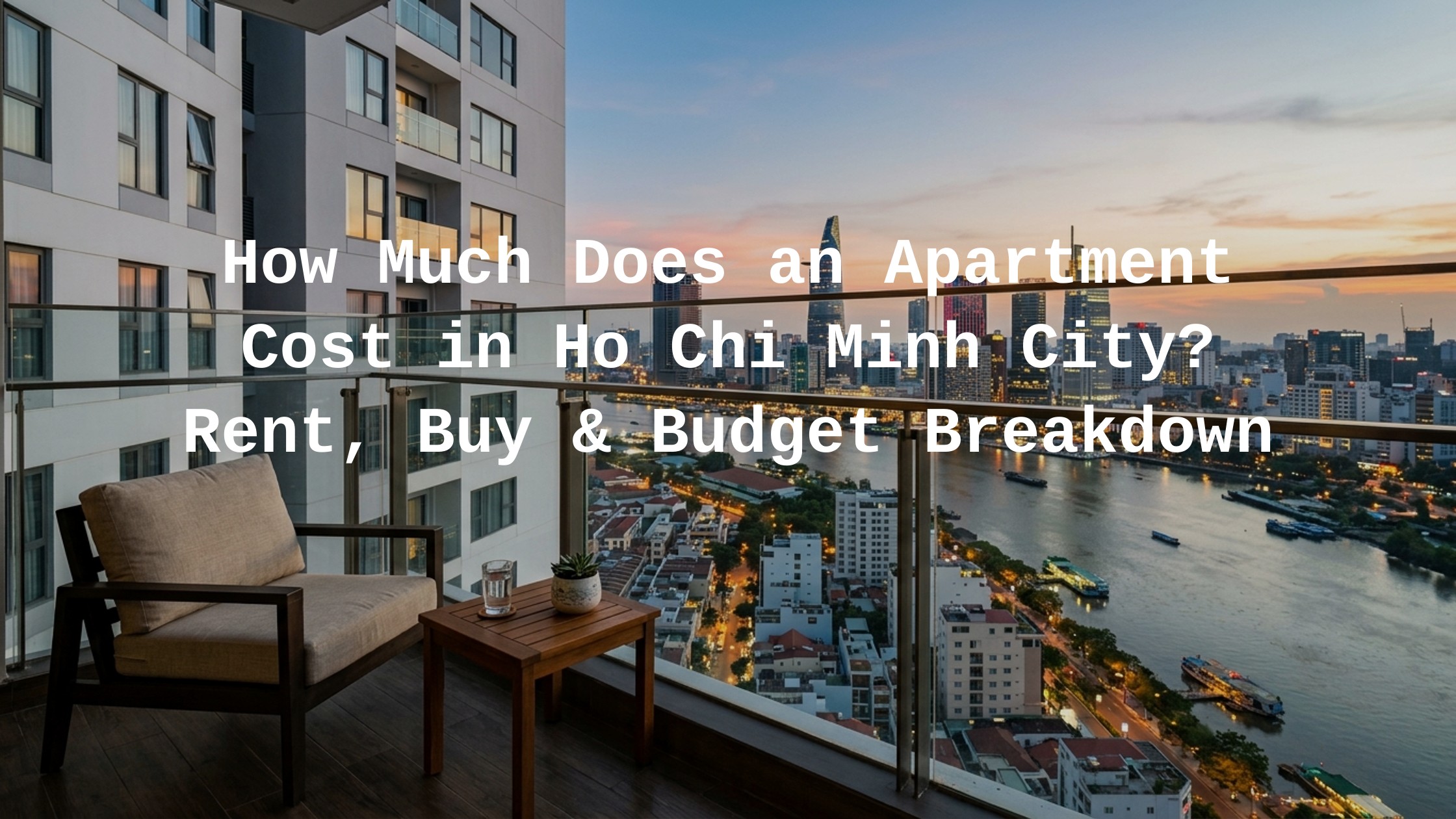
Ho Chi Minh City — still affectionately called Saigon by locals and expats alike — is one of Southeast Asia’s most dynamic urban markets, and apartment costs here reflect that energy. Whether you’re planning a move, scoping out an investment, or just curious how far your budget goes, the numbers may surprise you in both directions.
Rental prices span from under $300 a month for a no-frills studio in an outer district to well over $3,000 for a luxury three-bedroom in the expat heartland of Thao Dien. On the buying side, prices have surged dramatically , with average apartment values hitting record highs in 2025. This guide breaks down everything you need to know about apartment costs in Ho Chi Minh City — by size, neighborhood, and buyer type.
Pro Tip: All USD figures in this article use an approximate exchange rate of $1 = 25,000 VND, consistent with current market conventions.
Average Rent in Ho Chi Minh City by Apartment Size
Rental prices in Ho Chi Minh City vary widely based on apartment size, building quality, and location. That said, you can get a useful baseline by looking at market-wide averages across unit types.
The median monthly rent for rental homes in Ho Chi Minh City sits at approximately $1,003, with averages by apartment size breaking down as follows: studios average $520/month, one-bedrooms average $1,214/month, two-bedrooms average $1,860/month, three-bedrooms average $3,096/month, and four-bedrooms average $5,551/month.
Those figures skew toward the higher end because they include a large volume of premium expat-targeted listings. If you’re looking for something more budget-conscious, the picture shifts considerably. A one-bedroom flat in the city centre costs around 10,839,415 VND (approximately $471 USD) monthly, while units further from the center can dip lower.
| Apartment Size | Budget Range (Monthly) | Mid-Range (Monthly) | Premium/Expat (Monthly) |
|---|---|---|---|
| Studio | $200–$350 | $385–$600 | $700–$1,000+ |
| 1 Bedroom | $300–$500 | $500–$900 | $1,000–$1,500+ |
| 2 Bedrooms | $500–$800 | $900–$1,500 | $1,500–$2,500+ |
| 3 Bedrooms | $800–$1,200 | $1,500–$2,500 | $2,500–$4,000+ |
A comfortable, modern, well-located apartment typically averages $500–$850 per month, which is a realistic target for most working expats. You can find cheaper options if you’re willing to live a bit further from the city centre — living outside the center can save you around 30% on rent.
Key Insight: Furnished apartments are the norm in HCMC. Most mid-range and premium units come fully equipped with appliances, air conditioning, and basic furniture — a significant value add compared to many Western markets.
For those on a tighter budget, understanding what apartment type suits your lifestyle is a smart first step before committing to a lease. A serviced apartment, for example, bundles utilities and cleaning into the rent — useful for short-term stays but typically pricier per square meter than a standard lease.
Average Apartment Purchase Price in Ho Chi Minh City
Buying an apartment in Ho Chi Minh City has become significantly more expensive in recent years. The market has experienced a sharp run-up in prices, driven by limited supply, rising construction costs, and surging demand from both domestic and foreign buyers.
The average price of apartments in Ho Chi Minh City rose by 24.3% to US$4,057 per square meter in Q4 2025, based on figures released by JLL Vietnam. Some reports place the figure even higher: Ho Chi Minh City property prices are experiencing extraordinary upward momentum as of mid-2025, with average apartment prices reaching $4,691 per square meter — a remarkable 47% year-on-year increase.
What does that mean in real dollar terms? The median sales price for a property in Ho Chi Minh City is approximately $339,430, with one-bedroom units averaging $266,284 and two-bedroom units averaging $232,351.
The rapid price surge reflects the market’s dominance of luxury and high-end developments, with nearly 90% of newly launched apartments priced between $3,000–$5,000 per sqm. In Q4 2024, 2,700 newly launched apartments had starting prices above $3,125 per sqm.
Important Note: Affordable apartments under $1,950/sqm now account for less than 15% of total stock in HCMC, according to Savills Vietnam. Budget-conscious buyers may need to look at suburban areas like Binh Duong or Dong Nai for entry-level pricing.
The scarcity of affordable apartments has led buyers with moderate budgets to look for markets in neighboring areas like Binh Duong, Dong Nai, and Long An, where apartment prices range from approximately $1,567 per sqm.
For those comparing HCMC to other Vietnamese cities, primary apartment averages as of Q4 2025 stand at $3,852/sqm in Hanoi, $6,113/sqm in HCMC, and $1,400–$2,000/sqm in Da Nang.
Cost of Renting vs. Buying in Ho Chi Minh City
The rent-vs-buy decision in Ho Chi Minh City is more nuanced than in most Western cities, and for most expats and short-to-medium-term residents, renting is the practical default. Here’s how the math stacks up.
On the rental side, the estimated total cost of living for a single expat in Ho Chi Minh City generally ranges from $700 to $1,300 per month, depending heavily on rental choices, with rent for a modern, well-located apartment averaging $500–$850.
On the buying side, the average gross rental yield for a mid-range apartment in a central district is between 5% and 6% as of Q3 2025. In high-demand expat areas like Thao Dien, yields can approach 7%. That’s a meaningful return for investors, but it also means purchase prices are high relative to what you’d pay in rent.
| Factor | Renting | Buying |
|---|---|---|
| Upfront Cost | 1–3 months deposit | 20–30%+ down payment |
| Monthly Cost (2BR, mid-range) | $900–$1,500 | Mortgage + fees (~$1,200–$2,000+) |
| Flexibility | High | Low (50-year lease term for foreigners) |
| Ownership Rights | None | Limited (no freehold for foreigners) |
| Market Exposure | None | High — prices up 24–47% YoY in 2025 |
| Maintenance Responsibility | Landlord’s | Owner’s |
Vietnam’s housing market is facing pressure with soaring prices, making Ho Chi Minh City and Hanoi among Asia’s least affordable cities for homebuyers, according to a report by property consultant CBRE. The two Vietnamese cities have even surpassed Singapore in the gap between housing prices and average income.
For most people relocating to HCMC for work or lifestyle reasons, renting offers far more flexibility with a lower financial commitment. Buying makes more sense if you’re a long-term investor comfortable with Vietnamese property law, or a resident planning to stay for a decade or more. You can also explore urban living essentials to better understand what to look for in a city apartment before committing either way.
Pro Tip: For apartment rentals in Saigon, long-term rentals of 6 months to one-plus years can be negotiated much lower. Always ask for a discount if you’re committing to a 12-month lease.
Cheapest and Most Expensive Neighborhoods in Ho Chi Minh City
Ho Chi Minh City is a sprawling metropolis of 24 districts, and the neighborhood you choose will define both your daily experience and your monthly budget. Here’s a breakdown of where prices sit across the city’s most popular areas.
Most Expensive Neighborhoods
District 1 (CBD) — District 1 is the city’s undisputed core — the central business district, the primary hub for entertainment, and the seat of government. Gleaming skyscrapers like the Bitexco Financial Tower share the streetscape with historic French colonial buildings. Rent here typically ranges from $800 to $3,000+ per month depending on size and building quality.
Thao Dien / District 2 (Thu Duc City) — This is the number one choice for expatriate families, largely due to the high concentration of premier international schools. The lifestyle is relaxed and community-focused, with countless Western-style restaurants, artisanal bakeries, boutique shops, and family-friendly cafes. District 1 and Thao Dien command premium prices above $7,000 per sqm for purchase.
District 7 (Phu My Hung) — A planned urban zone popular with Korean and Japanese expats, known for wide streets, international schools, and modern infrastructure. Rentals here typically run $700–$2,000/month for mid-to-large units.
Most Affordable Neighborhoods
Binh Thanh District — Binh Thanh District is famous for budget apartments and studios for expats. It sits halfway between the CBD and Thao Dien, offering solid value with easy access to both. Studios and one-bedrooms can be found from $300–$600/month.
District 3 — District 3 is perfectly fine for expats to rent an apartment at an affordable price. It’s walkable, culturally rich, and less tourist-heavy than District 1, with solid mid-range options in the $400–$900/month range.
Phu Nhuan, Tan Binh, and District 4 — These inner-ring districts offer the best value for budget-conscious renters who still want proximity to the center. Expect to pay $300–$700/month for a decent one-bedroom.
Common Mistake: Many new arrivals default to District 1 because it’s the most visible. Unless you specifically need to be in the CBD, you’ll often get more space, better value, and a more authentic experience in Binh Thanh, District 3, or District 4 at 20–40% less in rent.
If you’re drawn to the idea of city apartment living and want to understand how different urban neighborhoods stack up, practical apartment living tips can help you think through your priorities before signing a lease.
What Affects Apartment Prices in Ho Chi Minh City
Understanding what drives apartment costs in HCMC helps you make smarter decisions — whether you’re negotiating rent, timing a purchase, or evaluating a neighborhood on the rise.
Location and District
Proximity to District 1, international schools, and major transport hubs is the single biggest pricing factor. A 2-bedroom in Thao Dien can cost twice as much as an equivalent unit in Binh Tan or Tan Phu. Real estate values in Vietnam vary based on your condo’s location — there isn’t a “one-size-fits-all” solution when it comes to pricing.
Foreign Investment and FDI
HCMC is Vietnam’s undisputed FDI magnet, consistently attracting over 35% of the nation’s total investment. This capital fuels the growth of multinational corporations, which in turn brings a steady stream of well-funded expatriate employees and their families, forming the bedrock of demand for high-end rental properties.
Infrastructure Development
Infrastructure mega-projects prove particularly attractive to foreign buyers. Metro Line 1’s completion, Thu Thiem’s transformation into a financial district, and the upcoming Long Thanh Airport create compelling investment narratives. Properties near new metro stations have seen the sharpest price appreciation.
Supply Constraints
In 2024, the HCMC real estate market continued to face a shortage of housing project supply, leading to a shortage of housing products. With developers focused on luxury launches, affordable supply has dwindled sharply. 40% of new inventory fell into the ultra-luxury category, exceeding $4,700/sqm. Only 1,300 units under $2,500/sqm were available — a decade-low supply.
Seasonal Demand
The HCMC rental market experiences distinct high and low seasons. The peak season typically runs from July to September, coinciding with the start of the international school year, when demand for family-sized homes is at its highest and negotiation power is limited.
Building Quality and Amenities
- Pool, gym, and 24/7 security add $100–$300/month to rental prices
- High-floor units with city or river views command a 10–20% premium
- Furnished vs. unfurnished can swing prices by $100–$400/month
- Main monthly running costs include building management fees, electricity and water bills, and internet/cable TV subscriptions — budget approximately $1.50–$2.50 per square meter of your apartment’s area for these total monthly costs.
How Ho Chi Minh City Compares to Other Major Cities
For international renters and buyers, one of the most useful benchmarks is how HCMC stacks up against comparable cities in the region and globally.
Ho Chi Minh City is generally 20% to 40% cheaper than Bangkok and Kuala Lumpur, largely driven by lower rental costs and the inexpensive nature of daily expenses like street food and transportation. While international schools are similarly priced across the three, HCMC offers far better value on rental properties.
| City | Avg. Apartment Price (per sqm) | Avg. 1BR Rent (City Center) | Relative Cost vs. HCMC |
|---|---|---|---|
| Ho Chi Minh City | $4,057–$4,691 | $471–$800 | Baseline |
| Bangkok | $3,000–$5,000 | $700–$1,200 | 20–40% more expensive |
| Kuala Lumpur | $2,500–$4,000 | $600–$1,000 | Similar to slightly cheaper |
| Da Nang (Vietnam) | $1,400–$2,000 | $300–$500 | ~30% cheaper |
| Singapore | $15,000+ | $2,500–$4,500 | 3–5x more expensive |
| Hong Kong | $20,000+ | $3,000–$6,000 | 5–7x more expensive |
HCMC is cheaper than most Western capitals like London, New York, and Sydney, and many East Asian hubs like Tokyo, Seoul, and Singapore. It’s more expensive than secondary Vietnamese cities but generally cheaper than Manila and many global Tier-1 cities for similar living standards — if you avoid premium expat enclaves.
However, the affordability picture is more complicated when you factor in local incomes. Vietnam’s housing market is facing pressure with soaring prices, making Ho Chi Minh City among Asia’s least affordable cities for homebuyers. Ho Chi Minh City and Hanoi have even surpassed Singapore in the gap between housing prices and average income.
For a side-by-side look at how another Southeast Asian city compares, see this breakdown of apartment costs in Kathmandu — a useful reference point for understanding how regional markets differ.
Can Foreigners Buy an Apartment in Ho Chi Minh City?
Yes — foreigners can legally purchase apartments in Ho Chi Minh City, but the rules come with important restrictions you need to understand before committing.
Key Legal Rules for Foreign Buyers
Foreigners can legally purchase apartments and landed properties in Vietnam under the 2023 Housing Law, with key restrictions: ownership is capped at 50-year renewable terms (not freehold), foreigners cannot own more than 30% of units in a single building, and are restricted to designated foreign-ownership projects.
- Ownership term: 50-year lease, renewable (not permanent freehold)
- Unit cap: Foreigners cannot collectively own more than 30% of units in any single condominium building
- Project eligibility: Only apartments in approved, designated projects qualify
- Residency requirement: You need a valid visa or temporary residence card (TRC) to legally purchase property. A TRC is strongly recommended, as it simplifies the legal process and is required by many developers for foreign-name title registration.
Who Is Buying?
The most active foreign buyers come from South Korea (25% of foreign purchases), Singapore (20%), China (15%), Taiwan (12%), and Japan (10%).
From 2014, when the housing law came into effect, to 2023, a total of 3,035 foreign individuals purchased homes in Vietnam. Most of these purchases involve apartments in commercial residential projects. Foreign organizations and individuals have primarily acquired properties in Hanoi (1,765), Ho Chi Minh City (850), Binh Duong Province (210), and Bac Ninh Province (110).
Additional Costs for Foreign Buyers
When buying a property in Vietnam, consider additional costs such as stamp duty (around 0.5%), registration fees, maintenance fees for condos, and legal fees — especially for navigating foreign ownership regulations.
Important Note: While Vietnamese real estate laws are strict compared to elsewhere in ASEAN and full foreign freehold ownership isn’t yet allowed, the country is moving in a positive direction. It’s still not as easy as nearby Malaysia or even Thailand, though.
Foreign buyers often face additional restrictions and higher rates, making cash purchases more common among international investors. The substantial down payment requirements mean buyers need significant liquid capital, while monthly mortgage payments constitute a major expense that must be weighed against rental income potential for investment properties.
If you’re weighing a major financial commitment like this, it’s worth reviewing practical ways to manage your living costs in tandem, so your overall budget stays balanced after a large purchase.
Tips for Finding an Apartment in Ho Chi Minh City
The HCMC rental market moves fast, especially in peak season. These practical tips will help you navigate it more confidently — and avoid the most common pitfalls.
1. Start with a Serviced Apartment
A key strategy for new arrivals is to budget for 1–2 months in a serviced apartment while conducting your permanent search. This ensures you can inspect properties in person and secure the best deal. Locking into a long lease before you’ve explored different districts is one of the most expensive mistakes you can make.
2. Time Your Search Strategically
The period during and immediately after the Tet (Lunar New Year) holiday — usually late January to February — is often the quietest time, presenting a potential window of opportunity for renters to find better deals. Avoid searching during July–September if possible, as that’s peak demand season.
3. Negotiate — Especially for Longer Leases
While modern high-rises often have fixed prices, always try to negotiate your rental contract, especially if you commit to a 12-month or longer lease. Landlords in HCMC frequently offer one to two months free or a reduced monthly rate for annual commitments.
4. Use Reputable Platforms and Agents
Platforms like FazWaz, Dot Property, Living in Vietnam, and Housing Saigon list verified properties across all districts. For expat-focused rentals, boutique agencies specializing in expat housing can save you significant time and help you avoid scams. Foreign buyers also commonly use real estate agents to overcome language barriers and navigate government bureaucracy — be sure to choose a highly rated agency with a proven track record.
5. Know What’s Included in the Rent
Always clarify upfront what’s included in the monthly price. Utilities are surprisingly affordable, with electricity being the main variable due to the heavy use of air conditioning during HCMC’s hot seasons. Some landlords charge sub-metered electricity at rates above the government rate — ask for the billing method before signing.
6. Explore Beyond the Obvious Districts
Choose neighborhoods outside District 1 for better rent-to-value ratios — Districts 2, 7, Phu Nhuan, and Binh Thanh are strong alternatives. Negotiate rent for stays of 6–12+ months, as many landlords offer discounts.
7. Budget for Move-In Costs
While most apartments are furnished, you will likely spend $500–$1,500 USD upfront on small items, kitchenware, and custom necessities. Factor in a security deposit of one to three months’ rent as well, which is standard across the market.
Pro Tip: Join expat Facebook groups like “Expats in Ho Chi Minh City” or “Saigon Expats” before your search. Landlords and departing tenants frequently post direct rental listings here, often at below-market rates with no agent fees.
Finding the right apartment in Ho Chi Minh City takes patience, but the value on offer — especially compared to Western cities — remains genuinely compelling. Ho Chi Minh City remains one of the world’s most dynamic and affordable major cities for international professionals, digital nomads, and families, offering a magnetic combination of an energetic job market, world-class dining, and a vibrant cultural life — all accessible at a fraction of the cost found in global hubs like Singapore, Hong Kong, or even New York.
Whether you’re renting a studio in Binh Thanh on a tight budget or investing in a two-bedroom in Thao Dien, understanding the full cost picture puts you in a far stronger position. Use the data in this guide as your starting point, verify current listings through trusted local platforms, and don’t rush the process — the right apartment in Saigon is absolutely worth the search. For more context on how apartment living costs compare globally, this overview of current HCMC rental listings is a useful real-time reference.