Your Preschooler Has an Imaginary Friend — Here’s What That Really Means

May 1, 2026
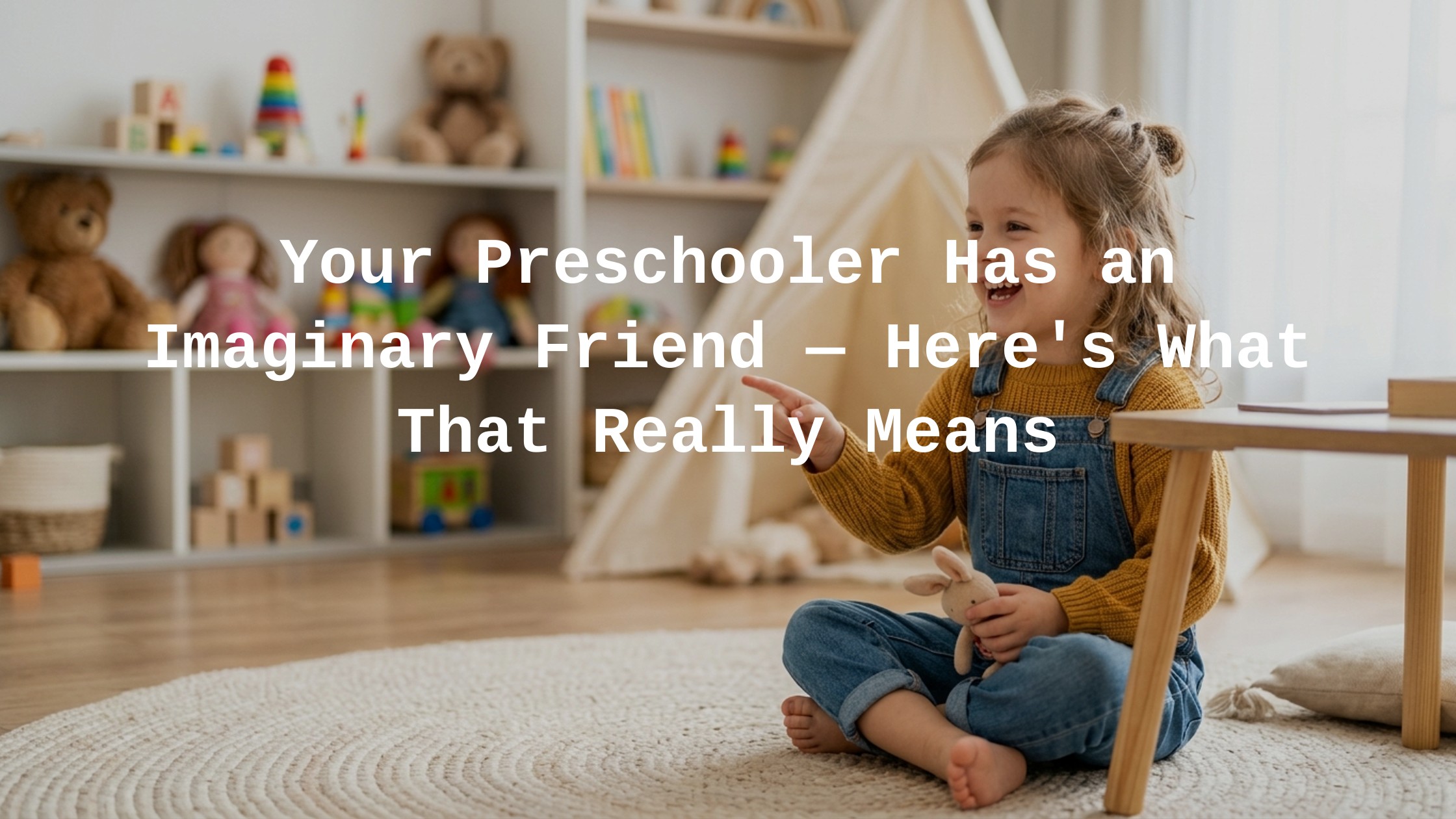
Your child sets a place at the table for someone you cannot see, introduces you to their best friend who lives behind the couch, or scolds an invisible companion for taking the last cookie. If this sounds familiar, take a breath — you are not alone, and there is nothing wrong with your child.
Imaginary friends are one of those parenting surprises that can catch you off guard, especially the first time it happens. But developmental experts and child psychologists consistently describe them as a healthy, even impressive, sign of early childhood development. Understanding what is actually happening in your child’s brain — and knowing the small handful of signs that do warrant attention — can help you feel genuinely calm instead of just telling yourself not to worry.
Key Insight: Most of what you read here applies across many parenting approaches. Whether you lean toward gentle parenting, attachment parenting, or something in between, the guidance on imaginary friends is largely the same: stay curious, stay calm, and follow your child’s lead.
The Short Answer
An imaginary friend is almost always a normal, healthy part of child development. If your preschooler has conjured up an invisible companion, the research is firmly on your side. Studies show that around 65% of kids had imaginary friends at some point before they turned seven.
“An imaginary friend is more likely to demonstrate positive attributes of a child — creativity and resilience, for example — than anything that parents should be concerned about.” That reassurance comes straight from Cleveland Clinic pediatric experts, and it reflects the broad consensus in developmental psychology.
Decades ago, imaginary friends got a bad rap, putting their creators under the microscope, but contrary to that belief it’s completely normal — and very common — for little ones to have imaginary friends. So if your child’s invisible companion has been joining you for meals, car rides, and bedtime stories, you can officially stop second-guessing yourself.
Why Preschoolers Create Imaginary Friends
There is real developmental science behind this phase, and it touches on several things happening in your child’s brain and emotional world all at once.
As children reach their second and third year of life, their imaginations expand, and they are able to play pretend. This surge in imaginative capacity is not random — it is directly tied to cognitive leaps your child is making. Imaginary friends can be a manifestation of a child’s burgeoning imagination and cognitive abilities. During the preschool years, children undergo significant cognitive development, particularly in their ability to engage in symbolic thinking.
Children use imaginary friends to simulate real-life interactions in order to deepen their understanding of relationships. Preschool-aged kids have only just begun to see themselves as fully separate from their parents, so they are still working on developing an independent “voice” in their relationships. An imaginary companion gives them a safe, always-available space to practice exactly that.
Emotional regulation is another big piece of the picture. Sometimes imaginary friends “appear” when a child is going through a stressful time like moving to a new town. While they cannot control the changing situation around them, they can control their imaginary friend. That sense of control matters enormously to a child whose whole world is run by grown-ups.
Having an imaginary companion is not only a normal childhood experience, but it serves to provide the child with opportunities to practice theory of mind — representing what others are potentially thinking. Imaginary friends can improve a child’s capacity for empathy and understanding others’ perspectives.
Pro Tip: Language development gets a boost too. Because neither of you can actually see the imaginary friend, your child must use language to set up the scenario and describe what she imagined — making imaginary play one of the richest verbal workouts a preschooler can get.
Research shows that many children between the ages of three and seven create imaginary friends as part of normal cognitive, emotional, and social development. These companions often help children practice communication, problem-solving, emotional expression, and self-regulation.
When It Is Normal — and When to Look Closer
The vast majority of imaginary friendships fall squarely in the “completely normal” category. Here is a quick way to think about it.
| Typically Normal | Worth a Closer Look |
|---|---|
| Friend appears and disappears naturally | Friend never goes away, even when your child wants to stop |
| Child knows the friend is pretend if asked | Child cannot distinguish the friend from reality |
| Friend is kind, fun, or neutral in character | Friend says cruel things or encourages unsafe behavior |
| Child still plays with real peers | Imaginary friend replaces all real-world socializing |
| Friend appears during stress or transitions | Sudden dramatic changes in behavior or mood |
Imaginary friendships should be comforting and controllable. Children can usually make their imaginary friends “go away” when they are “done playing.” In general, imaginary friendships are a normal part of social development and will fade away over time.
It is also worth knowing that your child almost certainly understands the difference between real and pretend. Embracing an imaginary pal does not mean your child is out of touch with reality. By age 3 or 4, most little ones are pretty good at telling the world of reality apart from pretend.
Children as young as two and a half years can have imaginary friends. Children might have one imaginary friend or more. Children usually stop playing with make-believe friends when they are ready to move on. Imaginary friends are most likely to be around for several months, but they could be a feature of your child’s life for a few years. All of that is within the range of normal.
Your parenting style and the way you respond to your child’s imaginative play can shape how this phase unfolds. Parents who engage openly and warmly tend to find that the imaginary friendship runs its natural course without any friction.
How to Handle It
You do not need a complicated plan. A few simple, consistent approaches will serve both you and your child well throughout this phase.
1. Play Along — Without Taking Over
If your child has an imaginary friend, try to be accepting and curious about the relationship. “It’s a great opportunity to engage your child and get them to talk,” says one Cleveland Clinic expert. “Ask questions about the imaginary friend as if they were real. Talk to them about what they did with their friend today.” The key word is “curious.” You are not the director of this story — your child is.
Set an extra place at the table for the imaginary friend, if your child asks you to do so, but be careful not to take over. An imaginary friend is a unique and magical expression of your child’s imagination, so let your child be in charge of it.
2. Hold the Line on Behavior — Imaginary Friend Included
Playing along does not mean accepting bad behavior with a shrug. As one neuropsychologist puts it, “Don’t give the imaginary friend a pass on bad behavior as something for a child to hide behind. Sometimes children will test boundaries with their parents via their imaginary friends. Children must realize that they are responsible for the behaviors of their imaginary friend.”
It is fine to tell your child that this is not something their imaginary friend could have done and to offer consequences as usual. You can acknowledge the friend’s existence while still holding your child accountable. These two things are not in conflict.
Common Mistake: Dismissing the imaginary friend entirely or telling your child the friend “isn’t real” in a way that feels shaming. This closes down communication and can make your child feel embarrassed about a healthy, creative impulse.
3. Use the Friend as a Window Into Your Child’s World
The way children play with or talk about their friends can tell you a lot about how they are feeling. Make-believe friends give you insight into your child’s inner world and your child’s likes, dislikes, and tastes. If your child’s imaginary friend is always scared, always sick, or always being left out, that is worth gently noticing — not panicking about, but noticing.
This kind of attentive, mindful parenting can help you catch emotional themes early and respond with warmth before small feelings become bigger ones.
4. Redirect When the Friend Becomes an Obstacle
Some children insist on consulting with their imaginary friends all the time — for example, “I have to ask Sammy first.” They might also ask you to speak to their friend rather than directly to them. If you find this frustrating, try saying to your child, “I want to hear what you think — not what Sammy thinks.”
This approach respects the friendship while gently steering your child back toward their own voice and decision-making. It is a small but effective boundary. For parents navigating complex family dynamics, like those practicing co-parenting or parallel parenting, keeping this kind of gentle consistency across households can make the strategy even more effective.
5. Turn Chores Into Opportunities
You might find that you are being asked to hold open doors, fix snacks, or make the bed for your child’s imaginary friend. Rather than doing it yourself, encourage your child to hold the door open, set a place for the friend at dinner, or make the bed. This way you are accepting the imaginary friend but also taking the opportunity to develop your child’s skills.
It is a small reframe that turns the imaginary friend from a potential source of extra work for you into a vehicle for teaching responsibility and independence — a win on both sides.
When It Becomes a Red Flag
The overwhelming majority of children with imaginary friends will never experience any of the concerns listed below. But it is useful to know what to watch for so you can feel confident rather than anxious.
- The friend encourages unsafe behavior. Imaginary friends that are threatening or encouraging your child to use violence toward themselves or others are a clear signal to seek guidance.
- Your child seems genuinely afraid of the friend. It might be time to take a closer look if your child seems afraid of their imaginary friend. Fear is not part of healthy imaginative play.
- The friend says cruel or hateful things. If a child’s imaginary friend says cruel or hateful things to the child, or encourages them to behave badly, this could be a cause for concern.
- Real friendships are disappearing. If a child’s imaginary friend is getting in the way of socializing with real-life kids, especially at an older age, it is no longer helpful to the child.
- The friend never goes away. If the imaginary friends never “go away” or are “always talking,” that warrants a conversation with your pediatrician.
- The friend appears after a traumatic event. Sometimes, children who experience trauma develop imaginary friends as part of dissociation — a way of distancing or disconnecting from reality during a stressful time.
Important Note: The overwhelming majority of kids with invisible friends will never encounter these kinds of problems. This list is meant to inform, not alarm. Trust your gut — you know your child best.
If you are raising a child in a blended or step-family situation, it can sometimes be harder to track behavioral changes across households. Resources on step-parenting and the differences between parallel and co-parenting may help you and your co-parent stay on the same page about what you are observing.
When to Talk to Your Pediatrician
Your pediatrician is always a good first call when something feels off — and there is never any shame in asking. As one Cleveland Clinic expert puts it, “Talk to your pediatrician about any concerns. It never hurts to ask questions.”
According to the American Academy of Pediatrics via HealthyChildren.org , it is important to discuss any concerns you have with your pediatrician, particularly if you have other developmental concerns about your child, especially involving speech, talking patterns, or social interactions.
Other situations worth bringing up with your child’s doctor include:
- You notice sudden changes in your child’s social interactions, personal hygiene practices, speech patterns, or concentration ability.
- There is a strong family history of mental illness, especially in close relatives.
- Your child cannot distinguish the imaginary friend from reality, even when directly asked in a calm, age-appropriate way.
- The imaginary friend has appeared alongside other new and unexplained behavioral changes.
While imaginary companions are usually benign, there are times when consultation with a qualified child mental health professional is appropriate. A trained clinician can help differentiate imagination, emotional coping, sensory sensitivity, and stress responses — without rushing to diagnosis or labels.
If you are exploring different parenting approaches and how to align them with your child’s emotional needs, you may also find it helpful to read about conscious parenting — a framework that emphasizes tuning into your child’s inner world, which pairs naturally with this kind of attentive observation.
Pro Tip: When you do talk to your pediatrician, bring specific examples — what the friend says, how long the friendship has lasted, and any behavioral changes you have noticed. Concrete details help your doctor give you the most useful guidance.
Frequently Asked Questions
At what age do imaginary friends typically appear?
Children as young as two and a half years can have imaginary friends. Whilst many imaginary companions first come into existence when the child is three or four years old, those in middle childhood and even adolescence also create them. The preschool years — roughly ages three to five — are the most common window.
Does having an imaginary friend mean my child is lonely?
It seems logical that children who invent invisible friends might be lonely or have social problems, but research does not support those assumptions. In fact, compared to those who do not create them, children with imaginary companions tend to be less shy, engage in more laughing and smiling with peers, and do better at tasks involving imagining how someone else might think.
Should I play along with my child’s imaginary friend?
Yes — within reason. Engaging warmly and curiously with the imaginary friend helps your child feel respected and seen. Initially, you should support your child as they create a relationship with their invisible friend. They will feel respected and loved as you ask them questions about what their made-up companion is doing and play along with their stories. Just remember to let your child lead the narrative.
When do imaginary friends usually go away?
Just like other developmental phases, as a child grows, the phase of imaginary friends will eventually disappear. Kids will grow out of their imaginary friends, just like they are going to grow out of their belief in the Easter Bunny or Santa Claus. Most children naturally move on as their real-world social lives expand — usually by early elementary school age.
Can an imaginary friend be a stuffed animal or toy?
Some imaginary friends are completely incorporeal beings, while others are personified by physical objects, such as a favorite stuffed animal or doll. Both count, and both are equally normal. They can be based on someone your child already knows, a storybook character, or even a soft toy. Sometimes they come purely from your child’s imagination. They are mostly human, but they can also be animals.
Is it normal for my child to have more than one imaginary friend?
Children might have one imaginary friend or more. Having a whole cast of invisible companions is not unusual, especially in children with particularly active imaginations. As long as the friendships are positive and your child is still engaging with the real world, a crowd of imaginary friends is nothing to worry about.
My child blames their imaginary friend for bad behavior. What should I do?
Hold the line — kindly but clearly. If you notice that your child is blaming their imaginary friend for things they do, such as wasting food or disrupting family interactions, you can try setting boundaries. Acknowledge the friend’s existence, but make clear that your child is still responsible for their own choices. This is a common testing behavior, and a firm, warm response is all it usually takes. For more on navigating these kinds of boundary moments, the guide on parenting a child through the preschool years offers helpful context.