How Much Does an Apartment Cost in Johannesburg? Rent, Buy & Neighborhood Prices

April 30, 2026
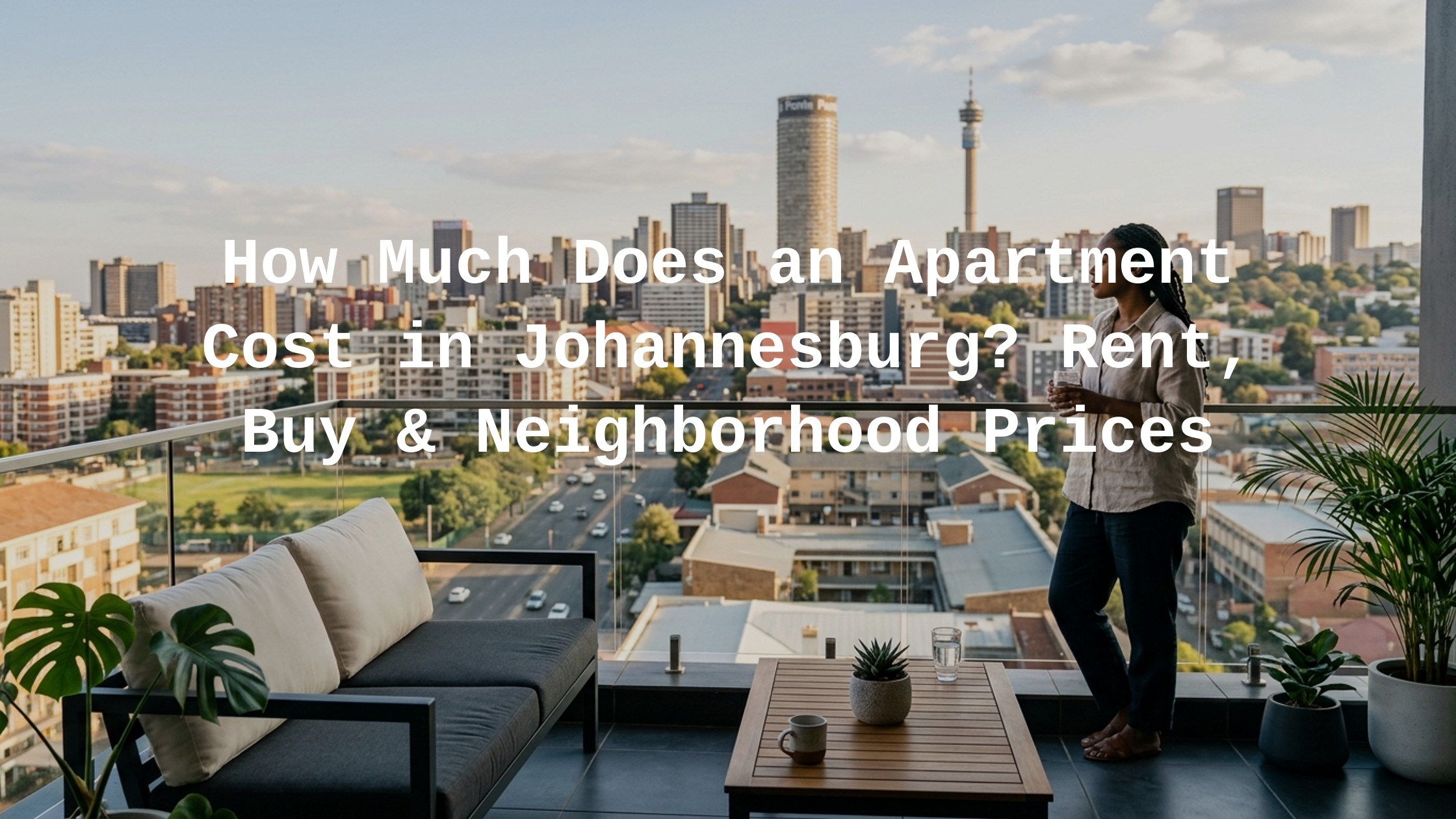
Johannesburg is one of Africa’s most dynamic cities — a sprawling economic powerhouse where corporate towers meet leafy suburbs, and where apartment prices can swing wildly depending on which side of the city you’re looking at.
Whether you’re relocating for work, investing in property, or simply trying to budget your next move, knowing exactly what apartments cost in Joburg can save you from serious financial surprises. This guide breaks down real rent and purchase figures by apartment size, neighborhood, and buyer type — so you can plan your budget with confidence.
Pro Tip: Johannesburg’s rental market is highly location-dependent. The same one-bedroom apartment can cost R5,500 in Randburg and R18,000 in Sandton — so always compare neighborhoods before committing.
Average Rent in Johannesburg by Apartment Size
Rental prices in Johannesburg vary significantly based on apartment size, building quality, and location. That said, the city remains notably more affordable than Cape Town across almost every category.
Rent prices in Johannesburg are approximately 32.6% lower than in Cape Town. To put it in perspective, a one-bedroom apartment in Joburg’s city centre averages at R7,632 per month, compared to R13,564.81 in Cape Town’s CBD. If you’re coming from a more expensive city, you’ll likely find Johannesburg’s rental market a welcome relief.
The city presents attractive opportunities with studio apartments starting from ZAR 2,500 per month, while premium three-bedroom units in Sandton can command up to ZAR 20,000 monthly. Here’s a practical breakdown of what you can expect to pay by apartment size across different parts of the city:
| Apartment Size | Budget Area (e.g., Randburg, CBD) | Mid-Range Area (e.g., Fourways, Bryanston) | Premium Area (e.g., Sandton, Rosebank) |
|---|---|---|---|
| Studio / Bachelor | R2,500 – R5,000 | R5,000 – R7,500 | R7,500 – R10,000 |
| 1-Bedroom | R5,500 – R7,500 | R8,000 – R11,000 | R11,000 – R17,000 |
| 2-Bedroom | R6,500 – R9,000 | R11,000 – R16,000 | R16,000 – R28,000 |
| 3-Bedroom | R8,000 – R12,000 | R15,000 – R22,000 | R25,000 – R48,000 |
In mid-range Johannesburg neighborhoods like Fourways (Douglasdale/Lonehill) and Bryanston, monthly rents typically range from R8,000 to R11,000 for a one-bedroom apartment, R11,000 to R16,000 for a two-bedroom, and R18,000 to R28,000 for a three-bedroom townhouse.
In Johannesburg’s most expensive rental neighborhoods like Sandton CBD, Morningside, and Rosebank, high-end apartments command R11,000 to R17,000 for a one-bedroom and R16,000 to R28,000 for a two-bedroom.
On the budget end, the cost of a one-bedroom apartment in the city centre ranges from R5,500 to R7,500 per month, and prices climb significantly for larger homes or premium locations. If you’re willing to explore social housing options, the Johannesburg Housing Company offers one-bedroom apartments starting from around R3,000 per month for lower- to middle-income earners.
When budgeting your rent, don’t forget utilities. Numbeo’s 2025 data shows that basic utilities in Johannesburg for a 2-bedroom apartment come to about R2,147.82 per month. The City of Johannesburg’s 2025/26 budget has confirmed tariff hikes — electricity is set to increase by 12.4%, water and sanitation by 13.9%, and refuse removal by 6.6%.
Key Insight: Utility costs aren’t always included in rent. When landlords do include utilities, they typically range from ZAR 1,500 to ZAR 3,000 monthly for two-bedroom apartments, covering electricity, water, sewerage, and refuse removal — though many landlords require tenants to handle these directly.
Average Apartment Purchase Price in Johannesburg
If you’re thinking about buying rather than renting, Johannesburg’s property market offers some of the most accessible entry points in South Africa — particularly for sectional title units like apartments and townhouses.
As of January 2026, the median apartment price in Johannesburg sits around R1.2 million (about $65,000 or €60,000), while the average reaches approximately R1.45 million ($78,000 or €72,500) because premium areas like Sandton and Rosebank pull the numbers up.
The average freestanding home costs approximately ZAR 1.5 million as of September 2025, while sectional-title units range from ZAR 650,000 to ZAR 850,000. This makes apartments a significantly more affordable entry point for first-time buyers or investors looking to get into the Johannesburg market.
In terms of price per square meter, as of early 2026, the estimated median price per square meter in Johannesburg is around R11,000 ($650 or €550), while the average sits higher at roughly R14,000 per square meter ($830 or €700).
Here’s a quick snapshot of what your budget can get you across different price tiers:
| Budget (ZAR) | What You Can Expect | Example Areas |
|---|---|---|
| R500,000 – R800,000 | 1–2 bedroom entry-level apartment | Hillbrow, South Hills, Marshalltown |
| R800,000 – R1.2 million | 1–2 bedroom sectional title unit | Randburg, Roodepoort, Midrand |
| R1.2M – R2.2M | 2-bedroom mid-range apartment | Killarney, Maboneng, Oakdene |
| R2.2M – R5M+ | Luxury 2–3 bedroom apartment | Rosebank, Sandton, Houghton Estate |
Compared to September 2024, Johannesburg property prices increased by approximately 3–5%, marking the first sustained growth period in several years. This growth reflects improved economic conditions and renewed investor confidence in the Johannesburg residential market.
You should also factor in additional buying costs. Transfer duties can range from 3% to 13% of the purchase price, legal fees cover the services of an attorney handling the transfer, and municipal rates and utility costs may vary by location. For properties purchased under R1 million, no transfer duty applies — a meaningful saving for budget buyers. You can explore different types of apartments to better understand which format suits your budget and lifestyle before committing to a purchase.
Cost of Renting vs. Buying in Johannesburg
One of the most common questions for anyone arriving in Johannesburg is whether it makes more financial sense to rent or buy. The answer depends heavily on your timeline and financial goals.
Buying property in Johannesburg currently offers significant advantages over renting, particularly for long-term residents and investors. Buyers gain access to equity building, value appreciation potential, and protection against future rent increases. The decision ultimately depends on your timeline and financial goals, but current market conditions strongly favor purchasing for anyone planning to stay beyond three years.
On the other hand, a one-bedroom apartment in the city center rents for approximately R7,600 monthly, while renting makes sense for individuals seeking flexibility, particularly expats and young professionals who may relocate frequently.
Here’s a side-by-side comparison to help you think through the decision:
| Factor | Renting | Buying |
|---|---|---|
| Upfront Cost | 1–2 months deposit + first month’s rent | 10–20% deposit + transfer duty + legal fees |
| Monthly Cost (1-bed, city centre) | ~R7,600/month | ~R8,500–R10,000/month (bond repayment) |
| Flexibility | High — move when lease ends | Low — tied to property |
| Equity Building | None | Yes — builds over time |
| Maintenance Responsibility | Mostly landlord | Owner’s responsibility |
| Best For | Short stays, expats, flexibility seekers | Long-term residents, investors |
As of mid-2025, Johannesburg property investors face mortgage rates aligned with South Africa’s prime lending rate of 11% to 12% per annum. As of early 2026, the demand outlook for residential property in Johannesburg is mildly positive, with improving buyer sentiment driven by six consecutive interest rate cuts since September 2024 that have brought the prime rate down to 10.25%.
Important Note: Banks use a rough formula: your monthly bond payment shouldn’t exceed 30% of your gross monthly income. So if you earn R25,000 a month, you can afford bond payments of about R7,500. With a 10% deposit and current interest rates, that gives you a budget of roughly R950,000 to R1,000,000.
If you’re looking to cut your overall cost of living while in Johannesburg, it also helps to be smart about everyday spending. Check out these 9 ways to cut your grocery costs to stretch your budget further once you’ve settled in.
Cheapest and Most Expensive Neighborhoods in Johannesburg
Johannesburg’s neighborhoods span an enormous price range — from ultra-affordable inner-city areas to some of the most exclusive real estate on the African continent. Knowing where to look can make a dramatic difference to your budget.
Most Affordable Neighborhoods
The most affordable neighborhoods in Johannesburg for apartment buyers include Hillbrow, Berea, Yeoville, and parts of the Johannesburg CBD, where prices typically range from R8,000 to R12,000 per square meter. Neighborhoods like Berea and Yeoville are considered among the most affordable in Johannesburg, with some apartments available for under ZAR 800,000. While affordable, these neighborhoods may have varying levels of amenities and infrastructure.
As of early 2026, the most affordable property prices per square meter in Johannesburg are also found in Soweto neighborhoods like Protea Glen and Orlando East (R6,000 to R12,000/sqm), parts of Roodepoort such as Florida and Discovery (R10,000 to R15,000/sqm), and Randburg areas like Ferndale and Blairgowrie (R10,000 to R18,000/sqm).
For renters on a tight budget, Ferndale in Randburg offers affordable flats close to main roads with taxis and bus routes aplenty, Windsor East has budget rentals within walking distance of Cresta Shopping Centre, and Weltevreden Park is leafy and peaceful with a low-key suburban feel.
Most Expensive Neighborhoods
The most expensive neighborhoods in Johannesburg are concentrated in the northern suburbs, particularly Sandton areas like Morningside, Bryanston, and Sandown, plus Rosebank, Melrose, and Houghton, where prices range from R18,000 to R30,000 or more per square meter.
The price gap between Johannesburg’s cheapest areas like Hillbrow at R8,000 per square meter and premium nodes like Sandton at R30,000 per square meter is nearly four times. In the most exclusive pockets, typical apartment prices range from R35,000 to R55,000 per square meter for modern, well-managed stock, with ultra-prime buildings in Sandhurst and Atholl pushing even higher.
Common Mistake: Many buyers focus only on purchase price and overlook ongoing costs. In affordable inner-city areas, body corporate levies, security upgrades, and building maintenance can add significantly to your monthly outgoings. Always ask for the levy schedule before signing.
For a broader sense of Johannesburg’s urban living landscape, including what different neighborhoods offer in terms of lifestyle, take a look at these urban living essentials every big city apartment must have — a useful checklist when evaluating any apartment in the city.
What Affects Apartment Prices in Johannesburg
Understanding what drives apartment prices in Johannesburg helps you make smarter decisions — whether you’re renting, buying, or investing. Several key factors shape what you’ll pay.
Location and proximity to business nodes is the single biggest driver. Location is a critical factor, as it influences property value, rental potential, and quality of life. Proximity to amenities, schools, and transport links can significantly enhance a property’s appeal. Apartments near Gautrain stations, for instance, consistently command a premium.
Security features carry enormous weight in Johannesburg’s market. Johannesburg faces significantly higher crime rates and safety concerns, driving demand premiums for security features and gated estates while limiting overall property appreciation in less secure areas. Complexes with 24-hour guards, access control, and CCTV attract higher rents and purchase prices.
Interest rates and financing conditions directly influence what buyers can afford. Economic uncertainty, load-shedding concerns, and security issues contributed to buyer hesitation during the 2019–2023 period. The recent rate-cutting cycle has improved conditions considerably.
New developments and urban renewal are reshaping pricing in several areas. As of early 2026, the highest concentration of new-build developments in Johannesburg can be found in Midrand (particularly along the Gautrain corridor), the Fourways growth band, and pockets of Rosebank and Sandton where mixed-use projects have added apartment stock.
- Gautrain access: Stations in Sandton, Rosebank, and Midrand push nearby apartment prices upward
- School catchment areas: Proximity to well-regarded private and government schools boosts family-oriented suburbs
- Body corporate management: Well-run complexes with healthy reserve funds hold value better over time
- Load-shedding resilience: Buildings with backup generators or solar installations are increasingly valued
- Gentrification trends: Areas like Maboneng, Braamfontein, and Melville are seeing renewed investor interest
The cost of living in Johannesburg is relatively high, influencing apartment prices and demand. Rising utility costs and inflation can impact affordability for potential buyers. Keeping an eye on these macro factors helps you time your entry into the market more effectively. You might also find it helpful to review how apartment costs in Kathmandu compare if you’re evaluating multiple cities for relocation or investment.
How Johannesburg Compares to Other Major Cities
When you stack Johannesburg up against other South African cities — and global markets — it becomes clear that Joburg offers strong value, particularly for buyers and investors.
Johannesburg vs. Cape Town: Cape Town dominates South Africa’s residential property market with average prices of R31,000 per square meter versus Johannesburg’s R14,000 as of September 2025. The Western Cape capital offers superior capital appreciation and faster resale times, while Johannesburg provides higher rental yields. Put simply, you pay significantly more to buy in Cape Town, but Joburg’s rental income potential is stronger.
Johannesburg vs. Durban: Renting and buying homes cost slightly less in Johannesburg and even less so in Durban. Durban has the cheapest rent and cost of living exclusive of rent; however, the average monthly salary is significantly less than Cape Town and a few thousand rand less than Johannesburg. Johannesburg’s higher earning potential often offsets its slightly higher housing costs.
Johannesburg vs. Pretoria: Gauteng, home to Johannesburg and Pretoria, represents the economic heartland with average prices of R1.3 million. The region benefits from strong employment opportunities, business activity, and established infrastructure. Pretoria generally offers slightly lower property prices than Johannesburg, though it lacks the same concentration of corporate employers.
| City | Avg. Price per sqm | Avg. Rental Yield | 1-Bed City Centre Rent |
|---|---|---|---|
| Johannesburg | ~R14,000 | 9–11% | ~R7,600/month |
| Cape Town | ~R31,000 | 6–7% | ~R13,565/month |
| Durban | ~R10,000–R12,000 | ~10.68% | Lower than Joburg |
| Pretoria | ~R9,000–R12,000 | ~15.2% | Lower than Joburg |
The Johannesburg residential market offers some of South Africa’s most affordable property investments while maintaining solid rental yields between 9–10%. For investors prioritizing cash flow over capital appreciation, Johannesburg is hard to beat among South Africa’s major cities.
Can Foreigners Buy an Apartment in Johannesburg?
If you’re an international buyer eyeing a Johannesburg apartment, the good news is that South Africa’s property laws are relatively open to foreign ownership.
Foreigners can legally buy and own property in Johannesburg with minimal restrictions compared to South African citizens, except for specific regulations on agricultural land and exchange control compliance. As of September 2025, the Johannesburg property market remains one of Africa’s most accessible for international investors, with no nationality-based limitations and straightforward purchase procedures for residential and commercial properties.
You gain the same property ownership rights as South African citizens, including the ability to rent out your property, modify it within planning regulations, and sell it at any time. The only prohibition applies to individuals classified as “illegal aliens” — those not legally residing in South Africa.
However, financing as a foreigner comes with restrictions. Foreign buyers in Johannesburg typically need a 50% deposit because South African banks limit mortgage financing for non-residents to around half the property value. Typically, expats can expect to pay a higher deposit compared to South African residents, with many banks requiring a minimum deposit of 40% to 50% of the property’s value. This is because lenders deem lending to non-residents a higher risk.
Important Note: Non-residents can purchase property, but they may need approval from the South African Reserve Bank for transactions exceeding a certain amount. It’s strongly recommended to work with a local conveyancer and a reputable estate agent familiar with foreign buyer requirements.
Sandton, Rosebank, Melrose Arch, Parkhurst, and Morningside represent the most popular Johannesburg neighborhoods among foreign property buyers and expat residents. Sandton attracts international buyers as Africa’s financial hub, offering luxury apartments, excellent security, proximity to major businesses, and strong capital appreciation potential.
If you’re also considering apartment living with pets, it’s worth checking body corporate rules before purchasing — many complexes in Johannesburg have strict pet policies that vary considerably by building.
Tips for Finding an Apartment in Johannesburg
Navigating Johannesburg’s property market can feel overwhelming at first. Whether you’re renting or buying, these practical strategies will help you find the right apartment at the right price.
1. Use the major property portals. Property24 and Private Property are the two dominant listing platforms in South Africa. Both offer detailed suburb-level filters, price history, and agent contact details. Start your search here to get a realistic sense of what’s available in your target area and budget.
2. Work with a registered estate agent. Working with a reputable estate agent can simplify things considerably. A qualified agent will have in-depth knowledge of the local market, helping you narrow down options based on your preferences, budget, and lifestyle needs. They can also advise on areas popular with expats and assist with the practicalities of the search.
3. Visit in person before signing. Photos on listing portals don’t always reflect the reality of a building’s security, maintenance, or surrounding area. Always arrange an in-person viewing before committing to any lease or offer to purchase.
4. Check the body corporate levy and financials. For sectional title apartments, ask for the latest levy statement and body corporate financials. A building with a healthy reserve fund and well-managed maintenance schedule is a far safer purchase than one with deferred repairs and high special levies.
5. Negotiate — sellers expect it. As of early 2026, the average sale-to-asking price ratio in Johannesburg sits around 90 to 92%, meaning most properties close at an 8 to 10% discount from their listed price. Roughly 75 to 80% of Johannesburg properties sell below asking. Don’t be afraid to make an offer below the listed price, especially for properties that have been on the market for several weeks.
6. Understand the transfer timeline. From making an offer to getting keys, expect two to three months if everything goes smoothly — and often longer. Budget for bridging accommodation if your move date is firm.
7. Prioritize security in your shortlist. The property types and neighborhoods that have historically held value best during downturns in Johannesburg include well-managed sectional title complexes in established northern suburbs like Sandton, Bryanston, and Rosebank, as well as security estates with strong governance and access to Gautrain stations.
Pro Tip: If you’re new to Johannesburg, consider renting in your target neighborhood for six to twelve months before buying. Renting allows you to take time to find your ideal neighborhood and develop your understanding of the South African property market and home-buying process. This approach can save you from a costly purchase in the wrong area.
Johannesburg’s apartment market rewards those who do their homework. Prices vary enormously across the city, but with the right research, the right agent, and a clear sense of your priorities — whether that’s affordability, investment yield, or lifestyle — you’ll find an apartment that fits both your budget and your goals. For more useful cost comparisons and living guides, explore the different types of apartments available across South Africa’s urban centers to help narrow down your search.