How to Cook Everything Oil Free: 34 Methods From Steaming to Sous Vide

March 26, 2026
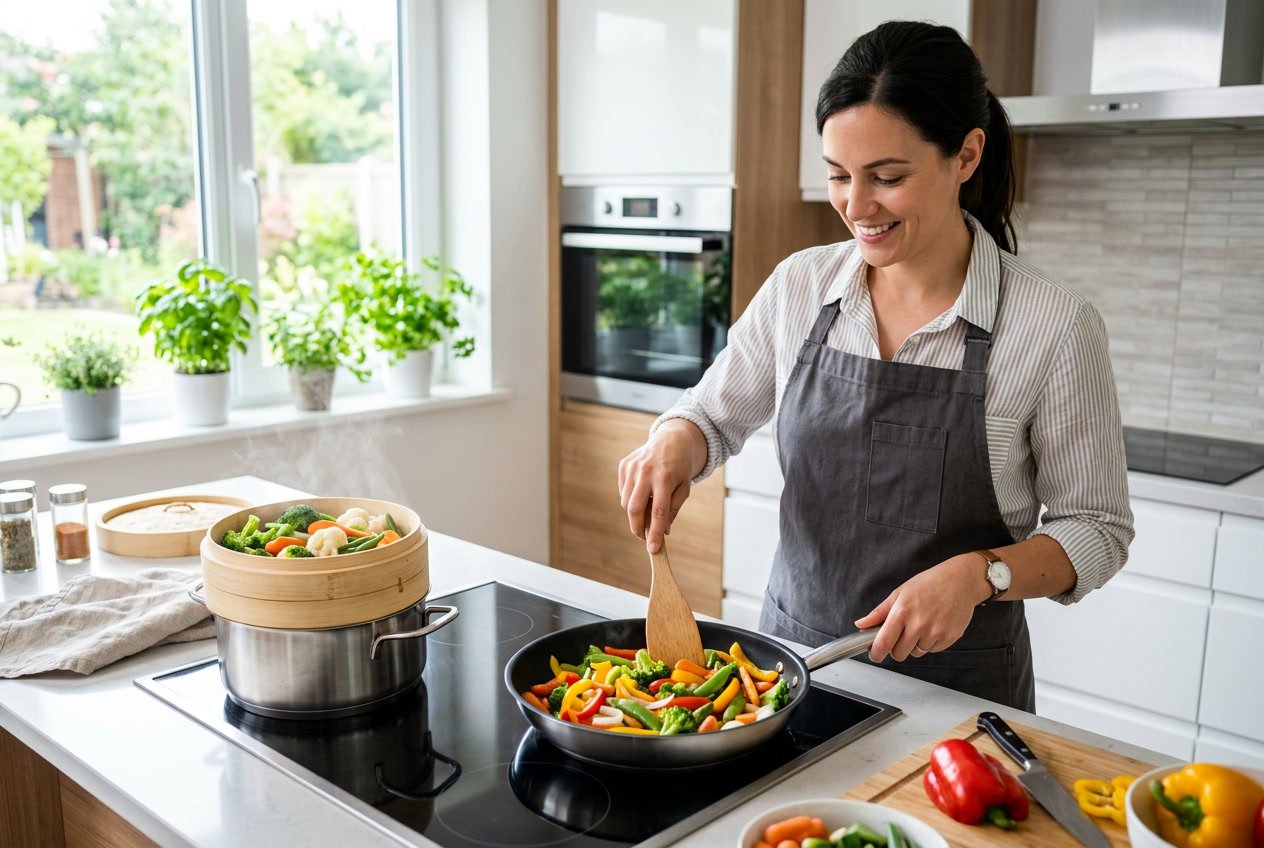
You don’t need oil to cook great food. That might sound like a bold claim, especially if you’ve spent years reaching for the olive oil bottle out of habit, but the truth is that most cooking methods work beautifully without it.
Whether you’re exploring oil free cooking for heart health, weight management, or simply to reduce added fat in your diet, you have far more options than you might think. From ancient techniques like pit roasting and clay pot cooking to modern methods like sous vide and infrared cooking, this guide walks you through all 34 oil free cooking methods — what they are, how they work, and exactly how to use them in your kitchen.
Key Insight: Oil is a cooking medium, not a cooking requirement. In most methods, it serves as a heat conductor or moisture barrier — both of which can be replicated with water, broth, steam, or the food’s own natural moisture.
1. Dry Roasting
Dry roasting uses oven heat alone to cook food, relying on the natural sugars and moisture inside ingredients to create browning and flavor. It works especially well for vegetables, nuts, seeds, and legumes. When you roast without oil, the exterior of your food still caramelizes beautifully — it just takes a bit more attention to prevent sticking.
To dry roast vegetables, preheat your oven to 400–425°F and spread your ingredients in a single layer on a parchment-lined baking sheet. The parchment eliminates sticking without adding fat. Flip halfway through cooking, and don’t overcrowd the pan — crowding traps steam and prevents browning.
- Best for: root vegetables, cauliflower, chickpeas, nuts, seeds
- Key tip: use parchment paper or a silicone baking mat to prevent sticking
- Temperature range: 375–450°F depending on the ingredient
Pro Tip: Toss vegetables in a small amount of vegetable broth or aquafaba before dry roasting to help seasonings adhere and promote browning without any added fat.
2. Baking
Baking without oil is one of the most versatile oil free cooking methods available, and it applies to far more than just bread and cakes. You can bake casseroles, stuffed vegetables, grain dishes, and protein-rich meals entirely without fat. The key is understanding what role oil plays in a given recipe so you can replace it intelligently.
In savory baking, oil typically adds moisture and prevents sticking. You can substitute unsweetened applesauce, mashed banana, pumpkin puree, or plain yogurt in equal amounts for most recipes. For oil free baking tips that apply to sweet recipes, aquafaba (the liquid from canned chickpeas) works well as a binding agent, while flax eggs add structure.
For more ideas on ingredient substitutions that keep your baking on track, check out these best egg substitutes for cooking that pair naturally with oil free approaches.
- Best for: breads, muffins, casseroles, stuffed peppers, baked oats
- Oil substitutes: applesauce, pumpkin puree, mashed banana, yogurt, aquafaba
- Key tip: reduce oven temperature by 25°F when using fruit-based substitutes to prevent over-browning
3. Broiling
Broiling uses intense direct heat from above to cook food quickly, creating a charred, caramelized surface similar to grilling. Because the heat is so high and direct, oil isn’t necessary — the food’s own sugars and moisture do the work. Broiling is one of the fastest oil free cooking methods for proteins and vegetables alike.
Place your food on a broiler-safe rack so air circulates underneath. A light brush of citrus juice, soy sauce, or vegetable broth before broiling adds flavor and helps with surface browning. Keep the oven door slightly ajar and watch carefully — broiling happens fast, and the difference between perfectly charred and burnt is often just a minute.
Important Note: Position your rack 4–6 inches from the broiler element for most foods. Thinner cuts and vegetables can go closer; thicker proteins need more distance to cook through before the surface burns.
4. Grilling
Grilling is one of the most naturally oil free cooking methods because the high heat of the grill grates creates a non-stick effect through the Maillard reaction — the same chemical process that produces browning and deep flavor. You don’t need to oil the grates if you preheat them properly and let the food cook long enough to release naturally before flipping.
For vegetables, marinate in citrus juice, vinegar, herbs, and spices before grilling. For proteins, a dry rub of spices works beautifully. The key is patience — food sticks when it isn’t ready to release, so resist the urge to move it too early. A well-preheated grill and properly marinated food make oil entirely unnecessary.
- Best for: corn, zucchini, bell peppers, mushrooms, tofu, fish, lean meats
- Key tip: preheat grill for at least 10 minutes before cooking
- Marinade base: citrus juice, vinegar, tamari, herbs, garlic
5. Steaming
Steaming is one of the gentlest and most nutrient-preserving oil free cooking methods available. Because food never touches boiling water, water-soluble vitamins like vitamin C and B vitamins stay in the food rather than leaching into the cooking liquid. It’s also one of the simplest methods — all you need is a pot, a steamer basket, and a few inches of water.
Steam vegetables until just tender-crisp for the best texture and nutrition. You can enhance flavor by adding aromatics to the steaming water — ginger, lemongrass, garlic, or fresh herbs infuse gently into the food as it cooks. Season after steaming with citrus, tamari, or a drizzle of rice vinegar for bright, oil free flavor.
For a practical look at how steaming compares to other preparation approaches, the broccoli cooking methods guide breaks down exactly how different techniques affect texture and nutrient retention.
6. Boiling
Boiling is straightforward and completely oil free by nature. It’s the go-to method for pasta, grains, legumes, and root vegetables, and it requires nothing more than water and heat. The challenge with boiling isn’t the technique itself — it’s avoiding the habit of adding oil to the water, which is unnecessary and doesn’t prevent pasta from sticking (draining and tossing immediately does).
Season your boiling water generously with salt for grains and pasta. For vegetables, keep boiling times short to preserve color, texture, and nutrients. Once boiled, toss immediately with herbs, citrus, or a sauce rather than oil to keep things flavorful and fat free.
Common Mistake: Adding oil to pasta water doesn’t prevent sticking — it actually coats the pasta and prevents sauces from adhering. Skip it entirely and stir the pasta during the first two minutes of cooking instead.
7. Poaching
Poaching involves cooking food gently in simmering liquid — typically water, broth, wine, or a flavored court bouillon — at a temperature between 160–180°F. Because the liquid itself carries flavor directly into the food, poaching is one of the most flavor-efficient oil free cooking methods. It’s especially effective for delicate proteins like eggs, fish, and chicken.
The key to successful poaching is temperature control. The liquid should barely move — small bubbles at the bottom of the pan, not a rolling boil. Add aromatics like bay leaves, peppercorns, lemon slices, and fresh herbs to the poaching liquid to build layers of flavor. If you’re using wine as part of your poaching liquid, these wine substitutes for cooking offer excellent oil free alternatives that maintain depth of flavor.
- Best for: eggs, salmon, chicken breast, pears, stone fruits
- Ideal temperature: 160–180°F (gentle simmer, not boiling)
- Flavor builders: bay leaf, peppercorns, lemon, fresh herbs, garlic
8. Simmering
Simmering sits just below boiling at around 185–205°F and is the foundation of soups, stews, sauces, and braises. It’s inherently oil free when you build your flavor base without fat — which is entirely possible using aromatics, tomato paste, and spices added directly to liquid.
To build a rich simmer without oil, start by dry-toasting your spices in the pot for 30–60 seconds before adding liquid. This blooms the spices and releases their essential oils into the dish without any added fat. Then add your aromatics, liquid, and remaining ingredients and let everything meld together over gentle heat.
Pro Tip: A tablespoon of tomato paste added to a simmering broth and cooked for two minutes before adding other ingredients creates a deep, savory base that rivals any oil-sautéed foundation.
9. Braising
Braising combines dry heat and moist heat: food is first seared or browned, then cooked slowly in a small amount of liquid in a covered pot. According to Wikipedia’s overview of braising , the technique is particularly well-suited to tougher cuts of meat and dense vegetables because the long, slow cooking breaks down connective tissue and concentrates flavor.
For oil free braising, skip the initial sear with oil and instead use a dry-hot pan or a splash of broth to brown your ingredients. The browning step adds flavor through caramelization — you can achieve this without fat by using a very hot, heavy-bottomed pan (cast iron works especially well) and allowing the food to sit undisturbed until it naturally releases. Then add your braising liquid and proceed as normal.
- Best for: cabbage, fennel, leeks, lentils, tougher cuts of meat, tofu
- Braising liquid options: vegetable broth, tomato juice, wine alternatives, citrus juice
- Key tip: use a heavy-bottomed, oven-safe pot with a tight-fitting lid
10. Pressure Cooking
Pressure cooking uses steam pressure to raise the boiling point of water, cooking food significantly faster than conventional methods. It’s completely oil free and exceptionally efficient for legumes, grains, tough vegetables, and proteins. A dish that takes 90 minutes on the stovetop can be ready in 15–20 minutes under pressure.
Modern electric pressure cookers like the Instant Pot have made this technique accessible to everyday cooks. You can sauté aromatics directly in the pot using the sauté function with just a splash of broth or water, then seal the lid and pressure cook — no oil required at any stage. The sealed environment also locks in flavor and nutrients that would otherwise escape as steam.
Key Insight: Pressure cooking is one of the best oil free cooking methods for dried beans and lentils. It eliminates the need for overnight soaking and produces creamy, fully cooked legumes in a fraction of the time.
11. Slow Cooking
Slow cooking in a crockpot or slow cooker is naturally suited to oil free cooking because the long, low-heat environment creates its own moisture from the ingredients inside. Vegetables release liquid, proteins render their own juices, and everything melds together into deeply flavored dishes without any added fat.
The main adjustment for oil free slow cooking is the aromatics. Rather than sautéing onions and garlic in oil before adding them to the slow cooker, simply add them raw — they’ll soften and sweeten over hours of cooking. For extra depth, add a tablespoon of tomato paste, a splash of soy sauce or tamari, or a teaspoon of smoked paprika directly to the pot.
12. Microwaving
Microwaving is one of the most underrated oil free cooking methods for everyday meals. It works by exciting water molecules inside food with electromagnetic waves, generating heat from within rather than from an external source. This means food essentially steams itself, requiring no added fat at all.
Microwaving is ideal for vegetables, reheating grains, cooking fish, and preparing quick sauces. For vegetables, add a tablespoon of water to the dish, cover with a microwave-safe lid or damp paper towel, and cook in short bursts to avoid overcooking. The result is tender, brightly colored vegetables that retain more nutrients than boiling.
- Best for: vegetables, fish fillets, reheated grains, steamed dumplings, poached eggs
- Key tip: always cover food and add a small amount of water to create steam
- Avoid: foods that need browning or crisping — microwaving produces soft textures only
13. Air Frying
Air frying uses rapid hot air circulation to mimic the crispy results of deep frying without any oil — or with just a minimal spray. It’s one of the most popular oil free cooking methods precisely because it delivers the texture people associate with fried food: crispy exteriors, tender interiors, and satisfying crunch. For a comprehensive look at how this fits into the broader landscape of different types of cooking methods, air frying represents one of the most significant recent innovations in home cooking.
To get the best results without oil, don’t overcrowd the air fryer basket — food needs space for air to circulate. Shake or flip halfway through cooking. A light coating of aquafaba or a mist of water on the surface of foods like tofu or vegetables helps seasonings stick and promotes crispiness without fat.
Pro Tip: For oil free air fried tofu, press it thoroughly, cube it, toss in tamari and cornstarch, then air fry at 400°F for 15 minutes. The cornstarch creates a crispy shell without a single drop of oil.
14. Dry Sautéing
Dry sautéing means cooking food in a hot pan with no liquid and no oil, relying entirely on the food’s own moisture to prevent sticking. It works best for mushrooms, onions, and other high-moisture vegetables that release liquid as they cook. As that moisture evaporates, the natural sugars concentrate and caramelize, producing deep, rich flavor.
The technique requires a heavy-bottomed pan — stainless steel or cast iron — heated until very hot before adding food. Spread the food in a single layer and resist stirring. The food will initially stick, then release naturally as its moisture evaporates and browning begins. This is one of the most effective oil free sautéing techniques for building flavor without fat.
- Best for: mushrooms, onions, bell peppers, cherry tomatoes
- Key tip: use a heavy pan and get it very hot before adding food
- Watch for: don’t add salt too early — it draws out moisture before browning can occur
15. Water Sautéing
The water sautéing method is one of the most practical oil free sautéing techniques for everyday cooking. Instead of oil, you use small amounts of water — typically 2–4 tablespoons at a time — to keep food moving in the pan and prevent sticking. The water evaporates quickly, so you add more as needed, and the food softens and develops flavor through the heat of the pan.
Start with a hot pan, add your aromatics (onion, garlic, ginger), then add 2–3 tablespoons of water. Stir frequently and add more water in small amounts whenever the pan looks dry. The result is softened, flavorful aromatics that form a perfect base for soups, stews, and sauces — all without a drop of oil. According to Forks Over Knives , water sautéing is one of the simplest and most effective transitions for anyone learning how to cook without oil.
16. Broth Sautéing
Broth sautéing works exactly like water sautéing but uses vegetable, chicken, or beef broth as the cooking liquid instead of plain water. This adds a significant flavor advantage — the broth’s natural compounds infuse into your aromatics and vegetables as they cook, building a more complex base than water alone can provide.
Use low-sodium broth so you can control the salt level of your dish. Add 2–4 tablespoons at a time, allowing it to reduce and concentrate between additions. The slight stickiness that forms on the pan between additions — called fond — is pure flavor. Deglaze it with the next addition of broth and stir it back into your food. These white wine substitutes for cooking work particularly well as broth sautéing liquids when you want a brighter, slightly acidic flavor profile.
Key Insight: The fond that builds up between broth additions is one of the richest sources of flavor in oil free cooking. Never discard it — always deglaze and incorporate it back into the dish.
17. Stir Frying With Water
Traditional stir frying uses high heat and oil to cook food quickly in a wok. When you stir fry with water instead, the technique stays the same — high heat, constant movement, small pieces of food — but water replaces oil as the cooking medium. The result is lighter, brighter, and significantly lower in calories.
Use a well-seasoned wok or a large, heavy skillet over the highest heat your stove can produce. Add 2–3 tablespoons of water and your ingredients immediately, keeping everything moving constantly. Add more water in small amounts as needed. The high heat causes the water to flash-evaporate, creating a brief steaming effect that cooks food rapidly while preserving color and crunch.
18. Stir Frying With Broth
Stir frying with broth follows the same high-heat, fast-movement principle as water stir frying but delivers noticeably more flavor. Broth adds savory depth that complements Asian-inspired dishes, vegetable medleys, and grain bowls. It also reduces slightly as it cooks, creating a light glaze on your ingredients.
For the best results, use a broth that complements your dish — vegetable broth for plant-based stir fries, chicken broth for poultry-based dishes. Add a splash of soy sauce, rice vinegar, or sesame-free hoisin to the broth before cooking to build a more complex sauce. Keep everything moving in the pan and work in batches if cooking large quantities to maintain high heat throughout.
- Best for: bok choy, snap peas, broccoli, mushrooms, tofu, shrimp
- Broth amount: 2–4 tablespoons at a time, adding more as needed
- Flavor add-ins: soy sauce, rice vinegar, ginger, garlic, five-spice
19. Blanching
Blanching involves briefly cooking food in boiling water — usually 30 seconds to 3 minutes — then immediately transferring it to an ice bath to stop cooking. It’s completely oil free and serves several purposes: it preserves vibrant color, partially cooks vegetables for use in other dishes, loosens skins for peeling, and reduces bitterness in greens like kale and broccoli rabe.
Blanching is also a critical step in meal prep. Blanched vegetables can be refrigerated for several days or frozen for months without losing color or texture. For a detailed look at how blanching compares to other preparation techniques for specific vegetables, the broccoli cooking methods guide covers timing and technique in detail.
Pro Tip: Add a generous pinch of salt to your blanching water — it seasons the vegetables and helps maintain their bright green color by neutralizing acids released during cooking.
20. Sous Vide
Sous vide (French for “under vacuum”) involves sealing food in a bag and cooking it in a precisely temperature-controlled water bath for an extended period. The technique produces extraordinarily consistent results — proteins cooked to the exact doneness you want, edge to edge, every time. And because the food cooks in its own juices inside the sealed bag, no oil is needed at any stage.
You’ll need an immersion circulator and food-safe bags (vacuum-sealed or zip-lock with the air pressed out). Season your food directly in the bag with herbs, spices, citrus, and broth or a splash of soy sauce. The extended cooking time allows flavors to penetrate deeply. After sous vide cooking, you can finish proteins in a very hot dry pan for a brief sear to develop surface texture — no oil required if your pan is hot enough and your protein is dry.
- Best for: chicken breast, salmon, eggs, root vegetables, pork tenderloin
- Temperature examples: chicken breast at 145°F for 1.5 hours; salmon at 125°F for 45 minutes
- Key tip: dry the surface of proteins thoroughly before the finishing sear for maximum browning
21. Smoking
Smoking is one of the oldest cooking methods in human history and one of the most naturally oil free. Food is cooked by exposure to smoke from smoldering wood chips, chunks, or pellets at low temperatures over long periods. The smoke itself carries flavor compounds that penetrate the food, creating the distinctive depth associated with smoked meats, fish, and vegetables.
You can cold smoke (below 90°F) for flavor without cooking, or hot smoke (225–250°F) to cook food through. Neither method requires oil. For oil free smoking, season your food with dry rubs of spices, herbs, salt, and pepper. The smoke does the heavy lifting on flavor. Wood choice matters: hickory and mesquite are bold and assertive; apple and cherry wood are milder and sweeter.
Key Insight: Smoked paprika, liquid smoke, and smoked salt are oil free ways to add smoky flavor to dishes when you don’t have access to a smoker — a useful technique for everyday cooking.
22. Salt Crusting
Salt crusting involves encasing food — typically whole fish, chicken, or root vegetables — in a thick shell of coarse salt before baking. The salt crust creates a sealed environment that traps moisture and heat inside, essentially steaming the food from within. The result is exceptionally moist, evenly cooked food with a subtle seasoning that penetrates without making the food overly salty.
To make a salt crust, mix coarse salt with egg whites and sometimes fresh herbs or spices until it reaches a paste-like consistency. Pack it firmly around your food, completely sealing it, and bake at 400–450°F. Crack the crust open at the table for dramatic presentation. No oil is needed at any point — the salt crust does everything.
23. En Papillote
En papillote is a French technique that translates to “in parchment.” Food is sealed inside a folded parchment paper packet with aromatics, a splash of broth or wine alternative, and seasonings, then baked. The sealed packet traps steam, cooking the food in its own moisture and the added liquid — no oil required.
This method works beautifully for fish, chicken, and vegetables. Assemble each packet on a sheet of parchment, add a tablespoon of broth or citrus juice, season generously, fold and crimp the edges tightly to seal, and bake at 400°F for 12–20 minutes depending on the protein. The packets puff up dramatically in the oven and can be served directly at the table. For wine-free liquid options that work equally well in en papillote cooking, these red wine substitutes for cooking provide flavorful, oil free alternatives.
- Best for: fish fillets, chicken breast, asparagus, zucchini, cherry tomatoes
- Liquid options: broth, citrus juice, wine alternatives, tomato juice
- Key tip: crimp edges tightly — any gaps will allow steam to escape and the food will dry out
24. Clay Pot Cooking
Clay pot cooking is one of the world’s oldest culinary traditions, used across North Africa, Asia, the Middle East, and Europe for thousands of years. Unglazed clay pots absorb water when soaked before use, then release that moisture as steam during cooking — creating a self-basting, oil free environment that keeps food exceptionally moist and flavorful.
Soak your clay pot in cold water for 15–30 minutes before use. Add your ingredients — vegetables, legumes, grains, or proteins — with broth, tomatoes, or other liquid, season generously, and place in a cold oven (clay pots can crack if placed directly in a preheated oven). Bring the temperature up slowly to 375–400°F. The result is deeply flavored, tender food cooked entirely without fat.
Important Note: Always start clay pots in a cold oven and bring the temperature up gradually. Thermal shock from placing a clay pot directly into a hot oven can cause cracking.
25. Stone Cooking
Stone cooking uses the heat-retaining properties of natural stone — typically granite, basalt, or soapstone — to cook food. The stone is heated to very high temperatures, then food is placed directly on its surface. The intense, even heat sears food rapidly without any oil, creating a beautifully browned exterior through direct conduction.
Tabletop volcanic stone grills and heated stone slabs are available for home use. Heat your stone in the oven at 500°F for at least 30 minutes before cooking. The high surface temperature means proteins and vegetables cook quickly — thin slices of meat, fish, and vegetables work best. The porous surface of natural stone also adds a subtle mineral character to food.
26. Plancha Cooking
A plancha is a flat, smooth metal cooking surface — essentially a flat-top griddle — that cooks food through direct contact with intense, even heat. Popular in Spanish cuisine and increasingly common in restaurant and home kitchens, plancha cooking produces beautifully seared food without oil when the surface is properly preheated.
Heat your plancha or flat cast iron griddle until it’s extremely hot — a drop of water should evaporate instantly on contact. Place food directly on the surface and allow it to sear undisturbed until it releases naturally. The high heat creates a non-stick effect through the Maillard reaction. Vegetables, seafood, and thinly sliced proteins all cook beautifully on a plancha without any added fat.
27. Infrared Cooking
Infrared cooking uses electromagnetic radiation in the infrared spectrum to heat food directly, bypassing the air entirely. Infrared grills, broilers, and countertop cookers heat food from the inside out and from the surface simultaneously, producing faster cooking times and exceptional browning without oil. According to research discussed at Nutrition Studies , dry-heat methods like infrared cooking are among the most effective for reducing added fat while preserving flavor.
Infrared grills are particularly good for proteins — steaks, chicken, fish — because the intense heat sears the surface rapidly while cooking the interior evenly. The high temperature also reduces flare-ups compared to traditional gas grills. No oil is needed; the food’s own natural fats (or moisture, in the case of vegetables) provide sufficient lubrication.
28. Convection Baking
Convection baking uses a fan to circulate hot air throughout the oven, cooking food more evenly and efficiently than conventional baking. The moving air removes the layer of cool, moist air that surrounds food during standard baking, accelerating browning and crisping — which means you can achieve better results without oil at lower temperatures and shorter cooking times.
When converting a standard recipe to convection baking, reduce the temperature by 25°F or reduce the cooking time by about 25%. This is especially useful for oil free baking because the enhanced browning compensates for the lack of fat on the surface. Vegetables roasted in a convection oven without oil come out noticeably crispier than those roasted in a standard oven.
- Best for: roasted vegetables, baked proteins, cookies, bread, casseroles
- Temperature adjustment: reduce by 25°F compared to standard baking
- Time adjustment: check 5–10 minutes earlier than recipe suggests
Pro Tip: Convection baking is ideal for oil free granola. The circulating air ensures every cluster dries and crisps evenly without the fat typically used to bind and brown the oats.
29. Flash Frying With Water
Flash frying with water is a technique borrowed from professional kitchens where food is cooked very briefly in a small amount of rapidly boiling water in a very hot pan. The water flash-evaporates on contact with the hot pan surface, creating an intense burst of steam that cooks food almost instantaneously. It’s particularly effective for thin, delicate ingredients that need only seconds of cooking.
Heat a heavy pan or wok over maximum heat until smoking. Add 2–3 tablespoons of water and your ingredients simultaneously — the water will evaporate within seconds. The brief contact with the extremely hot pan surface sears and cooks the food in one rapid motion. This method works best for thinly sliced vegetables, leafy greens, and pre-cooked proteins.
30. Steaming in Banana Leaves
Steaming food wrapped in banana leaves is a traditional technique used throughout Southeast Asia, the Caribbean, and Central America. The banana leaf wrapping acts as a natural cooking vessel, trapping moisture and imparting a subtle, slightly grassy, floral flavor to the food inside. It’s completely oil free and produces beautifully moist results.
Soften banana leaves briefly over a flame or in boiling water to make them pliable. Place your seasoned food — rice, fish, chicken, or vegetables — in the center of the leaf, add aromatics and a splash of coconut water or broth, and fold into a neat parcel. Steam over boiling water for 20–45 minutes depending on the filling. The result is food that is simultaneously steamed and lightly infused with the leaf’s natural compounds.
Key Insight: Banana leaves are available fresh or frozen at most Asian and Latin grocery stores. Parchment paper makes an acceptable substitute if banana leaves aren’t available, though it won’t impart the same subtle flavor.
31. Pit Roasting
Pit roasting is one of humanity’s oldest cooking techniques, practiced by cultures across every continent for thousands of years. Food — typically whole animals, large cuts of meat, or root vegetables — is slow-cooked in a pit dug into the earth, lined with hot coals or heated stones. The earth itself acts as an insulator, trapping heat and moisture for hours of gentle, even cooking.
Modern interpretations of pit roasting include Hawaiian luaus (imu), Mexican barbacoa pits, and Polynesian umu. The method is inherently oil free — the food cooks in its own juices and the steam generated by moisture in the earth and the food itself. Wrapping food in banana leaves, corn husks, or burlap before placing it in the pit adds moisture retention and flavor.
32. Tandoor Cooking
Tandoor cooking uses a cylindrical clay oven — the tandoor — heated by charcoal or wood to temperatures between 480–900°F. Food is cooked by three simultaneous mechanisms: radiant heat from the clay walls, convective heat from the hot air inside, and conductive heat from the charcoal. This combination produces food with charred exteriors, smoky flavor, and juicy interiors — all without oil.
Traditional tandoor dishes include naan (bread baked on the clay walls), tandoori chicken (marinated in yogurt and spices), and seekh kebabs. The high-fat marinades used in restaurant versions are entirely optional — a yogurt and spice marinade provides sufficient moisture and flavor for oil free tandoor cooking. The intense heat does the rest.
- Best for: flatbreads, marinated proteins, vegetables on skewers, paneer
- Temperature: 480–900°F (significantly hotter than a conventional oven)
- Oil free marinade base: plain yogurt, lemon juice, ginger, garlic, spices
33. Hot Stone Cooking
Hot stone cooking — distinct from the tabletop stone cooking described earlier — refers to the traditional practice of heating stones in a fire and using them to cook food either by direct contact or by placing them inside a cooking vessel. Indigenous cultures worldwide have used this technique for millennia, from Māori hāngī cooking in New Zealand to Native American stone boiling.
In stone boiling, heated stones are placed directly into a liquid-filled vessel — a basket, clay pot, or hide — to bring it to a boil without an external heat source under the vessel. In direct stone cooking, food is placed on or wrapped around heated stones. Both methods are completely oil free and rely entirely on stored heat energy from the stones. This connects beautifully to the broader tradition of diverse cooking methods that humans have developed across cultures and centuries.
34. Sand Cooking
Sand cooking uses heated sand as a cooking medium, transferring heat to food through conduction from millions of tiny contact points simultaneously. It’s practiced in parts of Egypt, Turkey, and the Middle East, where coffee is traditionally prepared in small pots buried in hot sand — a method that produces exceptionally smooth, evenly heated results. The technique is also used for cooking eggs, potatoes, and small fish.
The sand is heated over a flame until very hot, then food (in a pot or wrapped directly) is buried in it. The sand distributes heat evenly from all sides simultaneously, preventing hot spots and producing consistent results. Because the food cooks in its own moisture within the sand’s heat, no oil is needed. It’s one of the most unusual oil free cooking methods, but the results — particularly for coffee and eggs — are genuinely remarkable.
Pro Tip: Turkish sand coffee (kumda kahve) is prepared in a long-handled pot called a cezve, buried in hot sand and swirled gently as it heats. The sand’s even heat prevents scorching and produces a rich, smooth brew that’s impossible to replicate on a direct flame.
Cooking without oil is less about restriction and more about expanding your culinary toolkit. Each of the 34 methods in this guide demonstrates that fat free cooking methods aren’t a compromise — they’re simply a different set of techniques, many of them older, more nuanced, and more flavorful than the oil-dependent shortcuts that became standard in modern kitchens.
Start with the methods closest to your current cooking habits. If you sauté regularly, try water sautéing or broth sautéing this week. If you roast vegetables, switch to parchment-lined dry roasting. Once those feel natural, explore further — try en papillote for your next fish dinner, experiment with clay pot cooking on a weekend, or set up a simple sous vide setup for consistently perfect proteins. For more inspiration across different ingredients and healthy cooking without added fat, explore the full range of catfish cooking methods that apply many of these same oil free principles to a specific protein.
The goal isn’t perfection from day one. It’s building a repertoire of techniques that make oil free cooking feel natural, satisfying, and genuinely delicious — because it absolutely can be all three.