Why Your Preschooler Can’t Focus (And When You Actually Need to Worry)

April 6, 2026
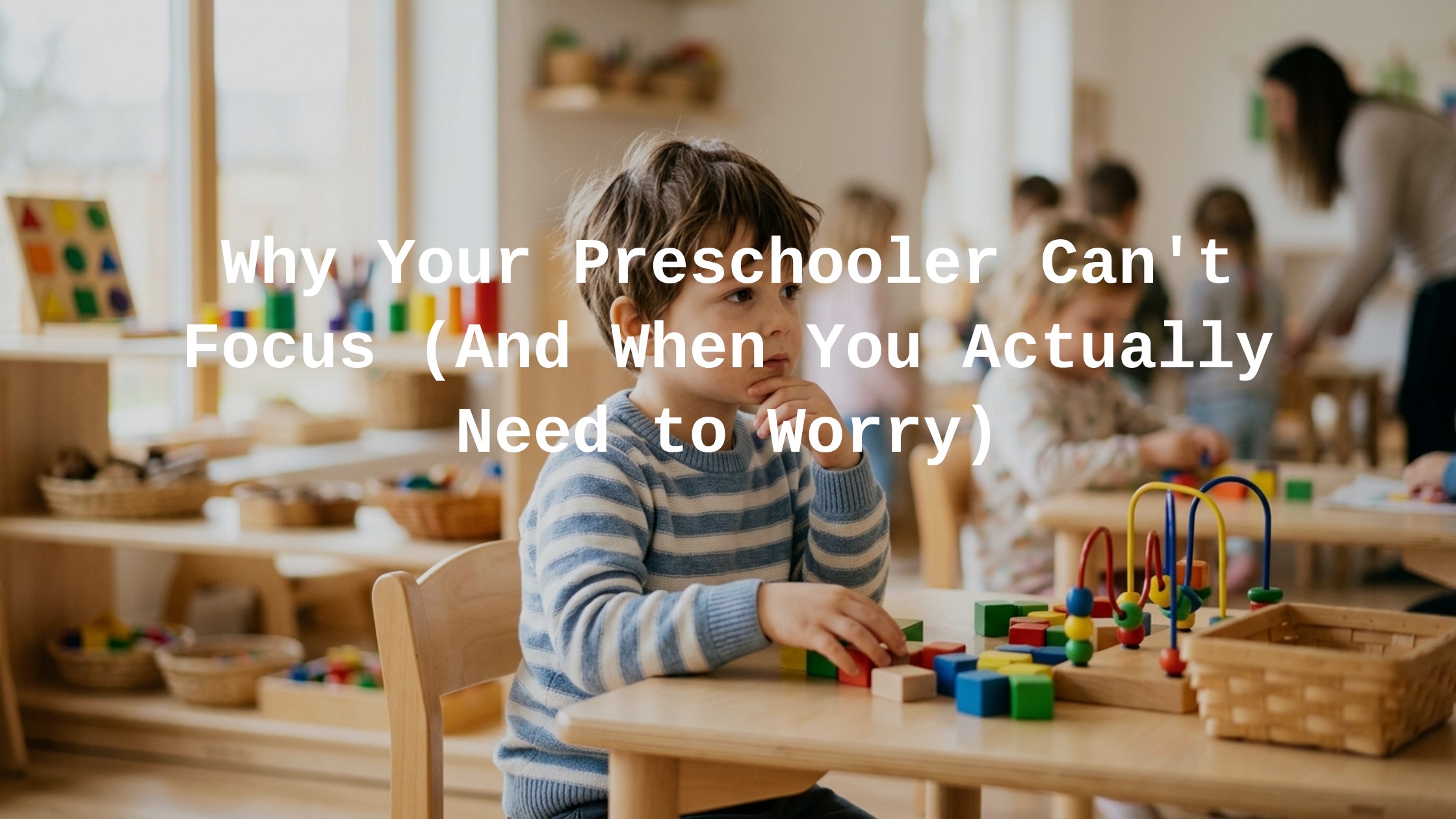
You’ve asked your child to sit down and finish a puzzle three times in the last five minutes. They’re now spinning in circles, narrating an imaginary adventure, and somehow have a sock on one hand. Sound familiar?
If you’re wondering whether your preschooler’s inability to focus is normal — or a sign of something more — you’re in very good company. The short answer is: it’s almost certainly normal. But there’s more to the story, and understanding it can make daily life a whole lot easier for both of you.
The Short Answer
Yes, it is completely normal for a preschooler to have trouble focusing. It’s very common for preschoolers to be distracted, active, and impulsive. This isn’t a character flaw, a parenting failure, or necessarily a sign of a developmental disorder — it’s simply what preschool-age brains do.
Childhood development experts generally say that an average attention span by age is just two to three minutes per year of a child’s age — that’s the period of time for which a typical child can maintain focus on a given task. So for a 4-year-old, you’re looking at roughly 8 to 12 minutes on a good day, with a task they actually enjoy.
Key Insight: According to research cited by Beyond BookSmart, a 3- to 4-year-old’s typical attention span is approximately three to eight minutes. Expecting more than that from your preschooler isn’t just unrealistic — it can add unnecessary stress for both of you.
Attention span not only varies by age — it varies depending on the type of task, setting, emotional state, and more. In other words, the same child who can’t sit through a five-minute story might spend 20 minutes carefully arranging toy animals. That’s not inconsistency; that’s a developing brain doing exactly what it’s supposed to do.
Why Preschoolers Have Trouble Focusing
There’s a very real biological reason your child bounces from one thing to the next — and it starts in the brain. In the brain, attention span is mainly controlled by the frontal lobe. As the frontal lobe matures, so does a child’s attention span.
Here’s the key detail: the frontal lobe — and specifically the prefrontal cortex — is one of the last parts of the brain to fully develop. The gradual development of focus and concentration continues throughout early childhood and even into adolescence, mostly enabled by the prefrontal cortex as it matures. Your preschooler is working with a brain that is still very much under construction.
There’s also a fascinating developmental mismatch at play. The limbic system — responsible for emotions — matures early, while the prefrontal cortex, which acts as the brain’s “brakes,” matures later. This creates a “developmental gap” where a child’s age and energy level progress faster than their brain’s ability to regulate impulses and behavior.
Beyond brain development, there’s another reason preschoolers scatter their attention so freely: it actually serves a purpose. A child’s brain develops rapidly during the first few years of life. They constantly process new information, make neural connections, and learn about the world around them. This continuous influx of data can make it challenging for them to stay focused on a single object or task for very long. But their inability to pay attention to one thing may actually have a developmental upside — it allows them to take in a wider variety of information about their environment.
Pro Tip: When your child darts from activity to activity, they’re not being defiant — they’re absorbing everything. Try narrating what they’re exploring rather than redirecting them back to a single task.
Emotional regulation is also deeply tied to focus. Research has explored the associations between sustained attention development during the toddlerhood to preschool period and toddlers’ emotion regulation strategies. Simply put, a child who is excited, frustrated, hungry, or overtired will have a much harder time staying on task — not because they’re choosing not to, but because their brain doesn’t yet have the tools to manage those feelings while also concentrating.
Understanding mindful parenting approaches can help you tune into your child’s emotional state before expecting focused behavior from them.
When It Is Normal — and When It’s a Concern
Most of what you’re seeing in your preschooler is developmentally expected. All kids can occasionally struggle with focus, especially since they’re still learning and growing. Here’s a helpful way to think about the difference between typical and potentially concerning behavior:
| Typically Normal in Preschoolers | Worth Monitoring More Closely |
|---|---|
| Moves between activities frequently | Cannot stay focused even on favorite activities |
| Has trouble sitting still during long tasks | Cannot sit through a meal or short bedtime story |
| Gets distracted by new sounds or sights | Seems unable to filter any background stimulation |
| Needs reminders to finish tasks | Never completes any task, even preferred ones |
| Struggles to focus when tired or hungry | Struggles to focus regardless of rest or mood |
| Energetic and impulsive at home | Behavior causes problems in multiple settings |
Typical preschoolers might sometimes have a hard time sitting still during circle time at school, or they might be really energetic at home. But overly distractible preschoolers may have so much trouble with focus that they can’t even pay attention when they want to.
Keep in mind that average attention spans are only generalizations. How long your child is truly able to focus will be significantly influenced by factors like the number and type of nearby distractions, hunger, fatigue, and subject matter. It’s also harder for kids to pay attention to something they have no interest in — which is true for all of us.
Your approach to parenting can also play a role in how much opportunity your child gets to practice sustained attention. Routines, calm environments, and play-based learning all support the natural development of focus over time.
How to Help Your Preschooler Focus
You don’t need to overhaul your entire household — small, consistent shifts can make a meaningful difference. Here are five strategies that work with your child’s developing brain rather than against it.
1. Match the Task to Their Attention Window
Always keep age-appropriate attention span expectations in mind. For example, does it make sense for a young child to tackle a project that requires 40 minutes of focus? That might be a stretch, but if you break it up into shorter sessions with a break in between, you are working with your child’s strengths.
For preschoolers, aim for activities that naturally wrap up in 5–10 minutes, or build in a physical break between segments of longer tasks.
2. Reduce Distractions Before You Begin
Keep distractions to a minimum. Turn any screens off, and look at the activity in a quiet place. A cluttered, noisy environment makes focusing harder for everyone — but especially for a preschooler whose brain is already taking in everything at once.
Think about the setup before the task: clear the table, turn off the TV, and sit with your child rather than calling instructions from another room.
3. Follow Their Lead
Follow your child’s lead. You’re likely to get better attention from them when the activity is something they’re excited about. This doesn’t mean your child only ever gets to do what they want — but it does mean you can use their interests as a bridge. A child obsessed with dinosaurs will focus longer on a dinosaur puzzle than a generic one.
Pro Tip: Use your child’s current obsession as the vehicle for learning. If they love trucks, count trucks, sort trucks by color, and build roads for trucks. The focus comes naturally when the content feels meaningful to them.
4. Move Their Body First
When your child needs a break to improve their attention span, get them moving. Encourage them to run around outside, play fetch with the dog, or put on some music and dance. Exercise is a great way to activate the brain and a child’s ability to comprehend and memorize.
Try some physical movement beforehand. Sometimes running around outside or doing some heavy work can help your child get ready to sit and focus. Even five minutes of active play before a quieter activity can make a noticeable difference.
5. Build a Predictable Routine
Establishing a predictable routine with short breaks can make it easier for your child to pay attention, as it can teach them how to regulate their attention span. When children know what to expect, they spend less mental energy on anticipating what’s next — and more on what’s in front of them.
Consistent meal times, nap times, and activity sequences give your child’s brain the scaffolding it needs to settle in. This is especially true for children who thrive with structure, which you can read more about in the context of different parenting styles.
Exploring gentle parenting techniques can also help you respond to focus challenges with warmth and patience rather than frustration, which keeps the dynamic positive and keeps your child more open to your guidance.
When It Becomes a Red Flag
While short attention spans are normal in preschoolers, there are specific patterns that deserve a closer look. The key distinction isn’t how often your child gets distracted — it’s whether their behavior is significantly out of step with other children their age and whether it’s causing real problems in daily life.
It’s very common for preschoolers to be distracted, active, and impulsive. That’s why young children won’t be diagnosed with ADHD unless their distractibility or activity level has a significant impact on daily life — for example, if the child’s behavior is causing difficulty with learning, making friends, or other activities.
Researchers at the Kennedy Krieger Institute suggest parents watch for the following patterns, which may be associated with an ADHD diagnosis when children reach school age:
- Dislikes or avoids activities that require paying attention for more than one or two minutes
- Loses interest and moves on after engaging in an activity for only a few moments
- Talks significantly more and makes more noise than other children of the same age
- Is nearly always restless — constantly kicking, jiggling, or twisting in their seat
- Gets into dangerous situations because of fearlessness or impulsivity
The most common early signs include constant, aimless movement (feeling “driven by a motor”), an inability to stop even when in physical danger, extreme distractibility in quiet settings, and meltdowns that are significantly more intense than typical tantrums.
It’s also worth knowing that not all attention difficulties point to ADHD. ADHD is often the first disorder associated with inattention, but it’s not always the correct diagnosis. Different forms of anxiety, obsessive-compulsive disorder, trauma, stress, or learning disorders may be the culprit.
Important Note: Sleep deprivation, nutritional gaps, and high stress levels can all mimic attention problems. Before assuming a developmental cause, consider whether your child is sleeping enough, eating well, and feeling emotionally safe.
If you and your child’s other parent are navigating separate households, it’s worth noting that transitions and stress can significantly affect a preschooler’s ability to focus. Resources on co-parenting and parallel parenting can help you maintain consistency across environments, which supports your child’s focus and emotional regulation.
When to Talk to Your Pediatrician
Knowing when to bring in a professional can feel tricky — you don’t want to overreact, but you also don’t want to wait too long if something needs support. Here’s a straightforward guide.
If you’re noticing attention issues in your child, try to keep it in perspective — chances are, it’s part of typical childhood development. At the same time, it’s important to listen to your gut. Talk with your pediatrician if you have concerns.
In order to be diagnosed with ADHD, a young child has to show several symptoms of inattention or hyperactivity/impulsivity in different settings — such as at home and in preschool. The symptoms also need to have been present for at least the past six months.
Reach out to your pediatrician if you notice any of the following:
- Your child’s focus difficulties are present in multiple settings (home, preschool, grandparents’ house) — not just one
- The behavior has been consistent for six months or more, not tied to a specific stressor or transition
- Your child struggles to focus even during activities they love and choose themselves
- Teachers or caregivers are independently raising concerns — without you prompting them
- The behavior is affecting your child’s ability to make friends, learn, or feel good about themselves
- You’re seeing intense meltdowns, dangerous impulsivity, or extreme restlessness beyond what peers show
There is no single medical test for ADHD. Instead, professionals evaluate behavior patterns across multiple settings like home and daycare. They also rule out “medical mimics,” such as hearing issues or nutrient deficiencies.
It’s a good idea to discuss your concerns about your child’s focus with their teachers. Do they also have concerns about the attention span? Is the child able to follow directions and participate in circle time and other activities in the classroom? If your concerns persist, talk with your child’s health care provider, who can help assess whether or not this may be ADHD and — even more important — provide you with some strategies to help address your concerns.
Also remember: it’s not true that ADHD can’t be diagnosed until third grade. Preschoolers can get an ADHD diagnosis. Early evaluation and support — when needed — is always better than waiting.
If you’re parenting across two households or navigating a blended family, consistency is especially important when managing a child’s attention challenges. Explore overcoming parenting differences for strategies that help both parents stay aligned. You might also find it helpful to look at conscious parenting principles, which emphasize understanding the root of a child’s behavior before responding.
Frequently Asked Questions
At what age should a preschooler be able to focus?
According to North Carolina A&T State University and Oxford Health NHS Foundation Trust, children aged 3 to 4 years old have an average attention span of approximately three to eight minutes. This grows gradually as the brain matures, so don’t expect sustained focus during the preschool years — expect short bursts with lots of movement in between.
My child can focus for a long time on screens but not on other things. Is that normal?
Yes — and it’s a common source of confusion. Screens are engineered to hold attention through rapid changes, sound effects, and reward loops that a puzzle or book simply can’t replicate. Studies show that giving a child too much screen time “has been found to negatively impact attention span and language and cognitive development.” The American Academy of Pediatrics recommends limiting children ages 2–5 to up to one hour of high-quality screen time per day.
Could my preschooler’s focus issues be related to anxiety?
Absolutely. A child who seems not to be focusing could have chronic worries that teachers and even parents are not aware of. Anxiety “tends to lock up the brain,” making it hard for anxious kids to concentrate. If your child seems worried, clingy, or easily overwhelmed alongside their focus challenges, it’s worth mentioning to your pediatrician.
Does diet affect a preschooler’s ability to focus?
It can play a role. What a child eats plays a critical role in their ability to concentrate. A diet high in processed foods, sugary snacks, and refined carbohydrates can lead to energy spikes followed by crashes, making it difficult for a child to maintain focus. Conversely, a diet rich in whole foods provides the necessary nutrients for healthy brain function.
Is it possible my child just needs more sleep?
Very possible. Adequate rest is essential for a child’s brain development, memory retention, and concentration. When children do not get enough sleep, it can result in difficulty focusing, irritability, and even behavioral issues. Preschoolers typically need 10–13 hours of sleep per day (including naps). If your child’s sleep is disrupted or inconsistent, that’s a great place to start before looking for other explanations.
My child’s preschool teacher mentioned ADHD. Should I be worried?
A teacher’s observation is worth taking seriously — but it’s not a diagnosis. Diagnosing ADHD in children requires expertise, since its symptoms are similar to normal behaviors in young kids. Talk to your pediatrician, share what the teacher observed, and ask for a referral to a developmental specialist if needed. Getting more information is always the right move. You can also explore different attachment parenting and intensive parenting approaches to understand how your relationship and involvement can support your child’s development in the meantime.