Your Preschooler Is Obsessed With One TV Show — Here’s What’s Really Going On

May 4, 2026
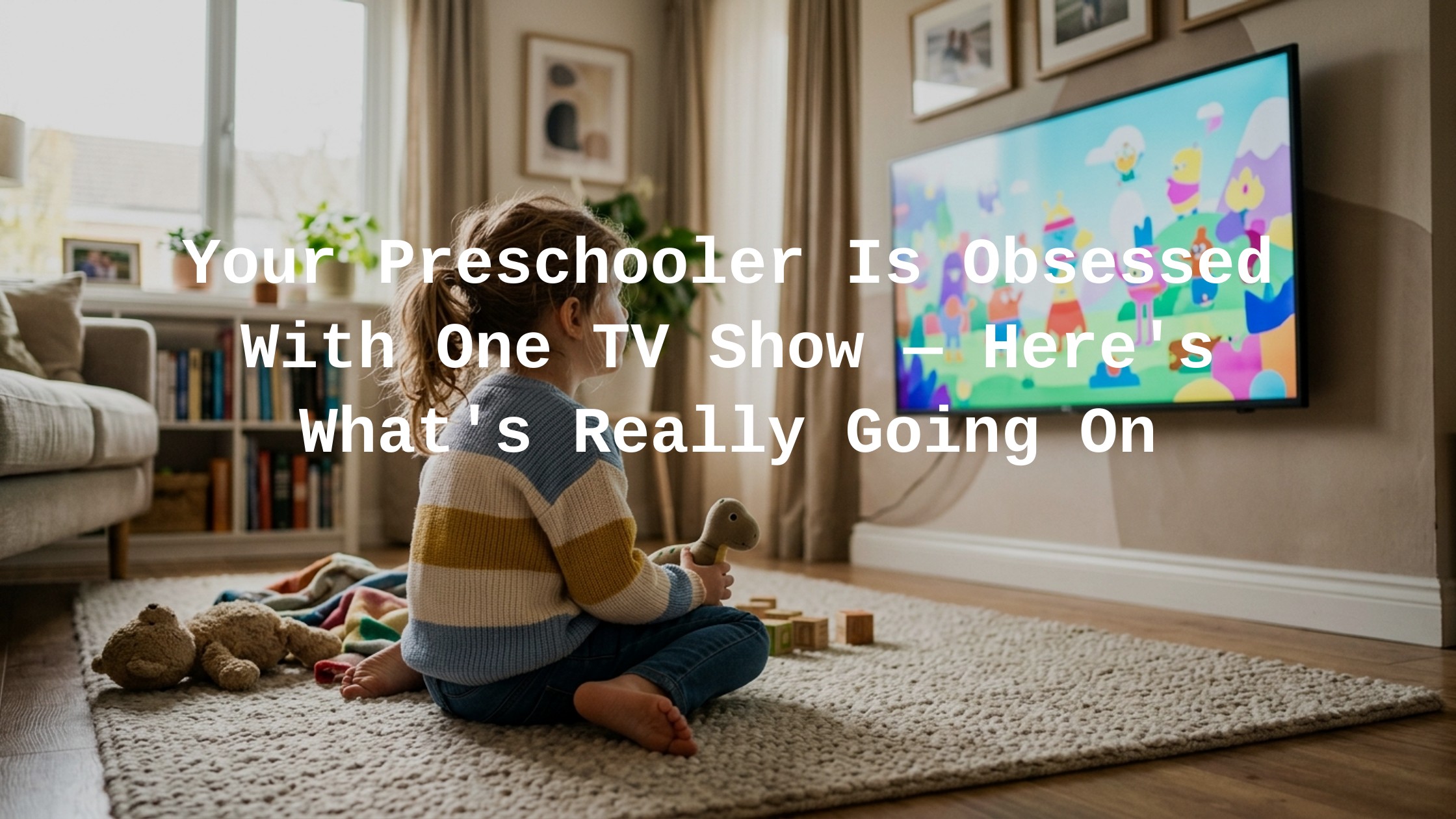
You’ve heard the theme song so many times you catch yourself humming it in the shower. Your child wants to watch the same episode — again — and the thought of sitting through it one more time makes you want to hide the remote. If your preschooler has latched onto a single TV show with the intensity of a tiny, passionate superfan, you’re in very good company.
The good news is that this kind of fixation is one of the most common things parents of young children report, and for most kids, it’s completely developmentally normal. Understanding why it happens — and knowing what to do about it — can make the whole experience feel a lot less maddening and a lot more manageable.
The Short Answer
Yes, it is normal for a preschooler to be obsessed with a TV show. According to child psychologists and mental health professionals, “show obsessions” are normal, developmentally useful, and often temporary. The repetition, the familiar characters, the predictable storyline — these aren’t signs that something is wrong with your child. They’re signs that your child’s brain is doing exactly what it’s supposed to do at this age.
That said, like most things in parenting, context matters. The obsession itself is rarely the problem; how much time is spent watching and what gets crowded out in the process are the real things worth paying attention to.
Pro Tip: The next time you feel frustrated by the repeat viewing, try watching one episode alongside your child. You’ll notice details you missed before — and so will they.
Why Preschoolers Get Fixated on the Same Show
There are several overlapping developmental reasons why young children lock onto one show and want to watch it on repeat. It’s not a quirk or a bad habit — it’s actually your child’s brain at work.
Repetition Is How Young Children Learn
Children have a lot to learn about themselves and the world, and a big part of the way they do this is through repetition. This applies to learning to walk, talk, and read — but it can also be said for TV shows and movies with a storyline. Each time your child watches the same episode, they’re picking up something new. Children may start by learning about the plot, and on subsequent viewings they may pick up more details about the characters, the songs, the context, or even the subtle twists and turns of the plot.
Cognitive science reveals that repetition helps kids detect patterns, a process critical for language and cognitive development. In other words, what looks like mindless re-watching is actually a form of active learning. Repetition helps children master new skills. Young children tend to repeat things to cement them into their brains — by repeatedly watching the same programs, they are learning more than we think they are.
It Provides Comfort and Emotional Regulation
Because life for a young child can be overwhelming, children might find comfort in watching the same thing on repeat as an attempt to self-soothe. This type of constant also provides a sense of security. “It’s comforting to have things be familiar and routine,” as one child psychologist explains.
The main job of childhood is learning, and that means actively seeking out new experiences and stimuli. However, having to process and adapt to new things can be exhausting — even for a toddler with boundless energy. The world can also be a stranger and more stressful place for children than it is for adults. As an adult, you will have learned what to expect and how to behave within particular contexts, but children are constantly encountering new situations for the first time.
Rewatching the same show can feel especially comforting during times of rapid development or transitions. So if your family has recently moved, welcomed a new sibling, or your child has started preschool, the obsession with a familiar show may actually be a healthy coping tool.
The Brain’s “Statistical Learning” at Work
Think of the brain as an organ doing its best to figure out what is normal in our lives — what’s part of a regular pattern and what isn’t. Researchers have discovered a phenomenon known as “statistical learning.” According to this idea, children are very sensitive to the occurrence of regularities and patterns in their lives. A beloved TV show is a rich source of those patterns — recurring characters, repeated phrases, predictable story arcs — and a preschooler’s brain is primed to absorb all of it.
Parasocial Connections Support Social-Emotional Growth
From ages 4–12, children often model behavior after fictional characters through parasocial relationships — one-sided emotional connections that support social and emotional growth. Researchers note that parasocial connections allow children to “simulate how they might feel and react in the situations in the stories from a position of safety,” fostering empathy, perspective-taking, and personal growth.
When your child talks about a character as if they’re a real friend, or gets upset when something bad happens to them on screen, that emotional engagement is actually a sign of healthy imaginative development — not over-attachment.
Key Insight: Your child’s brain is wired to seek out patterns and repetition. A favorite TV show is one of the most accessible ways a preschooler can satisfy that drive — especially in a world that often feels unpredictable to them.
When It Is Normal vs. When It Might Be a Concern
Most preschool-age TV obsessions fall well within the range of normal behavior. Here’s a simple way to think about it:
| Likely Normal | Worth Watching More Closely |
|---|---|
| Wants to watch the same show every day | Refuses all other activities for hours at a time |
| Acts out scenes or quotes characters in play | Can’t transition away from the show without extreme distress |
| Gets upset when screen time ends but recovers quickly | Meltdowns that are prolonged, intense, or daily |
| Prefers the show but still plays, eats, and sleeps normally | Screen time is replacing meals, sleep, or social interaction |
| Phase lasts weeks or a few months, then shifts | Obsession intensifies over time rather than fading |
A strong interest in TV is usually not a problem if your child can pause or transition away from the show with reasonable support and engage in other activities like play, schoolwork, and social time. The show becomes a concern when it begins to crowd out the rest of childhood.
Research notes that media effects tend to stabilize over time, and kids tend to grow out of show obsessions as developmental needs shift, school demands increase, or new interests emerge. Most show phases burn out in weeks or months — especially if you’re offering structure and variety.
How to Handle It
You don’t have to choose between letting the obsession run wild and going to war over the remote every day. There’s a calmer middle path, and it starts with a few practical strategies that work with your child’s development rather than against it.
1. Set Predictable Limits Before the Screen Goes On
Developmental experts suggest that predictability prevents power struggles and helps kids mentally prepare for transitions. Simple rules like “no TV before lunch,” “one episode, then off,” or “no TV after 7pm” give children a framework they can anticipate. The key is consistency — and announcing the rule before the show starts, not after.
Try saying something like: “You can watch two episodes of your show, and then we’re going to do something else.” When the time is up, a five-minute warning helps. Preschoolers struggle with abrupt transitions, and a heads-up makes the ending feel less like a punishment.
2. Channel the Obsession Into Offline Play
Instead of fighting the obsession, channel it. Preschoolers can act out scenes with toys, draw characters, or build settings out of blocks. Building the bridge to the real world supports imagination, motor skills, and creativity — and helps the interest move beyond passive watching.
This is one of the simplest and most effective strategies available to you. If your child loves a show about animals, pull out stuffed animals and act out the story. If they’re obsessed with a cooking show for kids, let them help you in the kitchen. The show becomes a springboard rather than a destination. You might also enjoy taking that enthusiasm on the road — real-world adventures inspired by a favorite show can be surprisingly memorable for preschoolers.
3. Watch Together When You Can
Rather than passive viewing, caregivers can promote active engagement by asking children about what they watched, encouraging them to reenact stories, or relating on-screen lessons to real-life situations. You don’t have to watch every episode — even checking in for a few minutes and asking “What’s happening with [character]?” signals to your child that their interest matters to you.
When a child watches something over and over, this opens up unique learning opportunities because they get to know the story so well. Once a child is very familiar with a storyline, they can have deeper discussions to help them think critically about what they are watching. Co-viewing turns screen time from a solo activity into a shared one, which is far healthier for development.
4. Keep the Rest of the Day Full
A child’s weekly schedule normally involves time for outdoor play, indoor play, and rest. There shouldn’t be large stretches of unfilled time when a child gravitates toward the TV set. When the day has enough variety — outdoor time, creative play, social interaction — the show becomes one part of the day rather than the whole of it.
This doesn’t mean you need to schedule every hour. Even unstructured outdoor time, a trip to the playground, or a simple craft activity gives your child’s brain the varied input it needs. Exploring age-appropriate activities for young children can give you fresh ideas when the day feels stale.
5. Choose the Show Thoughtfully
Parents should be aware that fast-paced television shows could at least temporarily impair young children’s executive function. Not all shows are created equal. Slower-paced, educational programming tends to be far gentler on the developing brain than high-stimulation cartoons with rapid scene changes.
Choosing age-appropriate, educationally enriching programs can enhance learning experiences. Platforms like PBS Kids and Sesame Workshop offer well-researched content that aligns with developmental needs. If your child is going to be obsessed with a show, it’s worth making sure the show is worth being obsessed with.
Pro Tip: Use Common Sense Media’s reviews to check the pacing and content of your child’s favorite show before committing to unlimited re-watches. Slower-paced, character-driven shows tend to be better for preschool brains.
When It Becomes a Red Flag
Most TV obsessions in preschoolers are harmless phases. But there are specific patterns that deserve closer attention — not because the show itself caused a problem, but because the behavior around it may be pointing to something worth exploring.
Pay attention if you notice:
- Extreme, inconsolable distress when the show is turned off — beyond typical preschool protest, lasting well after the transition
- No interest in other toys, activities, or people when the show isn’t playing
- Repeating dialogue or sounds from the show constantly, outside of play context, in ways that seem involuntary
- Physical behaviors during or after viewing — hand flapping, rocking, spinning — especially if these appear only around screen time
- Rigid insistence that the show play in a specific way, at a specific time, or that certain scenes never be skipped
- Social withdrawal — preferring the show to any human interaction, including with familiar caregivers
It’s worth noting if your child has other repetitive behaviors like repeating parts of the show when it’s not playing, spinning, walking in circles, or hand flapping. Extreme inflexibility and refusal to change could signal an anxiety disorder or autism spectrum disorder — it depends on whether it’s a recurrent pattern across other situations as well.
Mental health professionals note that intense interest in a TV show often spikes during periods of stress, boredom, or upheaval. If the obsession has suddenly intensified alongside a big life change — a new sibling, a move, a change in caregivers — that context matters and is worth discussing with your child’s doctor.
Understanding your parenting approach and how it shapes your child’s relationship with media can also be a helpful lens here. Parents who practice mindful parenting often find it easier to notice these shifts early, simply because they’re more attuned to their child’s emotional baseline.
Important Note: A TV obsession alone is not a diagnostic sign of anything. It’s the cluster of behaviors — rigidity, social withdrawal, repetitive physical movements, and inability to transition — that warrants professional attention.
When to Talk to Your Pediatrician
You know your child best. If something feels off — beyond the ordinary exhaustion of hearing the same theme song for the 400th time — it’s always okay to bring it up at your next well-child visit.
Consider reaching out to your pediatrician if:
- Your child’s language development seems delayed or regressing, and screen time is heavy
- Your child shows little interest in interacting with other children or adults
- Transitions away from the TV trigger meltdowns that are extreme and don’t improve with consistent limits
- You’ve noticed a cluster of repetitive behaviors — not just the show, but in play, speech, or physical movements
- Your gut is telling you something is different, even if you can’t quite name it
Excessive screen time can impact a child’s speech, physical, and emotional development. The American Academy of Pediatrics (AAP) recommends no screen time for children younger than 18 to 24 months, and no more than one hour of screen time for children between ages 2 and 5 years. If your child is significantly exceeding those guidelines and you’re seeing developmental concerns alongside that, it’s worth a conversation.
Even if a school or daycare reports no concerns, it’s always good for parents to trust their gut and get more information. You can address the issue with your pediatrician and ask at what level you should be concerned about repetitive media viewing.
Your pediatrician can help you distinguish between a typical preschool phase and something that warrants a developmental evaluation. Early conversations are always better than waiting. If you’re navigating a more complex family situation — like co-parenting or parallel parenting — it can also help to get all caregivers on the same page about screen time limits so your child has consistency across households.
If you’re ever concerned about your child’s behavior or development, it’s always best to speak with a pediatrician or developmental specialist. That’s not overreacting — it’s good parenting.
Pro Tip: Before your pediatrician appointment, jot down specific examples of what you’re seeing — how long the meltdowns last, what other behaviors you’ve noticed, and how long the pattern has been going on. Concrete details help your doctor give you the most useful guidance.
Frequently Asked Questions
Is it okay to let my preschooler watch the same show every day?
Yes, within reason. Watching a favorite show daily is very common and developmentally normal for preschoolers. The key factors are total screen time (the AAP recommends no more than one hour per day for ages 2–5), the quality of the content, and whether your child is still engaging in other activities like play, outdoor time, and social interaction. A daily episode of a slow-paced, educational show is very different from hours of high-stimulation content.
Why does my child want to watch the same episode over and over instead of new ones?
In a child’s favorite show, there are no surprises — and that can be deeply reassuring. Children like to get to know the characters, the dialogue, and the songs, which gives them the opportunity to be an active participant and enjoy it even more. Familiarity is genuinely comforting to young children, whose lives are full of new and unpredictable experiences.
My child acts out scenes from the show constantly. Is that healthy?
Generally, yes. Acting out scenes from a favorite show is a form of imaginative play, which is one of the most important things a preschooler can do. Imagination and artistic expression can be fostered by the storytelling, music, and creative problem-solving emphasized in many children’s shows. Shows that promote curiosity, exploration, and imaginative play can encourage children to think creatively outside the screen. As long as your child is also engaging with the real world — other children, other toys, other activities — this kind of play-acting is a healthy sign.
Could my child’s TV obsession be a sign of autism?
A TV obsession on its own is not a sign of autism. However, if the fixation is accompanied by other patterns — significant difficulty with transitions, repetitive physical behaviors, limited interest in social interaction, or delayed language — it’s worth discussing with your pediatrician. Although there isn’t evidence that screen media use causes autism, there are a growing number of studies that link higher daily screen use with more autism-like symptoms in early childhood. If you have concerns, bring them up at your child’s next well-child visit. Early evaluation is always better than waiting.
How do I get my preschooler to stop having a meltdown when I turn off the show?
Consistency and advance warning are your best tools. Give a five-minute heads-up before the show ends, keep limits predictable so your child knows what to expect, and have the next activity ready to go. Predictability feels safe, and young children especially thrive on repetition. Over time, consistent limits reduce the intensity of protests because your child learns that the rule doesn’t change. If meltdowns remain extreme despite consistent limits, that’s worth mentioning to your pediatrician.
When will my child grow out of this phase?
Kids tend to grow out of show obsessions as developmental needs shift, school demands increase, or new interests emerge. Most show phases burn out in weeks or months — especially if you’re offering structure and variety. It can feel like forever in the moment, but these phases are almost always temporary. Offering offline activities inspired by the show — drawing characters, building scenes, acting out stories — can help the interest evolve naturally over time. You might also find that exploring your overall parenting approach helps you feel more grounded when navigating these phases.