Is It Normal for a Preschooler to Be Aggressive? What Parents Need to Know

May 1, 2026
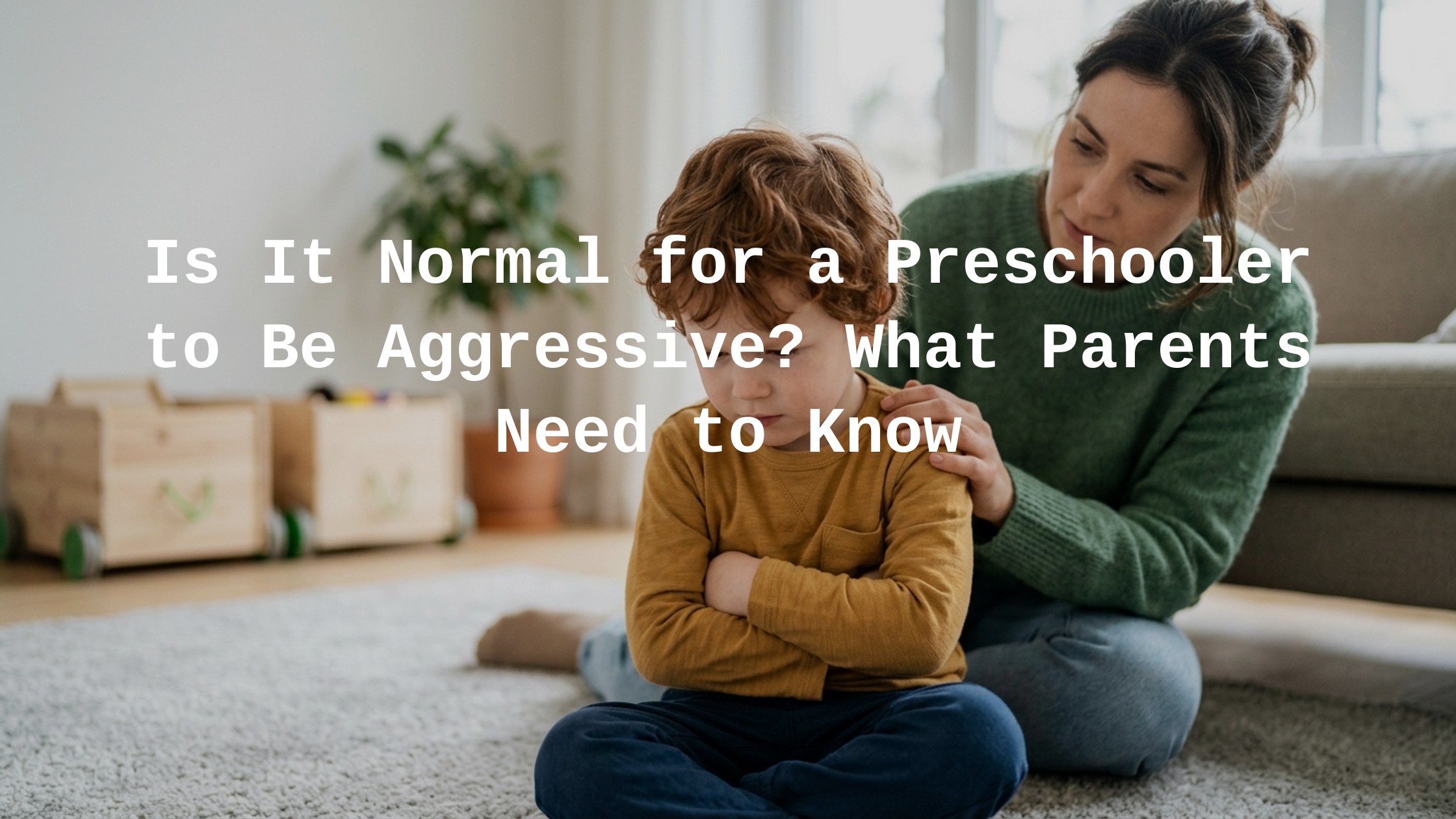
Your sweet three-year-old just hauled off and hit their best friend over a toy truck. Or maybe your four-year-old has been biting at daycare, and the teacher pulled you aside — again. If you’re feeling a mix of embarrassment, worry, and exhaustion, you’re in good company.
Preschool aggression is one of the most common concerns parents bring up, and it’s also one of the most misunderstood. The good news: in most cases, it doesn’t mean something is “wrong” with your child — or with your parenting. Understanding what’s actually driving the behavior makes all the difference in how you respond to it.
The Short Answer
It is normal for preschoolers to be aggressive sometimes. Almost every child will hit, kick, grab, spit, punch, or yell now and then. That’s a reassuring place to start.
Occasional aggressive outbursts are normal behaviors for a preschooler who’s overwhelmed with strong emotions. The key word there is “occasional.” A preschooler who lashes out when frustrated is not a bully in the making — they’re a small person with big feelings and a brain that isn’t yet equipped to manage them.
Aggressive behavior does not make your child “bad” and does not mean you’ve failed as a parent. Children communicate with behavior when they don’t yet have the tools to express themselves another way or when they’re having trouble coping with emotions. That reframe alone can take a lot of pressure off your shoulders.
Pro Tip: When your child acts aggressively, resist the urge to label them as “mean” or “bad.” Focus instead on the behavior itself — it’s a communication problem, not a character flaw.
Why Preschoolers Hit, Bite, and Push (The Brain Behind the Behavior)
To understand why your preschooler acts aggressively, it helps to take a peek inside their developing brain. The prefrontal cortex — the part responsible for impulse control, reasoning, and emotional regulation — won’t be fully developed until a person’s mid-twenties. At ages three to five, it’s still very much a work in progress.
Their brains are still building the skills needed for self-regulation. With limited self-control and emerging social abilities, this stage often comes with challenges such as biting, hitting, or refusing to share. It’s not defiance for the sake of it — it’s a developmental reality.
Aggressive behavior in toddlers — hitting, kicking, biting — usually peaks around age two, a time when toddlers have very strong feelings but are not yet able to use language effectively to express themselves. Toddlers also don’t have the self-control to stop themselves from acting on their feelings. They are just beginning to develop empathy — the ability to understand how others feel. By the preschool years, things are improving, but slowly.
There are also some very specific, everyday triggers that set off aggressive behavior in this age group. There are many reasons why preschoolers are aggressive. Sometimes it works — if the behavior gets the preschooler what they want, it will likely continue. They may also be exerting independence and control: “I want it and I will get it.” At times, preschoolers are aggressive when they don’t have the emotional maturity to manage their emotions. They may also struggle with language skills to say what they are feeling or what they want. Feelings of frustration often lead to aggressive behaviors.
Fatigue is another common factor. Like all of us, when a preschooler is tired it is challenging to have the energy needed to manage emotions. When preschoolers are hungry, it is difficult for them to manage their feelings and actions. When a preschooler is stressed, it is common for the physical tension created by stress to be relieved through physical or verbal aggressive behavior.
Aggressive behaviour is a normal and typical part of growing up, and it is critical for parents to help their children learn how to manage it. As preschoolers get older, they show less and less physical aggression, mostly because the parts of their brains that control aggression are better developed and refined over time.
Key Insight: Hunger, tiredness, and stress are among the most overlooked triggers for preschool aggression. Before assuming a behavioral problem, check the basics — when did your child last eat or sleep?
When It Is Normal — and When It Might Be a Concern
Not every outburst needs to send you running to a specialist. Here’s a simple way to think about the difference between typical and concerning aggression in preschoolers.
Signs That It’s Developmentally Normal
- Hitting, biting, or pushing that happens occasionally and in response to a clear trigger (frustration, tiredness, hunger, overstimulation)
- Aggression that is decreasing as your child gets older and their language improves
- Behavior that happens in one or two settings but not everywhere
- Outbursts that calm down relatively quickly with your support
- A child who shows remorse or empathy after an incident
As your preschooler grows older and their vocabulary and self-control increases, these aggressive behaviors should diminish. That trajectory — moving toward less aggression over time — is a healthy sign.
During the preschool years, children tend to resort to instrumental and physical expression of aggression such as snatching toys and pushing a playmate. Hostile aggression — aggressive behavior directed at others such as name-calling, criticizing, and ridiculing — comes much later, at around seven years of age. So some of what you’re seeing is simply age-appropriate behavior.
Signs That It May Need Closer Attention
- Aggression that is frequent, intense, or getting worse over time
- Behavior that happens across multiple settings — home, school, and elsewhere
- Outbursts that last a long time or are very difficult to de-escalate
- Physical injury to your child or others (bruises, bite marks, scratches)
- Aggression directed at animals
- No improvement despite consistent, calm responses from caregivers
It can also help to consider the context of the behavior. Could it be a response to a background stressor, such as a divorce or the death of a grandparent? Is the behavior happening solely at home or solely at school? If behavior occurs across contexts and continues for more than a few weeks, parents may want to seek support from a therapist.
Parenting approaches make a real difference here too. If you’re exploring strategies like gentle parenting or mindful parenting, you’ll find that many of their core tools — emotion labeling, calm responses, and connection before correction — align closely with what child development experts recommend for managing preschool aggression.
How to Handle It: 5 Practical Strategies
Knowing that aggression is developmentally normal doesn’t make it any easier to deal with in the moment. Here are five evidence-backed strategies that actually work.
1. Step In Immediately — But Stay Calm
Step in right away if you see your child being aggressive. Never ignore it, because ignoring aggression might let your child think it is okay to act that way. At the same time, your own energy matters enormously.
Keeping your body language and tone of voice calm can help in decreasing your preschooler’s aggression. When you stay regulated, you give your child’s nervous system something to co-regulate with. Yelling back, matching their intensity, or showing visible frustration tends to escalate the situation rather than resolve it.
2. Name the Feeling, Then Set the Limit
Young children have little natural self-control. They need you to teach them not to kick, hit, or bite when they are angry, but instead to express their feelings through words. The most effective way to do that is to name the emotion for them — “You’re really frustrated that she took the toy” — before stating the limit clearly: “But hitting hurts. We don’t hit.”
Visual schedules, simple emotion-labeling, and redirection can be especially helpful at this age. Emotion vocabulary cards, feelings charts, and books about big emotions are all tools that build this skill over time, outside of the heat of the moment.
Pro Tip: Teach emotion words during calm, connected moments — not during a meltdown. Read books about feelings at bedtime, or name your own emotions out loud throughout the day. (“I’m feeling a little frustrated right now. I’m going to take a deep breath.”)
3. Teach Alternative Behaviors — After They’ve Calmed Down
Talk with your preschooler about ways to handle problems. Work together to come up with a list of things to do instead of being aggressive. This conversation needs to happen when your child is calm and receptive — not in the middle of or immediately after an outburst.
Talk about what your child could do instead of being aggressive — after they have calmed down: “Why did you get so mad?” “What could you have said to Stacy instead of smacking her?” Preschoolers are surprisingly capable of this kind of reflection when they’re not flooded with emotion.
Preschoolers are capable of learning alternatives to aggression. Role-playing scenarios, using puppets, or practicing “what would you do if…” games are all effective ways to build these skills in a low-stakes environment.
4. Use Consistent, Age-Appropriate Consequences
Responses to misbehavior should be moderate and consistent. If a child gets time-out sometimes, but not others, they won’t learn that aggressive behavior leads to consequences. Avoid overreacting with harsh, severe discipline, which can harm a child’s mental health and development.
Until age three and sometimes later, children simply don’t understand the concept of punishment. Setting limits is a much better approach than punishment. Most children will respond to clear, calm, and sure limit-setting. A simple removal from the situation — a brief cool-down together or apart — is often enough.
5. Build Empathy and Model Calm
If your child hurts someone, include them in treating the hurt child. This helps them to develop empathy for others and understand the pain their actions can cause. Rather than forcing an apology, guide your child through the process of checking on the other person.
One of the best ways to teach appropriate behavior is to watch your own temper. If you express your anger in quiet, peaceful ways, your child will probably follow your example. Children learn emotional regulation by watching the adults around them — which is both a responsibility and an opportunity.
Your overall parenting approach shapes this environment significantly. Whether you lean toward attachment parenting, conscious parenting, or peaceful parenting, the shared thread is building a secure, connected relationship — which is the foundation your child needs to eventually regulate their own emotions.
Key Insight: Physical outlets help, too. Provide alternative physical outlets. Sometimes just releasing physical tension in a positive way — dancing to music, playing tag, or kicking a ball — helps decrease aggressiveness.
When It Becomes a Red Flag
Most preschool aggression falls squarely in the “normal, developmentally expected” category. But there are specific patterns that warrant a closer look.
Consider seeking professional support if aggression is frequent, intense, or worsening over time, interfering with school, friendships, or family life, or if it is causing significant distress for your child or others.
Here are some specific red flags to watch for:
- Aggression that causes physical injury — teeth marks, bruises, or head injuries to your child or others
- Cruelty toward animals — this goes beyond typical preschool roughness and warrants prompt attention
- No remorse or empathy after hurting someone, even when calmly guided through it
- Deliberate, planned aggression — waiting to retaliate or targeting a specific child repeatedly
- Aggression that is escalating rather than gradually decreasing over the preschool years
Certain behaviors do warrant additional attention when they happen often and continue over time. Examples include when a child appears fearless or reckless, taking a “daredevil” approach to life — which often leads to breaking things or intrusive behavior. Some children who need lots of “touch” to feel centered get this sensory input in unacceptable ways, such as hitting, shoving, or pushing.
It’s also worth knowing that some underlying conditions can look like — or amplify — typical preschool aggression. Preschoolers with ADHD tend to be more controlling and react with more hostility, anger, and aggression when upset, and are more likely to get calls home than their non-ADHD peers. When children act out persistently so that it causes serious problems at home, in school, or with peers, they may be diagnosed with oppositional defiant disorder (ODD). ODD is one of the most common disorders occurring with ADHD. ODD usually starts before eight years of age.
None of this means your child is destined for a difficult path. Early intervention is key. It’s much easier to work on these behaviors before they become deeply ingrained patterns.
For families navigating complex co-parenting situations, consistency across households is especially important. If you’re managing co-parenting or parallel parenting dynamics, working toward aligned responses to aggression — even when other things are in conflict — gives your child the predictability they need.
Important Note: A single aggressive incident — even a scary one — is rarely a red flag on its own. It’s the pattern over time that matters: frequency, intensity, duration, and whether the behavior is improving or worsening.
When to Talk to Your Pediatrician
Your pediatrician is a great first call when you’re not sure whether what you’re seeing is within the range of normal. They know your child’s developmental history and can help you figure out whether a referral to a specialist makes sense.
If your child seems to be unusually aggressive for longer than a few weeks, and you cannot cope with their behavior on your own, consult your pediatrician. You don’t need to have a crisis on your hands to make that call — ongoing concern is enough of a reason.
Here’s a practical checklist of when to pick up the phone:
- Aggression has been consistent for more than a few weeks without improvement
- Your child is hurting others or themselves in ways that leave marks
- The behavior is interfering with preschool — your child is being excluded, suspended, or flagged repeatedly by teachers
- You’re noticing signs of extreme emotional dysregulation beyond what seems typical for their age
- You feel unsafe or overwhelmed at home
- Aggression is happening across multiple settings and with multiple people
It is important for clinicians to have the full picture. Helpful information includes specific examples of aggressive behavior — what happened, what led up to it, and how it was handled — how often aggressive behaviors are occurring, what strategies help and which ones did not. Going to the appointment with notes will make the conversation much more productive.
If aggressive behavior persists, parents can seek counsel from a mental health center or evidence-based parent training program to learn more about the distinction between normal behavior and a pattern that could be problematic. Some common approaches include behavioral therapy for both child and parents, and parent training programs to strengthen skills and routines at home.
By age five, upwards of 90% of the brain is developed. Because of this, early childhood is a critical period of intervention, where new neural pathways can be built before patterns of behavior become entrenched. Acting sooner rather than later is always the right call.
Understanding your own parenting style and how it shapes your responses can also be part of the conversation with your pediatrician. Research consistently shows that warm, structured approaches — the kind explored in resources on modern parenting approaches — are associated with better emotional outcomes for children.
Pro Tip: Before your pediatrician appointment, keep a simple log for one to two weeks: note when aggression happens, what preceded it, how long it lasted, and how your child responded afterward. This data is far more useful than a general description of “he hits a lot.”
Frequently Asked Questions
Is it normal for a 3-year-old to hit and bite?
Yes, very much so. Aggressive behavior in toddlers is a normal part of development. Young children use actions like hitting or biting when they don’t have the words to express big feelings. At three, language is still catching up to emotion — and hitting or biting is often the fastest outlet available to them. The goal is to teach alternatives, not to panic about the behavior itself.
Why is my preschooler suddenly more aggressive?
Sudden changes in behavior often have a cause. Common triggers include a new sibling, a move, a change in childcare or preschool, family stress, illness, or disrupted sleep and routines. Aggression is often a signal that something else is going on under the surface. If you can identify a recent change in your child’s life, that’s usually a good place to start.
Should I be worried if my preschooler hits at school but not at home?
Not necessarily — this is actually quite common. The social demands of a preschool classroom (sharing, waiting, navigating conflicts with peers) are genuinely harder than home life. If your child has behaviors at home that may look like ADHD but does not have these behaviors in situations outside the home, there may be another explanation. The reverse is also true: school-only aggression often reflects the challenge of the social environment, not a deeper problem. Stay in close communication with the teacher and watch for patterns.
Does preschool aggression mean my child will have behavior problems later?
Not on its own. Occasional outbursts are normal among preschool-aged children. If aggressive behavior persists, parents can seek counsel from a mental health center or evidence-based parent training program to learn more about the distinction between normal behavior and a pattern that could be problematic. Most children with typical preschool aggression grow out of it as their language and self-regulation skills develop.
What should I do immediately when my preschooler hits someone?
Stay calm, intervene immediately, and address safety first. Treat any child who may have been hurt by the aggressor. Make sure no one is laughing or encouraging the child’s aggressive behavior. Then calmly name the behavior, state the limit, and — once everyone is calm — guide your child through what they could have done differently. Avoid lengthy lectures in the moment; keep it brief and clear.
Can my parenting style contribute to or reduce aggression?
Yes, significantly. The best way to prevent aggressive behavior is to give your child a stable, secure home life. Provide firm, loving discipline and full-time supervision during the toddler and preschool years. Parenting approaches that combine warmth with clear, consistent limits tend to produce the best outcomes. You can explore how different frameworks handle this — from navigating parenting differences with a partner to learning about what research says about effective parenting at different developmental stages.