How Much Does an Apartment Cost in San Francisco? Rent, Buy & Neighborhood Prices Explained

April 10, 2026
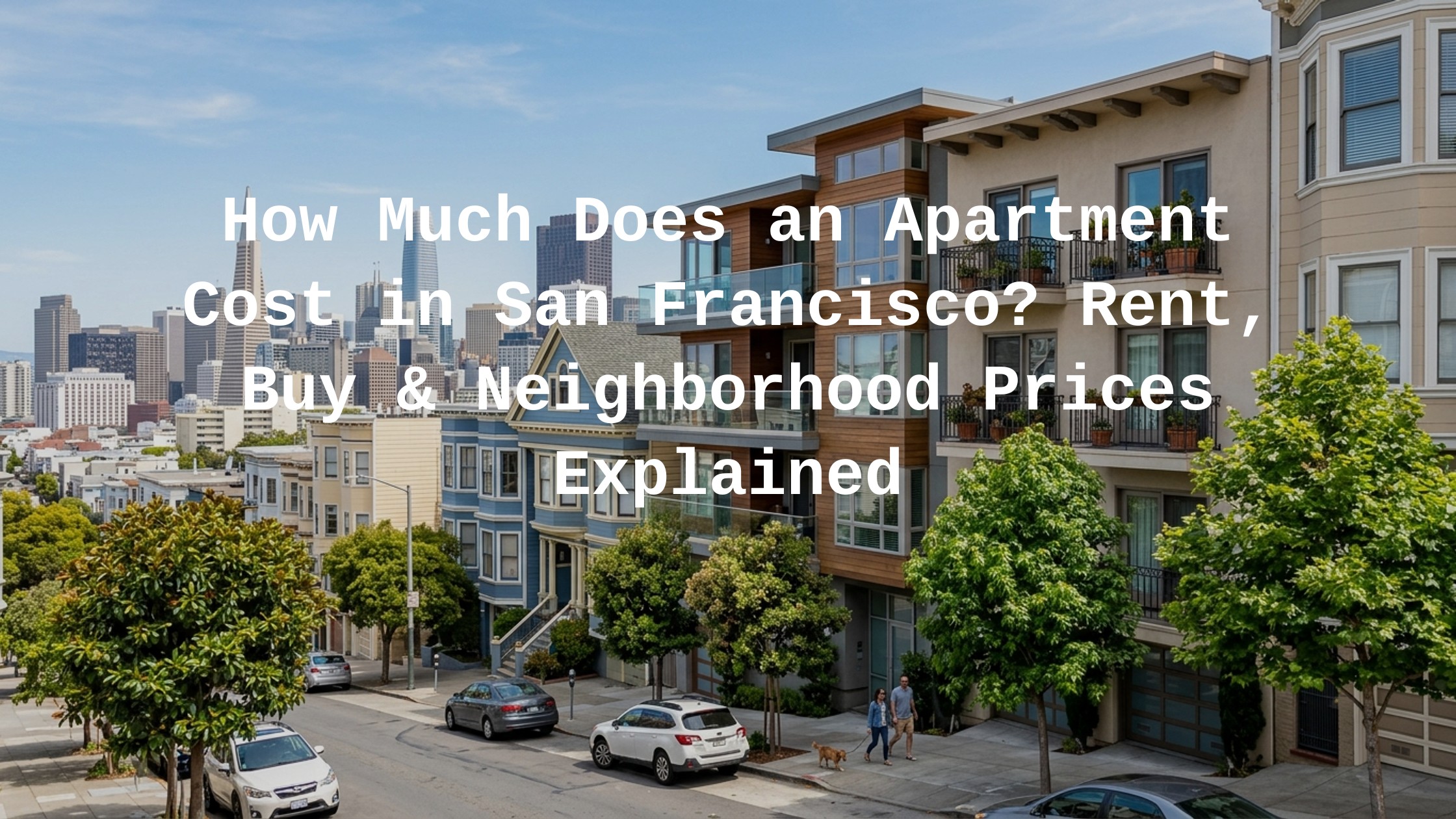
San Francisco is one of the most expensive cities in the United States — and its housing market makes that crystal clear the moment you start searching for a place to live. The median rent in San Francisco sits at $3,019, which is nearly 2.5 times higher than the national average of $1,231. Whether you’re relocating for a tech job, exploring life in the Bay Area, or simply trying to figure out what your budget will realistically get you, knowing what apartments actually cost here is the first step.
This guide breaks down current San Francisco apartment costs by size, purchase prices, neighborhood-by-neighborhood comparisons, and the key factors driving those numbers — plus practical tips to help you find a place that fits your budget.
Pro Tip: Rent prices in San Francisco vary significantly by data source and methodology. The figures in this guide draw from multiple platforms — including RentCafe, Apartments.com, and Apartment List — to give you the most balanced picture of current market conditions.
Average Rent in San Francisco by Apartment Size
The average rent for an apartment in San Francisco is $3,724 — a 9.24% increase compared to the previous year, when the average was $3,409. However, what you pay depends heavily on how much space you need. Prices range from compact studios to spacious three-bedroom units, each with a very different monthly cost.
Here’s a breakdown of average monthly rent by apartment size, based on current market data:
| Apartment Size | Average Monthly Rent | Average Square Footage |
|---|---|---|
| Studio | $2,548 – $2,795 | ~458 sq ft |
| 1 Bedroom | $3,019 – $3,851 | ~682 sq ft |
| 2 Bedrooms | $3,579 – $4,819 | ~1,017 sq ft |
| 3 Bedrooms | $5,703 – $6,295 | ~1,293 sq ft |
Studio apartments, averaging around $2,648 per month for approximately 458 square feet, offer the most budget-friendly option — ideal for single renters who prioritize location over space. As of mid-2025, the average rent for a two-bedroom apartment in San Francisco is $5,136, making them a popular choice for roommates splitting costs.
A full 67% of apartment rentals in San Francisco fall in the over-$3,000-per-month range, so if your budget is tighter, you’ll need to be strategic about which neighborhoods and building types you target. Units in luxury buildings with in-unit laundry, parking, or rooftop views run much higher, while older buildings or those farther from downtown can dip closer to $2,300. If you’re hoping to find a deal under $2,000, you’ll need to focus on more affordable neighborhoods like Outer Sunset — and act quickly when you find a match.
Key Insight: San Francisco’s rental market is seasonal. According to RentHop , rents typically drop about 3.4% between peak summer months and slower winter months — making fall and winter a smarter time to sign a lease if you have flexibility.
If you’re curious how San Francisco apartment costs compare to another major international city, check out this look at how much an apartment costs in Kathmandu for a striking contrast in global housing markets.
Average Apartment Purchase Price in San Francisco
Buying an apartment in San Francisco is a major financial undertaking. As of 2025, the median home price in the city exceeds $1.2 million, making homeownership a significant financial commitment. The overall San Francisco housing market in 2025 shows a citywide median home price around $1.29 million, though what you’ll pay depends greatly on the neighborhood and property type.
Luxury neighborhoods like Pacific Heights often see prices far above this median, while areas like Bayview or the Outer Sunset may offer relatively lower price points — though still well above the national average. The high cost of real estate is driven by limited housing supply and persistent demand from professionals and investors.
Here’s a snapshot of purchase price ranges by neighborhood tier:
| Neighborhood Tier | Estimated Median Home Price | Examples |
|---|---|---|
| Luxury / Premium | $2M – $5M+ | Pacific Heights, Sea Cliff, Presidio Heights |
| Mid-Range | $1.2M – $2M | Noe Valley, Inner Sunset, Cole Valley |
| More Accessible | $800K – $1.2M | Bayview, Excelsior, Outer Sunset |
As of 2025, Pacific Heights remains one of the most expensive places to buy in the city, with a median overall home price of approximately $2.1 million (including condos and co-ops). As of Q1 2025, average 30-year fixed mortgage rates are hovering around 6.7%, which continues to affect buyer affordability and financing decisions.
For those considering purchasing a home, additional expenses such as property taxes and maintenance should also be factored into the budget. HOA fees for condo buildings can also add hundreds of dollars per month on top of your mortgage payment.
Important Note: San Francisco’s condo and co-op market behaves differently from single-family homes. Condos in mid-rise buildings in neighborhoods like SoMa or Mission Bay often start around $700,000–$900,000, making them a more accessible entry point for first-time buyers compared to detached homes.
Cost of Renting vs. Buying in San Francisco
The rent-vs.-buy question is especially complex in San Francisco. San Francisco’s real estate market has long been one of the most expensive and complex in the nation. In 2025, potential residents and investors continue to grapple with the critical question: is it better to buy or rent in the City by the Bay?
Analysis of a typical 2-bedroom property across different San Francisco neighborhoods indicates that San Francisco has one of the longest break-even horizons in the nation, averaging 9–12 years before buying typically becomes financially advantageous compared to renting. That’s a long time to commit — and it means renting often makes more short-term financial sense for many residents.
Here’s a side-by-side comparison of key financial factors:
| Factor | Renting | Buying |
|---|---|---|
| Upfront Cost | Security deposit + first/last month (~$6,000–$12,000) | Down payment + closing costs (~$250,000–$350,000+) |
| Monthly Payment (2BR) | $3,579 – $5,136/month | $7,000 – $10,000+/month (mortgage + taxes + HOA) |
| Flexibility | High — move when lease ends | Low — tied to property for years |
| Equity Building | None | Yes — long-term wealth potential |
| Rent Control Access | Yes (pre-1979 buildings) | N/A |
The city’s enduring appeal, severe supply constraints, and strong economic fundamentals create a foundation for long-term real estate value, making buying a viable strategy for those with sufficient resources and a long-term horizon. However, the extraordinarily high entry costs, extended break-even timeline, and neighborhood-specific considerations mean that renting remains the more financially prudent choice for many residents — particularly those with shorter time horizons or those fortunate enough to secure rent-controlled units in desirable areas.
San Francisco rent control laws apply to buildings constructed before June 13, 1979, so some units in those neighborhoods may qualify. New developments do not. If you can land a rent-controlled unit, that protection becomes a significant long-term financial advantage worth factoring into your decision.
For a broader perspective on urban living costs and what to budget for, you might also find it helpful to explore urban living essentials every big-city apartment must have — a useful checklist when evaluating what you’re actually getting for your rent dollar.
Cheapest and Most Expensive Neighborhoods in San Francisco
San Francisco’s neighborhoods span an enormous price range. Where you choose to live can mean a difference of $1,500 or more per month on a one-bedroom apartment. Understanding this landscape is essential before you start your search.
Most Affordable Neighborhoods
The most affordable neighborhoods in San Francisco include Diamond Heights, where the average 1-bedroom apartment rent goes for $2,000; Portola, where renters pay $2,500 on average for a 1-bedroom; and Lower Nob Hill, where the average 1-bedroom goes for $2,545.
For other solid deals, check out listings in Tenderloin ($2,547 for a 1-bedroom apartment) or Alamo Square ($2,695 for a 1-bedroom apartment), compared to the $3,024 citywide average for a San Francisco 1-bedroom.
- Diamond Heights — ~$2,000/mo for a 1BR; quiet hilltop neighborhood with great city views
- Portola — ~$2,500/mo for a 1BR; family-friendly, off the tourist trail
- Lower Nob Hill — ~$2,545/mo for a 1BR; central location with transit access
- Tenderloin — ~$2,547/mo for a 1BR; urban, walkable, some safety concerns to be aware of
- Alamo Square — ~$2,695/mo for a 1BR; famous for the Painted Ladies, strong community feel
Some neighborhoods offer relatively more affordable options. Areas like Outer Sunset and Excelsior tend to have lower housing costs compared to the city’s most expensive neighborhoods. In these districts, the rent for a one-bedroom apartment can range from $1,500 to $3,000 per month, offering some respite for budget-conscious residents.
Most Expensive Neighborhoods
The most expensive neighborhoods in San Francisco are Rincon Hill, where the average rent for a 1-bedroom apartment is $4,414, followed by Hayes Valley at $4,060, and Mission Bay at $4,017.
- Rincon Hill — ~$4,414/mo for a 1BR; high-rise condos with bay views, close to the Financial District
- Hayes Valley — ~$4,060/mo for a 1BR; trendy boutiques, arts scene, strong walkability
- Mission Bay — ~$4,017/mo for a 1BR; new developments, waterfront, near Chase Center
- Pacific Heights — ~$4,000/mo for a 1BR; luxury inventory, historic mansions, Fillmore Street dining
- Presidio — ~$5,819/mo citywide average; these neighborhoods typically command higher rents due to location, amenities, and demand.
Common Mistake: Many renters assume that neighborhoods close to downtown are always the most expensive. In reality, areas like the Tenderloin and parts of the Mission District can be significantly cheaper than waterfront or tech-adjacent neighborhoods — despite being very centrally located.
If you’re open to exploring different types of apartments, you may find that a micro-unit or garden-level flat in a more affordable neighborhood gives you the location you want at a price that actually works.
What Affects Apartment Prices in San Francisco
San Francisco’s sky-high rents and home prices don’t exist in a vacuum. Several structural, economic, and policy-driven forces push costs upward — and understanding them helps you make smarter housing decisions.
Limited Land and Housing Supply
The city’s strict housing rules and high demand from the booming tech sector contribute to pricing pressure. Because there’s not much land to build on, there’s a big gap between how many homes are available and how many people want them. San Francisco is only 7×7 square miles, and geographic constraints — water on three sides, hills throughout — make large-scale development difficult.
Tech Industry Demand
Housing prices in San Francisco are among the highest in the nation, reflecting its status as a global tech and cultural hub. The concentration of high-income tech workers — many earning well above $150,000 annually — creates persistent upward pressure on both rents and home prices. Return-to-office mandates from many tech companies are increasingly implementing hybrid or full-time return-to-office policies, reigniting demand for housing within the city — particularly for well-located units that make commuting easier.
Building Age and Amenities
Prices vary significantly based on neighborhood, amenities, and the age of the building. Units in luxury buildings with in-unit laundry, parking, or rooftop views may run much higher, while older buildings or those farther from downtown hubs can dip closer to $2,300.
Apartment buildings in San Francisco are about 36 years old on average. Of these, 51% have been built since 2000, representing the newer options on the market and typically offering more amenities.
Rent Control Policies
San Francisco’s strong tenant protections and rent control policies continue to affect both the rental market and investment calculus for potential buyers. Rent-controlled units (in buildings built before June 1979) are highly sought after because they cap annual rent increases — creating a two-tier market where controlled units can rent for significantly less than comparable market-rate apartments.
Mortgage Rates and Investment Activity
Mortgage rates remain a key driver. As of Q1 2025, average 30-year fixed mortgage rates are hovering around 6.7%, which continues to affect buyer affordability and financing decisions. While some buyers have adapted to these higher rates, others are opting to wait or shift toward lower-priced properties and adjustable-rate products.
Overall Cost of Living
The cost of living in San Francisco is 65.3% higher than the national average. You can expect to pay 21.4% more for groceries, 58.3% more for utilities, and 43.1% more for transportation. These broader cost pressures reinforce housing demand in more affordable neighborhoods as residents try to balance their overall monthly budgets. For strategies on managing day-to-day expenses, see these 9 ways to cut your grocery costs — every dollar saved elsewhere helps stretch your housing budget further.
Is San Francisco Affordable Compared to the Rest of the US?
The short answer: no. San Francisco is ranked as the second most expensive US city for renters. In 2025, the median rent for a 1-bedroom apartment in San Francisco is $3,019 — that’s 113.5% above the national median of $1,231.
As of August 2025, the average rent in San Francisco is $3,076 per month — 88% higher than the national average rent price of $1,638/month, making San Francisco one of the most expensive cities in the US.
Here’s how San Francisco stacks up against other major cities:
| City | Median 1BR Rent | Median 2BR Rent |
|---|---|---|
| San Francisco, CA | ~$3,019 | ~$3,579 – $5,136 |
| San Diego, CA | ~$1,975 | Lower than SF |
| Sacramento, CA | ~$1,384 | ~$1,749 |
| National Average | ~$1,231 – $1,638 | ~$1,500 – $1,800 |
The median rent in San Francisco is $3,019 for a one-bedroom and $3,579 for a two-bedroom. In contrast, Sacramento’s median rent is $1,384 for a one-bedroom and $1,749 for a two-bedroom. That’s a difference of more than $1,600 per month for a one-bedroom — or nearly $20,000 per year.
San Francisco is notoriously expensive. It consistently ranks among the most expensive cities in the United States and is 145.5% more expensive than the average U.S. city. Housing costs are the primary driver, with exorbitant rent and home prices.
To live comfortably in San Francisco as a single adult with no dependents, aim for a salary of at least $133,000 before taxes. Expect to spend about $9,624/year for groceries, $14,580 for goods and services, and $62,592/year for housing.
Key Insight: MIT’s Living Wage Calculator suggests a single adult needs about $30.91 per hour, or roughly $64,292 annually, to cover basic expenses including rent, food, healthcare, and transportation in San Francisco. That figure covers bare minimums — comfortable living requires considerably more.
Tips for Finding an Apartment in San Francisco
San Francisco’s rental market moves fast and rewards preparation. With limited inventory and high demand — especially near tech hubs and transit stops — well-priced homes are claimed within days. To win in this fast-paced market, be ready to act fast, have your documents in order, and use tools like Apartment List to spot available units early.
1. Set a Realistic Budget Before You Start
Because the average rent in San Francisco is around $3,076, you’ll want to make about $10,253 per month or $123,036 per year. The general guideline is to pay no more than 30% of your monthly income on rent. However, you’ll also want to consider additional factors such as your monthly bills and other expenses. Factor in utilities, internet (~$67/month), renters insurance (~$26/month), and transportation costs before committing to a monthly rent figure.
2. Time Your Search Strategically
Winter is generally the best time to search. On average, there’s a 3.4% drop in rental prices between peak summer months and the slower winter months. With the added bonus of decreased competition from other renters, winter is generally considered the best time of year to find an apartment for rent in San Francisco.
3. Consider Rent-Controlled Buildings
San Francisco rent control laws apply to buildings constructed before June 13, 1979, so some units in these neighborhoods may qualify. Securing a rent-controlled unit offers long-term cost stability that can be worth far more than the initial monthly savings. Look for older Victorian and Edwardian buildings in neighborhoods like the Mission District, Lower Haight, and the Richmond.
4. Explore Affordable Neighborhoods First
San Francisco’s cheapest neighborhoods include Lower Nob Hill, Mission Terrace, and Outer Sunset. These areas offer meaningfully lower rents without sacrificing access to transit, restaurants, or city amenities. Find affordable apartments in San Francisco by browsing listings in budget-friendly neighborhoods such as Stonestown, Chinatown, and Bayview.
5. Get Your Documents Ready in Advance
San Francisco landlords typically require proof of income (usually 3x the monthly rent), recent pay stubs, tax returns, bank statements, and references from previous landlords. Having all of this organized in a digital folder means you can submit an application within hours of finding a listing — which is often the difference between getting an apartment and losing it.
6. Consider a Roommate
Splitting rent and utilities with a roommate is one of the easiest ways to cut your housing costs. Just make sure you pick someone reliable and set ground rules right away. A two-bedroom apartment split between two people can bring your individual housing cost closer to $2,000–$2,500 per month — significantly more manageable than a solo one-bedroom.
7. Use Official Resources for Below-Market Housing
Start your search on DAHLIA, San Francisco’s official housing portal run by the Mayor’s Office of Housing and Community Development. You can browse and apply for income-restricted rentals and ownership opportunities citywide. Non-profit organizations like Mercy Housing regularly list available below-market-rate units, so keep this resource in your back pocket.
8. Don’t Overlook Negotiation
If you have great credit or a steady income, you may be able to negotiate your rent in San Francisco. Landlords may knock off fees, reduce your deposit, or even lower rent for longer leases. With a mix of confidence, timing, and research, you can keep your budget in check.
Pro Tip: If you’re moving to San Francisco with a pet, be prepared for additional hurdles. Many landlords charge pet deposits of $500–$1,000, and pet-friendly listings are more limited. Check out this guide on the best pets for apartment living to find a companion that fits city life without limiting your housing options.
San Francisco’s apartment market is demanding, but it’s navigable with the right information and preparation. Whether you’re renting a studio in the Outer Sunset or considering buying a condo in SoMa, understanding the true cost of housing here puts you in a far stronger position to make a decision that works for your finances and your lifestyle. The San Francisco housing market is expected to continue its gradual recovery through 2026, supported by stabilizing interest rates, consistent demand from high-income professionals, and limited new housing supply — which means acting with a clear strategy now is better than waiting for prices to drop significantly.